













For many years, the printing world was divided into two distinct camps: the conventional world of flexography and offset, and the digital world of inkjet and toner. Conventional printing was the undisputed king of high-volume, low-cost production, while digital was the agile specialist for short runs and customization. However, the demands of the modern packaging market have forced these two worlds to merge. The result is hybrid printing for packaging a powerful technological synthesis that combines the raw speed and low material costs of analog with the variable data and plate-less flexibility of digital. This integration is not just a compromise it is a superior manufacturing model that is fundamentally reshaping what is possible in packaging design.
The Architectural Synergy of Hybrid Printing Systems
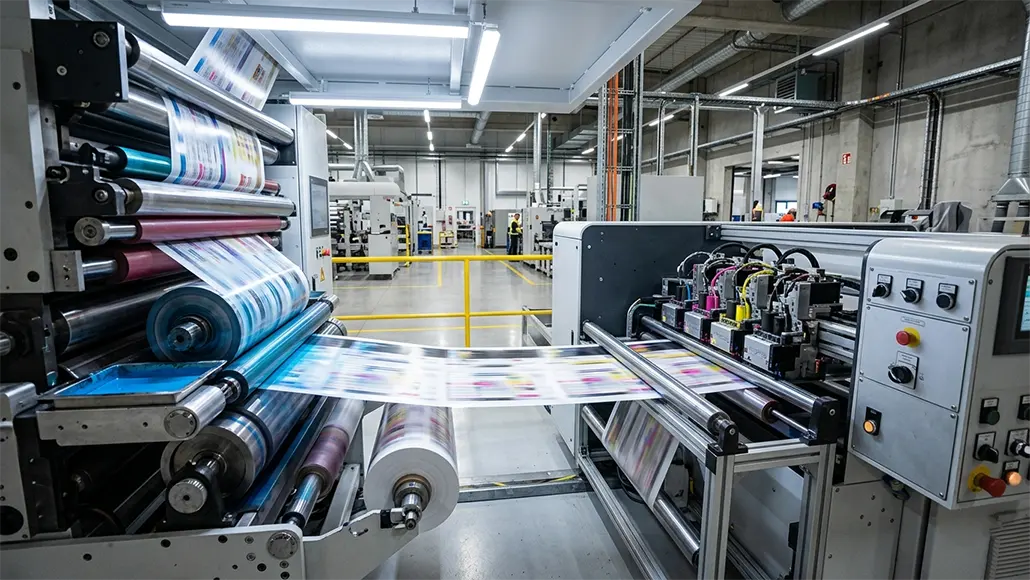
A hybrid press is more than just two machines sitting next to each other it is a single, integrated platform where conventional and digital stations are synchronized through a unified control system. Typically, this involves a flexographic front end that handles the heavy lifting such as printing large areas of solid color brand colors, applying white under-bases on clear films, or laying down specialty primers. This is where the analog process shines, providing a cost-effective way to use high-pigment inks that are often expensive or difficult to run through digital heads.
Following the flexo stations, the material enters the digital inkjet module. This is where the magic of customization happens. The digital heads can apply high-resolution graphics, variable text, serialized codes, or even unique patterns to every single package without stopping the press. Finally, the material may pass through additional analog stations for embellishments like cold foiling, spot varnishing, or die-cutting. By performing all these steps in a single pass, hybrid printing for packaging eliminates the need for secondary processes, reducing lead times and minimizing the risk of damage that occurs when rolls of material are moved between different machines.
Expanding Design Horizons through Bespoke Embellishment
One of the most exciting aspects of hybrid technology is its impact on high-end packaging design. Traditionally, adding luxury finishes like foil or tactile varnish was an expensive and slow process that was only viable for premium, high-volume products. In a hybrid environment, these embellishments can be applied on the fly. For example, a wine label could feature a standard flexo-printed background, a digitally printed unique serial number, and a spot-UV varnish applied by a following analog station all in one go.
This allows designers to be much more creative with versioning. A brand can produce five different versions of a luxury chocolate box for different regional holidays, each with its own unique metallic foil pattern and personalized messaging, without the astronomical cost of five different sets of analog plates. This mass-customization is a powerful tool for brand managers who want to create a sense of exclusivity and limited edition appeal while maintaining the economies of scale provided by the flexo base. Hybrid printing effectively democratizes luxury packaging, making premium effects accessible for mid-sized runs and niche products.
Operational Excellence and Waste Reduction
From a manufacturing perspective, the move toward hybrid printing for packaging is driven by a need for extreme efficiency. The packaging industry is seeing a trend toward shorter run lengths but a higher frequency of orders. In a purely analog shop, the time and material waste involved in changing over between different designs can consume a huge portion of the day’s profit. Every new plate change means stopping the press, washing up, and running hundreds of meters of setup waste to get the color and registration right.
Hybrid systems mitigate this by keeping the static elements of the design in the flexo stations while changing the dynamic elements digitally. This means that for a product line with ten different flavors, the brand’s main logo and background color the flexo part stay the same, while the flavor name and product image the digital part change instantly. The press doesn’t have to stop, and there is zero waste between versions. This versioning without downtime is the ultimate goal of the modern print shop, allowing for a much higher throughput and a significantly more sustainable production model.
Solving the Total Cost of Print Equation
When evaluating printing technologies, manufacturers often look at the cross-over point the run length where digital becomes more expensive than analog. Hybrid printing changes this calculation entirely. By offloading the high-volume, low-cost parts of the job to the flexo stations, the digital portion of the cost is localized only to where it provides the most value. This pushes the cross-over point much higher, making hybrid systems economically viable for a vast range of jobs that were previously stuck in the middle too large for pure digital but too complex for pure analog.
Furthermore, hybrid printing for packaging reduces the need for large inventories of finished goods. Because the turnaround time is so fast, brands can adopt a just-in-time approach to their packaging. Instead of ordering 100,000 labels and storing them in a warehouse for six months, they can order 10,000 labels every two weeks. This frees up capital, reduces the risk of obsolete stock, and ensures that the information on the package such as Use By dates or regulatory warnings is always current. In a volatile global economy, this agility is a critical competitive advantage.
The Technical Challenge of Color and Ink Integration
The primary technical hurdle in hybrid printing is ensuring that the flexo inks and the digital inks play well together. They are different chemistries flexo inks are often water or solvent-based, while digital inks are usually UV-curable. Achieving a perfect color match between a flexo-printed logo and a digitally-printed product image requires highly sophisticated color management software. The system must be able to translate the brand’s signature colors across these two different processes to ensure a seamless visual result.
Additionally, the trapping and registration between the analog and digital sections must be perfect. Modern hybrid presses use high-speed cameras and closed-loop control systems that monitor the output in real-time. If the digital image drifts by even a hair’s breadth from the flexo-printed border, the system detects it and makes an instant correction. This level of technical integration is what allows hybrid printing to deliver quality that is often superior to either process alone. The result is a sharp, vibrant, and incredibly consistent package that meets the highest standards of global brands.
The Future: AI and the Autonomous Hybrid Press
Looking ahead, the next evolution of hybrid printing for packaging will be driven by artificial intelligence. We are moving toward a future where the press can self-optimize. Imagine a machine that can look at a digital file, analyze the current inventory of inks and plates, and automatically decide the most efficient way to divide the job between the analog and digital stations. AI will also play a massive role in predictive maintenance, ensuring that the complex digital printheads are always in peak condition.
As the technology continues to mature, we will see hybrid capabilities expanding into new areas, such as corrugated board and flexible films. The hybridization of the industry is a reflection of a wider cultural shift toward personalization and speed. In a world where consumers expect products to be tailored to their specific needs and delivered almost instantly, the rigid, siloed manufacturing models of the past are no longer sufficient. Hybrid printing is the flexible, intelligent answer to the challenges of the 21st-century marketplace.
A New Era for Packaging Innovation
The impact of hybrid technologies extends far beyond the production floor it is a catalyst for innovation across the entire value chain. It allows designers to dream bigger, brand managers to move faster, and manufacturers to operate more sustainably. By breaking down the barriers between analog and digital, the industry is creating a new language of packaging one that is as dynamic and diverse as the consumers it serves.
Hybrid printing for packaging is more than just a new type of press it is a new way of thinking about the relationship between a product and its container. It acknowledges that in the modern world, every package is a piece of data, a marketing touchpoint, and a protective shell, all at once. The ability to manage these diverse roles with a single, integrated technology is the defining achievement of modern print engineering. The future of packaging is hybrid, and it is more creative, efficient, and responsive than ever before.