























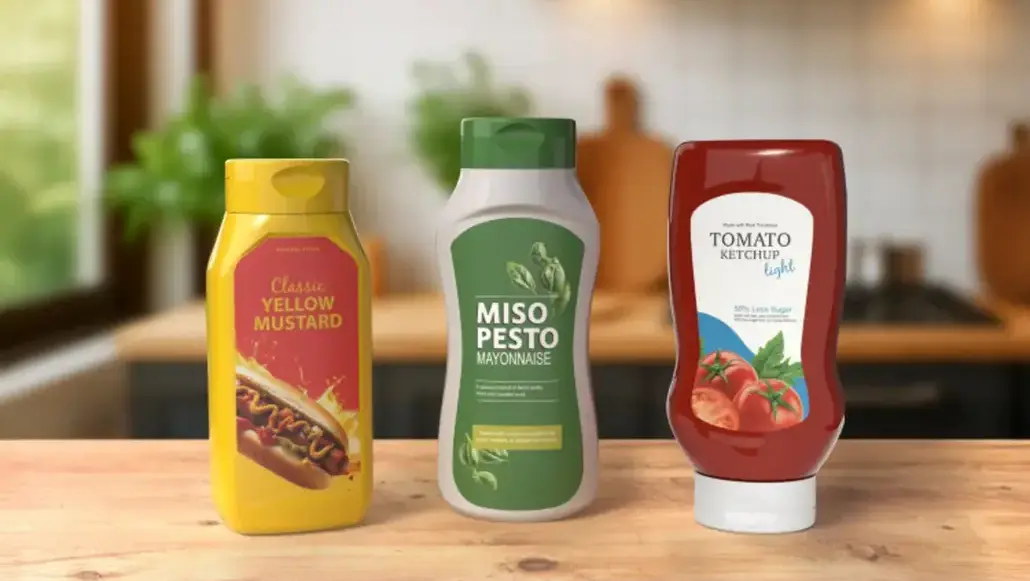
Amcor has introduced a new packaging solution aimed at improving sustainability outcomes in the condiment and sauce segment, unveiling its 55 mm Flava Flip Top Closure 38/400. The development reflects the company’s ongoing Flava closure innovation, targeting food and drink manufacturers seeking to lower environmental impact without affecting usability, particularly for high-viscosity products such as mayonnaise, ketchup, and sweet sauces.
Positioned as a step forward in circular packaging design, the closure delivers a lightweight alternative to conventional 38/400 caps. The company has reduced the closure’s weight by 1.9 g, bringing it to 8.5 g, which equates to an 18.7% reduction compared to earlier 55mm Flip Top Closure designs. This adjustment enables manufacturers to optimise material use while maintaining functional integrity across large-scale production environments.
For producers operating at volume, the reduction directly contributes to lower Scope 3 emissions and reduced plastic tax exposure. “The new Flava Flip Top Closure will help customers reach their carbon reduction targets thanks to its lighter design,” said Peter Briggs, UK sales director for food and beverage at Amcor. The Flava closure innovation is engineered to integrate into existing recycling systems, reinforcing its role in supporting circularity objectives.
The closure incorporates several design elements to enhance recyclability and compatibility:
- Mono-material construction simplifies processing within recycling streams
- Recyclable-ready design supports use with PET, HDPE, and PP bottles where infrastructure exists
- Integrated compatibility allows pairing with Amcor’s existing PET and HDPE bottle portfolio
Available in multiple colours and orifice sizes, the closure also features circular valves that ensure controlled and clean dispensing. While sustainability improvements are central to the design, user experience remains a priority. The flip-top mechanism is built for durability under repeated use while maintaining consistent product flow.
“Weight saving is critical in reducing the carbon impact of the closure, [but] it does not compromise performance,” Briggs added. “Getting this balance right is crucial for consumers. They can be reassured that the product can be dispensed cleanly and easily.” As sustainability targets for 2030 become more pressing, solutions such as this provide manufacturers with a scalable approach that aligns operational efficiency with environmental requirements.

