

























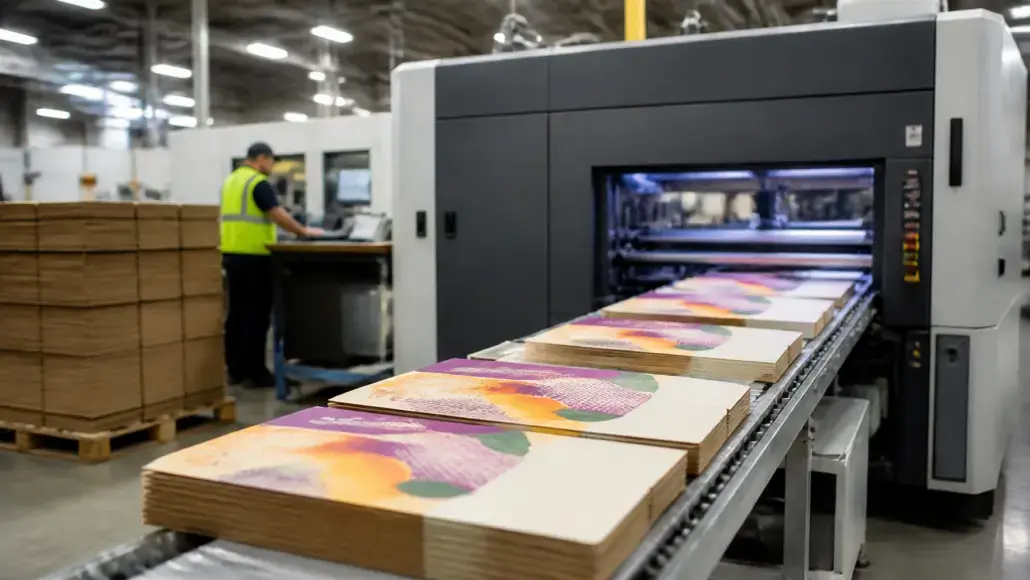

Corrugated has always been the volume business of packaging print. Flexo presses earned their dominant position by printing millions of square metres of shipping cases, trays and retail-ready packaging at a unit cost that alternatives could not touch. That logic is starting to bend. As brand owners break bulk orders into shorter, market-specific runs, the value of a corrugated press is shifting from raw throughput to time: how quickly a job can move from artwork approval to a pallet of sellable board.
Single-pass inkjet has circled this opportunity for the better part of a decade, initially held back by cost per square metre, ink chemistry and the colour expectations that flexo buyers had set over fifty years of press development. The equipment is no longer the constraint. Corrugated inkjet presses now print at industrial speeds, handle coated and uncoated liners with confidence, and hold colour tightly enough to win display work that once belonged exclusively to offset-litho laminated board. In practice, inkjet corrugated printing has moved from the sample room to the production schedule, and the pace of that move keeps accelerating as each press generation narrows the cost gap.
The result is a slow but visible shift in buying patterns. Converters that once treated digital corrugated printing as a sampling tool are installing dedicated single-pass lines, while sheet plants are routing a growing share of mid-run work to inkjet rather than waiting for a flexo slot in a crowded schedule. The change is driven less by novelty than by arithmetic: brands want shorter lead times, and inkjet shortens nearly every stage between approved artwork and a finished pallet.
Why Turnaround Windows Keep Shrinking
The pressure on lead times starts with assortment sprawl. A national grocery brand that once printed one shipping case design by the container load now manages regional variants, retailer-specific tray graphics, promotional overprints and seasonal editions. Each version needs its own stock-keeping allocation, and none of them justifies a long flexo run. Procurement teams have responded by cutting the packaging inventory they hold, which means orders arrive later, in smaller quantities, with firmer promised dates.
E-commerce has added a second channel of demand. Printed shippers and mailing cartons have become brand media in their own right, and subscription businesses reorder small batches frequently rather than large batches quarterly. Retail-ready packaging follows a similar rhythm, because store formats differ between banners and refresh cycles keep compressing.
The operational consequence for converters is an order book that has fragmented without shrinking. Total volume may hold steady or even grow, but average run length keeps falling, and the administrative and makeready cost of each job does not. A conventional plant absorbs that fragmentation by quoting longer lead times or by pushing customers into higher minimum order quantities, both of which irritate the brands whose demand patterns created the problem in the first place. Inkjet offers a third path: accept short runs as normal business instead of an exception to be priced defensively.
Converters describe the same pattern across markets: total square metres ordered each year barely moves, yet the number of order lines climbs steadily. A plant built for a thousand long jobs must now process five thousand short ones with roughly the same fixed capacity, and every manual step in the flow costs proportionally more than it did when runs were long. Turnaround, not price, has become the first question brands ask in a request for quotation, and equipment choices are being restructured around that priority.
Where Single-Pass Inkjet Now Competes
The technology’s first commercial beachhead was high-value display graphics, where the quality gap versus flexo was easiest to monetise and customers already expected to pay litho-laminated prices. That positioning still matters, but the centre of gravity has moved toward everyday volume work. Single-pass presses now run fast enough to sit inside a normal corrugated workflow, printing post-print directly onto combined board at widths that suit standard sheet sizes, with ink systems formulated for scuff resistance and food-contact requirements.
Three technical developments carried the shift. First, printhead reliability and ink recirculation have reduced the cleaning and warm-up routines that once eroded digital’s time advantage. Second, colour management for corrugated substrates has matured, so a press can hold a brand’s reference colours across coated liners, kraft and high-performance white top board without an operator re-tuning between jobs. Third, prepress pipelines have adapted: files built for flexo separation can be repurposed for inkjet with automated profiling rather than a manual rework project.
The infographic below captures how these capabilities translate into commercial advantages across the run-length spectrum.
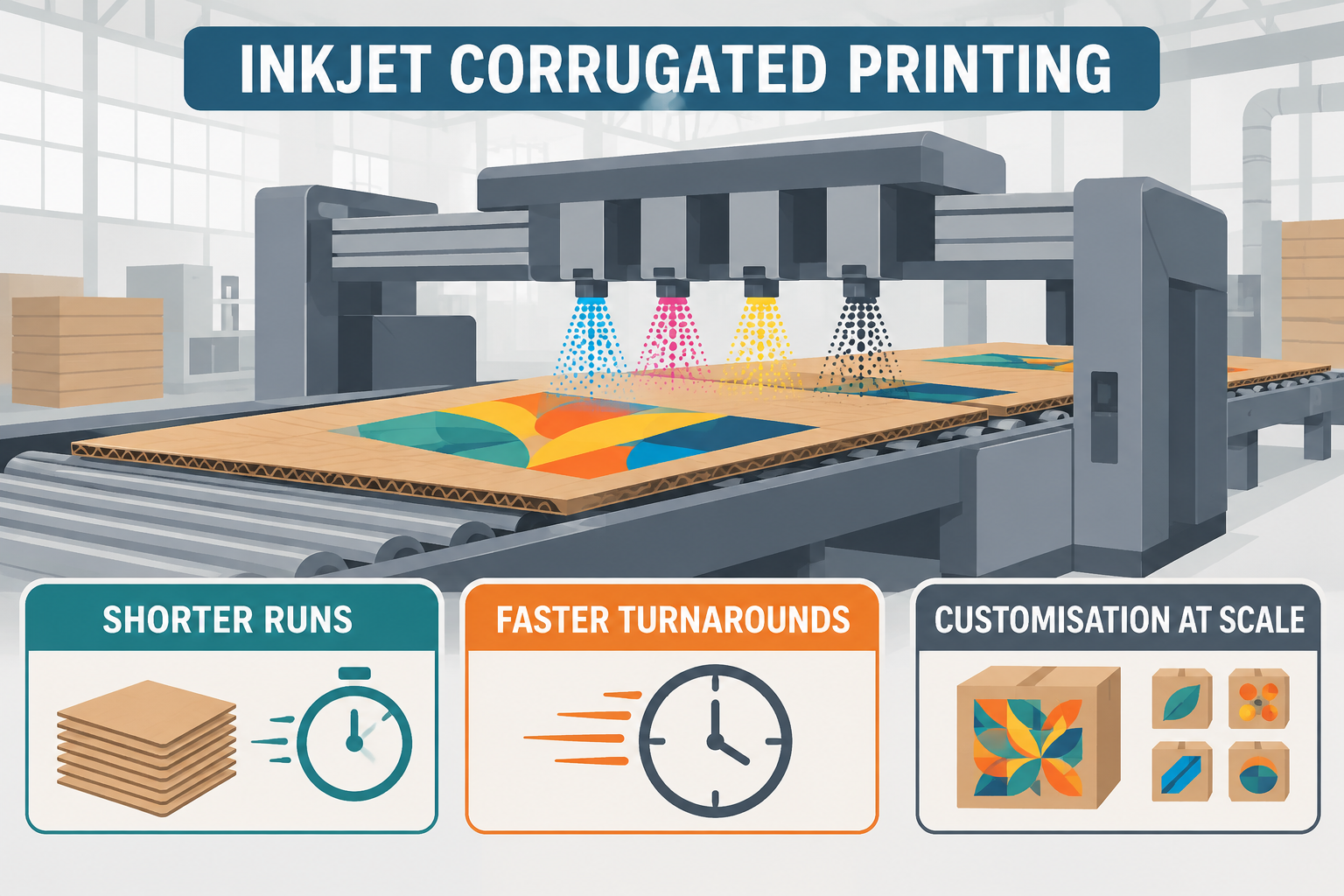
Quality expectations have adjusted in parallel. Retail buyers who once rejected anything that was not litho-laminated now accept premium post-print inkjet for shelf-facing cases, because the difference in perceived quality no longer justifies the extra cost and handling of laminated litho. That acceptance widens the addressable market well beyond the niche display segment. As a result, inkjet corrugated printing is increasingly specified for retail-ready cases and e-commerce shippers that would never have been considered digital candidates two years ago. Converters installing capacity today quote digital as their default answer for mid-range quantities, reserving flexo for genuine volume work, and that routing default is what turns a technology choice into a turnaround advantage.
The Short-Run Economics That Decide Deals
Inkjet does not win on ink cost. It wins on everything that surrounds the ink. A flexo job carries plate making or sleeve mounting, makeready, colour matching runs and set-up waste, all of which are fixed costs spread across the quantity ordered. When the quantity falls, the unit cost climbs steeply. A single-pass inkjet job carries a file preparation cost and a modest startup sequence, and after that it prints saleable board almost immediately.
For converters, the practical break-even between flexo and inkjet keeps moving toward longer runs as digital speeds rise and ink costs ease. Where the crossover sits in any given plant depends on the mix of substrates, coverage levels and the plant’s flexo utilisation, but the direction of travel is consistent. Mid-range quantities that were awkward to price two years ago are now comfortably digital territory.
There is a working capital dimension as well. Brands that order shorter runs more frequently reduce their packaging inventory, and converters that can serve those orders without punitive minimums become stickier suppliers. Some converters report that their inkjet capacity functions as a scheduling shock absorber, taking the jobs that would otherwise force disruptive changeovers on flexo lines. That role alone can justify the investment before any premium pricing on short-run work is counted.
Pricing conversations have shifted accordingly. Brands increasingly ask converters for unit costs across a range of quantities rather than for a single quotation at a fixed volume, and the digital answer stays flat where the flexo answer climbs. Converters equipped for inkjet corrugated printing can bid on orders they previously declined or priced defensively, which changes the shape of their order book rather than just its contents.
What Converters Weigh Before Investing
Capital committees examining a corrugated inkjet case tend to converge on the same set of questions, and the answers decide both the purchase and the operating model that follows:
- Substrate range: how well the press handles kraft, white top, coated liners and heavier board grades across the plant’s actual order book, not the sales team’s ambitions.
- Colour consistency: whether automated inline measurement can hold brand references across shifts without adding an operator role the plant does not have.
- Downstream fit: whether die-cutters, folder-gluers and strapping lines can absorb the output rate, because inkjet that outruns finishing simply moves the bottleneck.
- Ink economics: coverage assumptions in the order book, ink pricing trends and the sensitivity of unit costs to heavy-coverage display work.
- Service and uptime: spare part availability, printhead replacement terms and guaranteed response times, since a digital line down is revenue lost at premium margins.
- Data readiness: whether the plant’s prepress and scheduling systems can feed the press jobs quickly enough to keep utilisation high.
Plants that answer these questions honestly tend to phase the investment, starting with a press sized for their realistic near-term digital share rather than a flagship machine justified by optimistic projections.
Integration Is the Real Project
Press speed alone does not shorten turnaround. The elapsed time between artwork approval and a printed sheet is dominated by prepress handoffs, proofing loops, scheduling and estimating, and these steps do not care what technology sits in the press hall. This is where print workflow automation earns its place: converters that succeed with inkjet usually bind the press investment to a front-end upgrade, because digital capacity starves without a fast, disciplined flow of press-ready files.
The skills profile shifts too. Inkjet reduces the premium on analog craft, such as plate mounting and manual colour matching, and raises the premium on data discipline: colour profiling, file hygiene and systems thinking. Plants report that younger operators take to the technology readily, which helps address the industry’s wider recruitment difficulty in traditional print trades.
None of this diminishes flexo, which remains the rational choice for long-run commodity work and will do so for years. The realistic outcome for most large converters is a mixed estate: flexo for volume, inkjet for the fragmenting middle, and a deliberate policy for deciding which jobs route where. The converters gaining ground are the ones treating that routing decision as a daily commercial tool rather than an afterthought, because in a market defined by turnaround pressure, the fastest credible answer to a brand’s enquiry increasingly wins the order.