























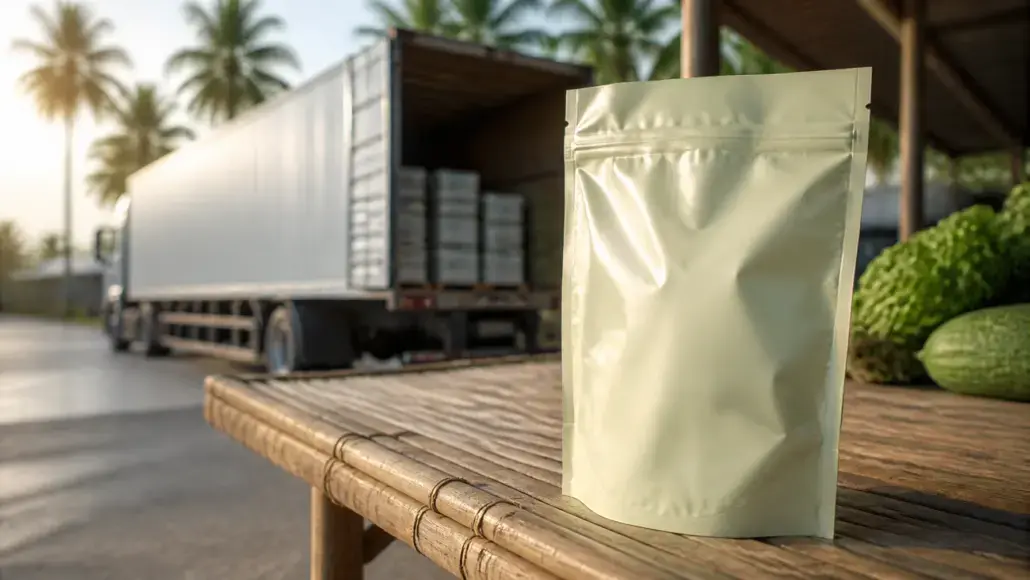

Flexible packaging earned its market share on efficiency: thin multilayer laminates protect food and consumer goods with a fraction of the material used by rigid alternatives. The same layering that makes them efficient makes them a recycling problem, because films that combine polyethylene, polypropylene, polyester, foil and adhesive layers cannot be separated by existing recovery streams. Regulators, brand owners and waste processors have converged on the same answer: simplify the structure so the package rides a single recycling stream. That answer works easily in temperate test labs and gets much harder when the packaging has to survive a forty-degree truck, an unventilated warehouse and six weeks at sea.
Designing recyclable mono-material flexible packaging for hot-climate supply chains has therefore become one of the most demanding briefs in converting. It asks a single polymer family to deliver the barrier performance, seal integrity and mechanical strength that a five-layer laminate once provided, while standing up to thermal conditions that accelerate every failure mode flexible packaging has.
Why Regulators and Retailers Are Forcing the Structure Question
The pressure is regulatory first. Extended producer responsibility schemes across Europe now modulate fees by recyclability, so a hard-to-recycle laminate costs the brand more per tonne than a mono-material equivalent. The European Union’s packaging rules push the logic further, setting recyclability grades and recycled content expectations that multilayer films struggle to meet. Similar frameworks are advancing in markets such as India, the Gulf states and Southeast Asia, where collection infrastructure is developing quickly and producers are being assigned explicit recovery obligations.
Brand commitments amplify the rules. Global consumer goods companies have pledged recyclable, reusable or compostable packaging across their portfolios, and flexible packaging is usually the last major category standing between them and the target. Retailers add commercial weight by listing products with recyclable formats ahead of non-compliant equivalents in some categories.
Design guidance has matured alongside the mandates. Industry protocols from packaging recovery organisations specify which polymer families are accepted in which recycling streams, how much barrier material a recyclable film may carry, and how adhesives and inks should be selected. Converters now work against these documents the way they once worked against customer specification sheets, and the hot-climate constraint sits on top of all of it. For converters and material suppliers alike, mono-material flexible packaging is now a specification exercise governed by documents that did not exist five years ago.
The Heat Problem in Flexible Supply Chains
Temperature attacks flexible packaging at every weak point simultaneously. Seal strength depends on the sealant layer staying within its working window; sustained heat above forty degrees Celsius can soften a standard polyethylene sealant enough that seals creep, deform or open under stack pressure in a warehouse. Oxygen and moisture transmission rates rise with temperature, so a barrier that passes a European shelf-life trial can underperform in a Gulf distribution loop. Puncture resistance drops as films soften, and luggage-style handling in manual warehouses adds abrasion the structure must survive.
Hot climates also change how products are transported. In many emerging markets, refrigerated distribution is partial or absent, so the package carries the entire preservation burden for longer periods. Add high humidity, which stresses moisture-sensitive products such as snacks, spices, powders and pharmaceuticals, and the barrier requirement for a hot-climate mono-material structure often exceeds what the equivalent European structure needs. For converters, the design brief is clear: mono-material flexible packaging for these markets must be validated against the worst conditions it will meet, not the average ones.
Product categories feel these stresses differently. Snack foods and baked goods face moisture gain that turns crisp textures stale within days of a compromised barrier. Spices and seasoning blends lose volatile aroma compounds through films that would be adequate in temperate climates. Detergents and personal care products may be chemically aggressive toward sealant layers, while powdered beverages combine moisture sensitivity with hot-fill processes. Each category pushes the structure design toward a different balance of barrier, sealant chemistry and mechanical strength, which is why converters serving hot-climate markets maintain category-specific design libraries rather than one standard answer.
These realities explain why early mono-material launches drew criticism when products failed in tropical and desert markets. The failure was rarely the recyclability concept; it was barrier and sealant performance specified against the wrong distribution profile.
Material Choices Converters Are Working With
The toolbox for mono-material flexible packaging has expanded significantly, and converters now select among several structural strategies, each with distinct thermal behaviour:
- All-polyethylene laminates using oriented PE films, which keep the entire structure in one recycling stream while adding stiffness and heat resistance that blown PE alone cannot deliver.
- Polypropylene-based structures, whose higher softening point suits hot climates well, paired with metallocene PE sealant films or PP-based sealants to keep the pack within a single stream.
- Barrier-coated films, where aluminium oxide or silicon oxide coatings provide transparency and recyclability together, replacing foil or EVOH layers that would disqualify the structure.
- Downgauged hybrid approaches, where paper carries stiffness and print surface while a thin PE web provides sealing, accepted by a growing set of recovery schemes.
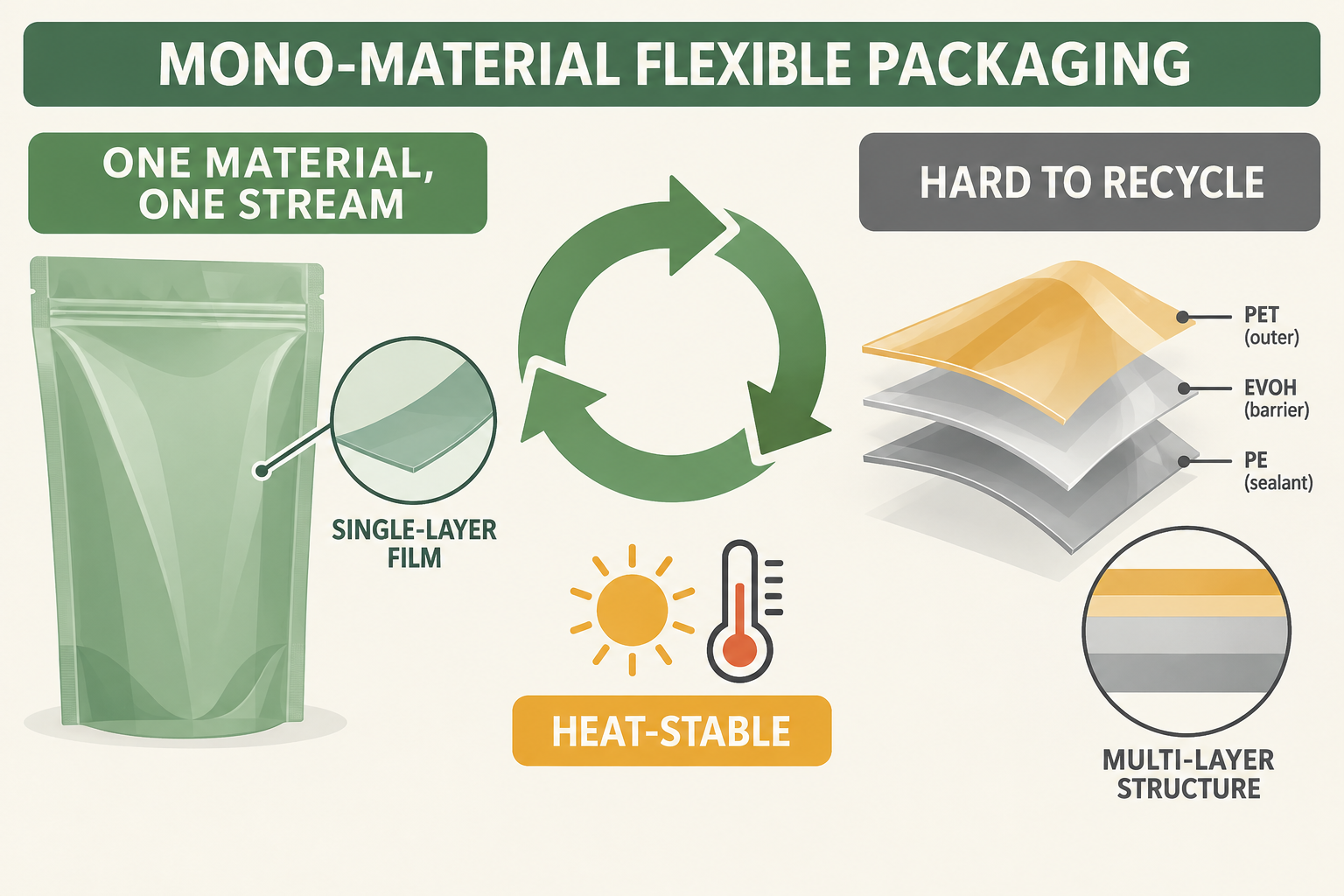
Choosing among them is a trade-off exercise. Polypropylene handles heat better but is less established in film recycling streams than polyethylene in some regions. Coatings add barrier but complicate the recyclability assessment and can raise seal window sensitivity. Every option costs more than the legacy laminate it replaces, at least for now, so brands prioritise the SKUs where the commercial or regulatory exposure is highest.
Converting and Design Trade-Offs
On the converting floor, mono-material structures change familiar processes. Seal windows are narrower and often sit at lower temperatures than the laminates operators know intuitively, so vertical form-fill-seal and horizontal machines need re-parameterising, and the margin for error in the sealing jaw setup shrinks. Stiffness profiles differ too: oriented films behave differently through former sets and tension zones, and heavier gauges are often needed to recover the puncture resistance lost when stiff barrier layers are removed.
Design decisions compress further at the pack level. A mono-material pouch may need a different geometry, gusset pattern or fitment strategy to stand and ship the way the legacy laminate did. Print surfaces change, which shifts ink selection and expectations for gloss and finish. Ink and adhesive selection follows the same logic, since migration compliance and recyclability grading both depend on the full material recipe rather than the film layers alone. Even front-of-pack thinking widens at this stage, because teams that once specified data features late in the process increasingly consider smart labels and serialisation during structure design, since coatings, adhesives and print layers can affect how printed codes and embedded inlays perform.
None of these trade-offs is disqualifying, but together they mean a mono-material conversion is a development project, not a material swap. Brands that budget for piloting, line trials and reformulation alongside the packaging change see far fewer field failures than those that treat it as a procurement exercise.
Scale economics are improving as volumes grow. Film producers have expanded oriented PE and polypropylene capacity specifically for these structures, coating suppliers have widened their qualified ranges, and converting experience compounds with every trial. None of it makes the films cheaper than legacy laminates yet, but the premium narrows each year, and early movers lock in the learning-curve advantage while late movers pay both for materials and for field failures.
Validating for Hot-Climate Distribution
Validation is where hot-climate programmes succeed or fail. Accelerated ageing at elevated temperature and humidity gives a first read on barrier loss and seal degradation, but it does not capture the full profile of real distribution: cyclic heat, vibration, stack compression and handling abuse. Leading programmes therefore combine laboratory ageing with instrumented transit trials on the actual lanes the product will travel, logging temperature and humidity inside secondary packaging for weeks at a time.
Seal integrity testing after ageing matters more than seal strength on day one, because the question is whether the seal survives the distribution loop, not the pack-out line. Converters also validate print and coating durability under heat, since scuffing and blocking worsen as films soften. Recycling compatibility is verified against the target market’s actual recovery infrastructure, because a structure that grades well under one region’s protocol may grade poorly under another’s.
The commercial logic still closes. Mono-material flexible packaging built for heat costs more per pack today, but it future-proofs brands against tightening EPR fees, protects them from retailer delisting risk and opens premium sustainability claims in markets where plastic waste is a highly visible consumer issue. Converters that build genuine hot-climate validation capability, rather than importing temperate-zone test assumptions, are positioning themselves as development partners for the global brands whose growth increasingly sits in exactly those climates. Documentation closes the loop: a validated structure, with its test records and lane data, becomes a reusable asset that shortens the next category’s conversion and justifies the premium with evidence rather than promises.