



















Label converting runs on two technologies that each dominate a segment of the order book and struggle in the middle. Flexo presses deliver the lowest unit cost on long runs but carry plate costs, makeready time and setup waste that make short jobs expensive to produce honestly. Digital presses remove plates and setup almost entirely, then lose their advantage as quantities grow because their running speed and ink economics trail conventional printing. Between those poles sits the mid-volume band, typically a few thousand to a few tens of thousands of labels per SKU, which is exactly where the industry’s order books have been fragmenting for years.
Hybrid label presses attack that band by putting flexo stations and a digital print engine on the same platform, in the same pass, under one control system. For mid-volume converters whose books are a mosaic of ever-shorter runs, the configuration has moved from an interesting option to a mainstream planning assumption.
The Mid-Volume Gap Between Flexo and Digital
The economics of the gap are straightforward. A flexo job’s fixed costs, including plates, mounting, colour matching and setup waste, are spread across the quantity ordered, so unit cost falls steeply with volume. A digital job’s unit cost is comparatively flat but starts higher, because digital ink or toner is more expensive than flexo ink at industrial volumes. The two curves cross, and everything near the crossing point is uncomfortable on either technology alone.
Order books have migrated toward that crossing point. Brand owners manage more SKUs, run more promotions and hold less inventory, so the same annual label volume arrives as many smaller orders. A converter with an all-flexo estate quotes longer lead times or subsidised short runs; a converter with an all-digital estate wins the short work but surrenders the profitable long jobs that keep a press earning through the night.
The mid-volume band also carries requirements neither pure technology satisfies alone. Long-run work often includes white ink on clear film, spot colours and heavy varnish, where flexo excels. Short and mid runs increasingly need variable data, versioned artwork or late-stage colour changes, where digital is the only practical route. The gap is not just about cost curves; it is about capability composition.
Private label demand accelerates the trend. Retail own-brand programmes launch more lines, refresh designs more often and order shorter quantities per design than national brands, and their volumes concentrate exactly in the mid-volume band. A converter winning private label business without hybrid capability either subsidises plate and setup costs or declines the work, and both options concede share in one of the fastest-growing corners of the label market. Hybrid label presses emerged precisely because the gap has this structure: fixed costs on one side, flat-but-higher unit costs on the other, and capability requirements that neither pure platform satisfies alone.
What a Hybrid Configuration Actually Looks Like
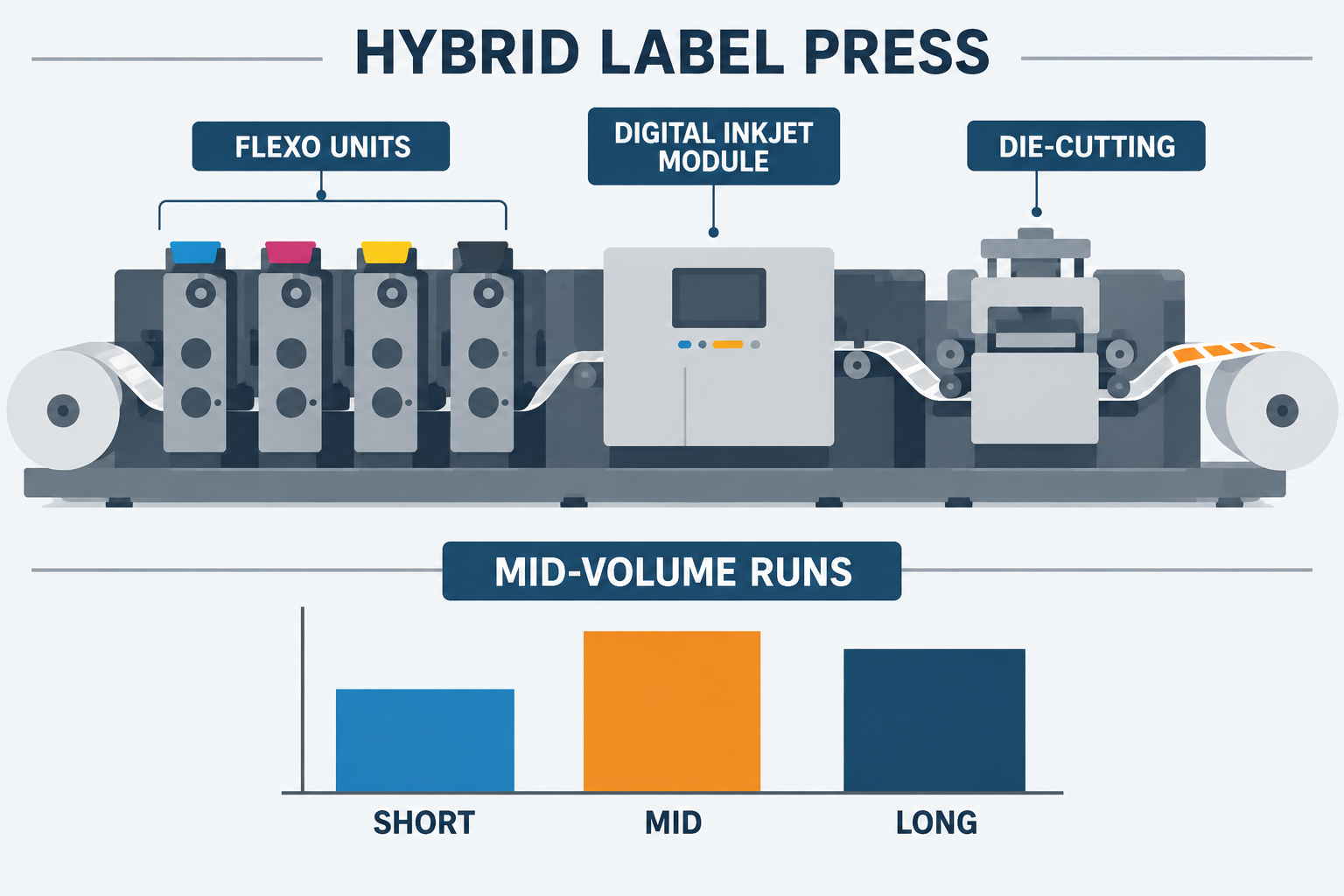
Hybrid platforms vary by vendor, but the working architecture is consistent: conventional stations handle what flexo does best, the digital engine handles what it does best, and finishing follows inline. Converters configuring a press for a fragmented order book typically specify:
- Flexo stations dedicated to white ink and opaque layers on clear and metallised films, where opacity and laydown remain flexo strengths.
- A digital module, either UV inkjet or dry toner, positioned for variable data, four-colour process work and versioned SKUs without plates.
- Cold foiling, screen or rotary stations for spot colour and metallic effect, applied conventionally ahead of or behind the digital unit.
- Inline die-cutting, matrix stripping, lamination and inspection, so a finished roll leaves the press in a single pass.
- Optional nearline finishing, which frees the combined press to keep printing while embellishment and die-cutting run offline.
Layout also decides what the pressroom can do with the platform. Inline configurations finish everything in one pass and favour speed; nearline configurations keep the press printing while die-cutting and embellishment run offline, favouring utilisation. Neither is universally better, and converters increasingly configure one hybrid inline for fast-turn work while leaving nearline capacity to absorb the finishing load as short-run volumes grow.
The configuration choices matter commercially. A press built around white-plus-digital-plus-finish serves premium clear-film work; one built around high flexo station counts plus a modest digital unit serves industrial and variable-code work. Converters increasingly spec the platform to their actual order book rather than to a vendor’s reference layout.
The Changeover Maths That Drive the Case
The financial argument rests on elapsed time per job. Every flexo changeover consumes minutes for plate mounting, ink changes, colour matching and registration, plus setup waste that must be sold or absorbed. On a plant printing dozens of short jobs per day, those minutes compound into hours of lost capacity and a scheduling grid full of friction. A hybrid press reduces plate count per job, since four-colour work migrates to the digital engine, and cuts the number of physical changeovers because the digital module carries the variable content while flexo stations hold static elements across the run.
The result shows up as throughput, not just cost. Plants running hybrid label presses commonly report that the same job mix that previously queued for separate flexo and digital passes now completes in one pass, with less WIP between processes and fewer roll-handling defects. Scheduling gains compound the arithmetic, because a job that no longer queues for two passes also stops occupying two press slots on the board. Where a job would previously have been printed conventionally, then rewound through a separate digital overprint unit for variable data, the hybrid path eliminates the rewind entirely.
Total cost per thousand labels, calculated honestly across plates, setup waste, ink, head time and labour, is the metric that decides investment cases. On fragmented books, hybrids win that calculation most often in the several-thousand to several-tens-of-thousands band, which is precisely the band that is growing. At the extremes, pure flexo still owns very long runs and pure digital still owns tiny ones, and most converters keep those technologies alongside the hybrid.
Colour Management and Substrate Reality
Combining two print engines in one pass creates a colour challenge that vendors have largely solved but converters must still operate. The flexo stations and the digital engine must sit inside the same colour space, so brand spot colours render identically whether printed conventionally or digitally, and four-colour images do not shift tone mid-web. This demands shared profiling, inline measurement and disciplined process control, plus a proofing workflow that simulates the combined output rather than each engine separately.
Substrate behaviour needs equal attention. Digital engines are qualified on defined film and paper families, and adhesion, toner fusing or ink anchorage can vary on specialty stocks, topcoated films and recycled papers. White opacity from flexo must be consistent under digitally printed colour, and varnish or lamination applied downstream must bond to both printed surfaces. Converters mitigate by narrowing substrate lists, qualifying stocks formally and maintaining a test protocol for new materials before a customer job depends on them.
Spot colour libraries require particular care. Brands arrive with Pantone references that must render identically whether printed flexographically or digitally, and converters build curated ink libraries and digital colour targets so the same brand colour can be produced on either engine without a customer-visible difference. Where a colour sits outside the digital engine’s gamut, the workflow must route it to a flexo station automatically, and the operator needs confidence that the routing happened correctly before the web starts moving.
Where Investment Decisions Are Landing
For converters weighing capex, the hybrid case usually rests on utilisation and service premium rather than raw unit cost. One press covering the fragmented middle keeps earning across a mixed book, shortens quoted lead times, and supports services customers will pay for, such as versioned campaigns and late artwork changes. Depreciation planning matters too, since digital engines carry consumable costs that flexo does not, and head or imaging unit replacements arrive on predictable cycles that finance teams should model from the outset. Converters who model five-year total cost of ownership, including service contracts and consumables, generally find the hybrid wins its place in the fleet by the flexibility it buys rather than the unit cost it promises. Many converters justify the platform further through premium capability, because the same inline path that carries the digital module can deliver digital embellishment effects such as foils, spot varnish and tactile finishes at short-run volumes that conventional tooling cannot serve profitably.
The counterweights are real: hybrid presses are complex, service-dependent machines, and a single platform failure can idle both conventional and digital capability at once. Experienced buyers weigh vendor service coverage, spare part logistics and head replacement economics as heavily as print specifications. They also plan the operating model deliberately, training operators across both technologies and redefining prepress so files arrive hybrid-ready. Where those plans are in place, hybrid label presses have settled into a durable role: the plant’s workhorse for the fragmenting middle, with flexo and digital capacity on either side handling the extremes.