
























Packaging has historically been passive: it protects whatever is inside it, regardless of whether that product remains fresh or has begun to spoil. Enzyme responsive packaging changes that relationship by making the packaging material itself react to chemical signals released by food as it degrades. Spoilage enzymes and their byproducts trigger visible changes or active responses in the packaging layer, converting the pack from a static barrier into a system that reflects the actual condition of its contents. Laboratory and pilot work has advanced rapidly over the past decade, and the first commercial deployments are emerging in categories where quality losses carry the highest costs.
Spoilage Chemistry as a Trigger Mechanism
Food spoilage follows recognizable biochemical signatures. As microbes multiply on a food surface, they release extracellular enzymes such as proteases, lipases and chitinases that break down proteins, fats and structural tissue. These enzymes, and the compounds they generate, provide a chemical record of spoilage that accumulates before any visible change appears. Biogenic amines, sulfur compounds, organic acids and shifts in local pH all accompany microbial growth, and each offers a measurable handle for detection.
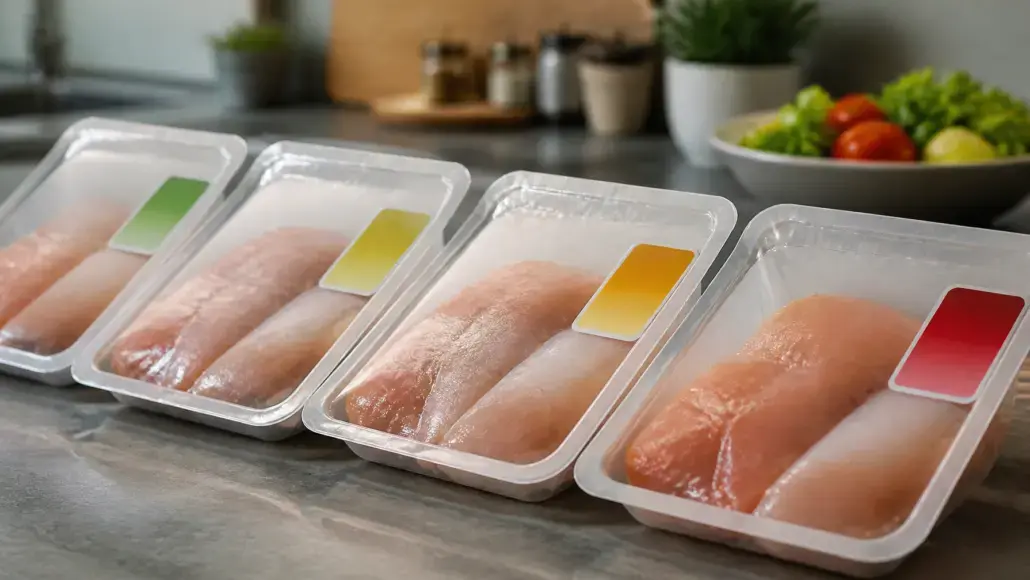
Enzyme responsive packaging exploits these signatures by embedding substrates that react specifically to them. A colorimetric film might contain a chromogenic substrate cleaved by proteases, releasing a visible color change as spoilage enzymes accumulate. A pH-sensitive indicator inside the pack shifts hue as organic acids from microbial metabolism lower the headspace humidity film’s acidity. The specificity matters: well-designed systems respond to enzymes associated with spoilage rather than to normal product chemistry, avoiding false alarms that would otherwise doom the concept in commercial settings.
Timing gives the approach its commercial value. Microbial spoilage chemistry often becomes detectable through the packaging before sensory spoilage becomes obvious to consumers, which creates a window for intervention, markdown management or targeted removal from the shelf. That window, measured in hours to days depending on the product and temperature, is where the technology earns its place.
Seafood provides the clearest application case. Fish spoilage proceeds through bacterial enzymes that generate measurable amine and sulfur compounds, and the chemistry accelerates sharply when cold-chain control slips at any point between harvest and display. Indicator systems tuned to those compounds can therefore flag packs whose storage history differs from their label, an ability that matters in a category where consumers cannot judge freshness before purchase and where quality failures carry food-safety implications for the retailer as well as the brand.
Material Platforms: From Indicator Films to Active Release
Two functional generations define the field. The first, already in commercial pilots, covers intelligent indicators: films, labels and indicator windows that change appearance in response to spoilage chemistry. Their value lies in information rather than protection, giving quality teams, retailers and consumers an objective freshness signal tied to the product’s actual condition rather than to an assumed date.
The second generation adds active response. Materials engineered to release antimicrobial agents only when spoilage enzymes are detected concentrate protection at the moment it becomes necessary, rather than dispersing it steadily from the first day of storage. Enzyme-triggered release systems embed antimicrobial payloads within biopolymer carriers such as chitosan, alginate or starch derivatives that degrade in the presence of target enzymes, freeing the active agent. Such systems align with broader industry moves toward natural antimicrobials and reduced additive loads, because the agent is deployed locally and only when required.
Fabrication platforms are maturing alongside the chemistry. Biopolymer films serve as both carrier and sensor matrix, nanoparticle immobilization stabilizes the reactive components, and printing technologies allow indicator zones to be patterned onto conventional films at line speed. Most enzyme-triggered release systems remain at laboratory or pilot scale, and packers should treat commercial timelines accordingly; intelligent indicators, by contrast, are already being evaluated in retail and logistics trials.
Cost structures differ sharply between the two generations. Intelligent indicators are essentially printed labels, and their cost profile approaches conventional variable-information printing, which makes them viable at retail volumes. Enzyme-triggered active release systems, by contrast, add functional biopolymers and encapsulated agents to the film itself, carrying costs closer to active packaging than to printing. That difference explains why indicators lead commercialization while release systems advance through research partnerships between film producers and food manufacturers.

Format Options and Integration with Existing Packaging Lines
Integration economics depend on how little the pack changes, and current formats reflect that priority:
- Smart labels and stickers carrying the indicator chemistry stick onto existing packs, adding detection without altering the primary packaging structure or the filling process.
- Indicator windows built into lidding films give a permanent, product-visible freshness signal for tray-packed chilled foods.
- Printed sensing zones applied directly to the inner surface of flexible films merge the function into the pack wall, the route chosen by several film converters running pilot programs.
- Enzyme-triggered antimicrobial coatings, still largely experimental, would sit within the sealant layer and activate only on spoilage chemistry, keeping the inactive pack lighter and cleaner.
Line impact for label and window formats is modest: application equipment and quality checks join the packing process, while film structures and sealing parameters remain untouched. The heavier integration burden sits upstream, in calibration and validation, since each product category carries its own spoilage chemistry and requires indicator thresholds tuned to its specific microbial flora and storage profile.
Validation, Data and Retail Decision-Making
Validation is where laboratory promise meets commercial reality. An indicator must correlate reliably with recognized microbiological or sensory endpoints across the full storage temperature range, because a signal that reads fresh on spoiled fish, or spoiled on fresh fish, destroys trust in the entire system. Developers therefore build calibration curves against plate counts and sensory panels across multiple strains and temperatures, then run blind distribution trials to measure false-positive and false-negative rates. Published validation studies show encouraging correlation for fish and poultry applications, where spoilage chemistry is pronounced, while calibration for slower-spoiling products remains harder.
Consumer communication raises its own questions. A visible indicator that turns amber invites interpretation, and retailers must decide how staff respond to customer questions about changed packs. Research on consumer response to freshness indicators suggests shoppers value the information when the meaning is explained clearly on pack, but unexplained color changes generate complaints and returns. Clear legend design, consistent color thresholds and staff briefing have proven as important to pilot success as the underlying chemistry itself, and suppliers now include consumer-facing artwork guidance in their pilot packages.
The data dimension may matter more than the indicator itself. Connected indicators scanned at case or shelf level generate a real-time map of product condition across the supply chain, letting retailers replace date-based markdown schedules with condition-based ones. Early pilots in chilled seafood logistics have used such readings to prioritize stock rotation and to pinpoint cold-chain breaks, outcomes that reduce waste even when the packaging itself changes nothing about preservation. Decision frameworks at retail, including who may act on a spoilage signal and how claims are handled, remain under development, and industry groups are drafting guidance for exactly these operational questions.
Dairy and fresh produce present the next calibration frontier. Their spoilage develops more slowly and through more varied microbial flora, so indicators validated on fish do not transfer directly, and developers are running category-specific trials to extend the calibrated range. Progress in these categories would multiply the addressable market several times over, which explains why film suppliers are investing in multi-year validation programs rather than launching single-product solutions and hoping demand follows.
Regulatory and Commercial Outlook
Regulatory pathways split between the packaging material and any claim made on its basis. In the European Union, food contact requirements under Framework Regulation (EC) No 1935/2004 apply to the indicator materials, and a freshness claim tied to a visible signal must be demonstrable and honest. United States routes run through food-contact substance processes for the film components. Systems that release active agents on trigger face the additional scrutiny applied to antimicrobial claims, and developers have learned to involve regulators early rather than after formulation is fixed.
Commercially, the near-term path runs through premium chilled categories with high waste costs, particularly seafood, fresh meat and fresh produce logistics, where a few saved days translate directly into margin. First traction is appearing alongside technologies that packers already trust: several pilot programs pair enzyme responsive indicators with active packaging materials for extending dairy product freshness, so the indicator confirms that the antimicrobial layer remains effective through the product’s life. As printing costs fall and validation data accumulates, the reasonable expectation is that freshness-indicating functions will follow the same adoption curve barrier films once did, moving from premium trials to standard specifications across chilled food categories, with dairy, seafood and fresh meat expected to lead the transition.