






















Warehouse operations are essential to the modern economy, but they remain environments with persistent safety challenges. The combination of heavy machinery, fast-paced manual tasks, and complex workflows creates numerous risks for employees. These risks can lead to serious injuries and operational disruptions, prompting leaders to seek more advanced solutions for protecting their teams.
Improving Hazard Recognition with Advanced Monitoring
A primary challenge in large facilities is maintaining consistent situational awareness. It is impossible for safety managers to be everywhere at once, which can lead to unsafe behaviors or conditions going unnoticed. New technologies are helping to close this gap by providing continuous oversight.
Real-Time Alerts for Unsafe Acts
Modern camera systems powered by artificial intelligence can monitor operational areas around the clock. These platforms can be trained to recognize specific high-risk activities. For example, a system can identify when a person enters a restricted zone near automated machinery or when a forklift operator drives with an elevated load. When such an event is detected, the system can send an immediate alert to a supervisor, who can then intervene before an incident occurs.
Proactive Risk Identification
Beyond immediate alerts, these technologies collect valuable data on operational patterns. Analyzing this information can reveal trends and potential hotspots for incidents. For instance, data might show that a particular intersection has a high number of near misses between forklifts and pedestrians. This insight allows safety teams to implement targeted improvements, such as adding mirrors, signs, or physical barriers, to address the root cause of the risk.
Reducing Collisions Between People and Equipment
Collisions involving forklifts and other vehicles are among the most serious hazards in a warehouse setting. Busy, noisy environments can make it difficult for operators and pedestrians to remain aware of each other, but technology offers new layers of protection.
Automated Pedestrian Detection
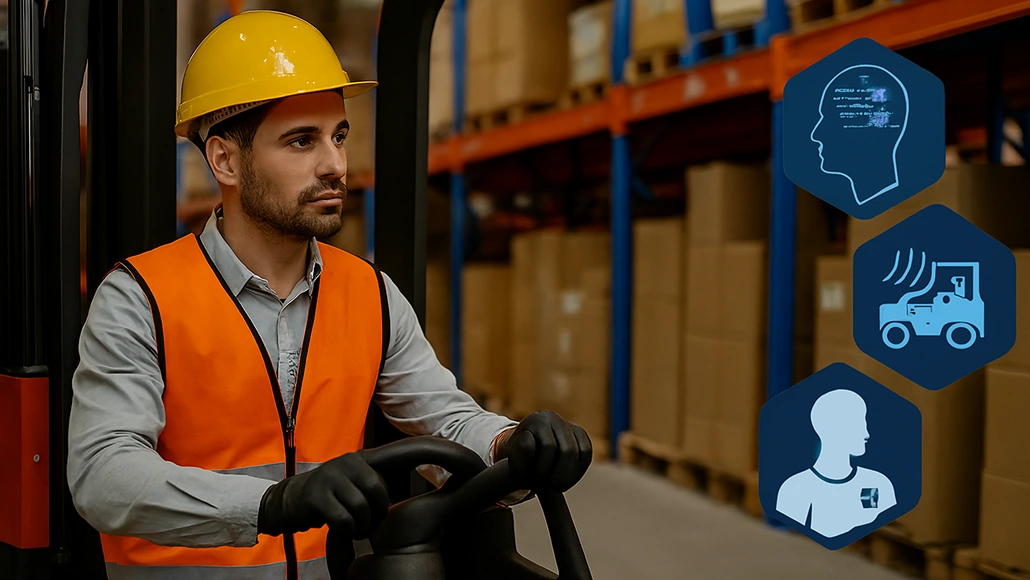
Many material handling vehicles can now be equipped with advanced sensor systems. Using cameras or radio-frequency identification (RFID) tags, these systems can detect when a person is in the vehicle’s path or in a blind spot. When a potential collision is identified, the system can issue an audible or visual warning to both the equipment operator and the nearby pedestrian, giving them critical time to react.
Traffic Management and Flow Analysis
Technology can also be used to analyze the movement of people and equipment throughout a facility. By tracking traffic patterns, managers can identify bottlenecks and high-risk areas where interactions are frequent. This information supports better facility design, including:
- Creating clearly defined and protected pedestrian walkways.
- Establishing one-way traffic rules in congested aisles.
- Optimizing equipment routes to reduce cross-flow with foot traffic.
Mitigating Strains and Sprains from Manual Tasks
Manual material handling is another leading source of warehouse injuries, with tasks like lifting, pulling, and reaching causing sprains and strains. Ergonomic technologies are emerging to help reduce the physical toll of these jobs on employees.
Wearable Sensors for Ergonomic Feedback
Small, wearable sensors can be worn by employees to monitor their movements throughout the day. These devices track postures and motions, such as bending at the waist to lift a heavy object or twisting while carrying a load. If a risky movement is detected, the device can provide immediate feedback, such as a gentle vibration, to alert the worker. This helps employees develop safer habits in real time.
Data-Driven Ergonomic Assessments
The data collected from wearable sensors provides safety managers with objective insights into ergonomic risks. Aggregated, anonymous data can highlight which specific tasks or workstations are associated with the most high-risk postures. This allows for focused interventions, such as providing new lifting equipment or redesigning a workstation to reduce the need for awkward movements.
A Scenario in Practice
Consider a distribution center that installed an AI-powered video monitoring system. Within weeks, the system flagged a high rate of near-miss events at a four-way intersection that was frequently used by both forklifts and pedestrians. The safety manager reviewed the data, which confirmed that blind corners were preventing operators and workers from seeing each other until the last second. In response, the company installed convex mirrors and added floor markings to direct foot traffic away from the intersection. Subsequent reports from the system showed a significant decrease in near-miss alerts, confirming the effectiveness of the changes and providing clear documentation of proactive safety management.
Adopting New Safety Approaches
New technologies are giving organizations powerful tools to move from a reactive to a proactive safety posture. By automatically identifying hazards, alerting teams to risks in real time, and providing data for long-term improvements, these systems help create a more resilient and protected workforce. Integrating these solutions supports a stronger safety culture where risks are managed before they can lead to injuries. For those looking to improve their facility’s safety, reviewing a comprehensive set of warehouse safety tips and best practices can provide a strong foundation.

