

















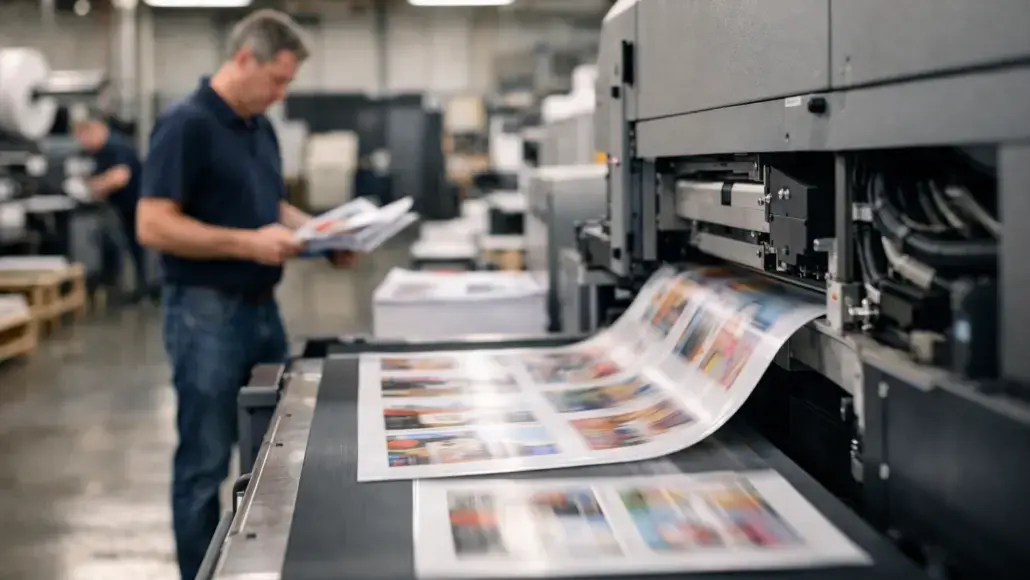
As commercial printing clients demand tighter turnarounds and greater flexibility, operations face pressure to deliver without extending lead times or compromising quality. Equipment that once met standard schedules can struggle, revealing limitations in speed, automation or substrate handling.
This shift has made equipment evaluation less about replacing functional machinery and more about determining whether current systems can sustain the pace clients now expect.
The State of Commercial Printing and Evolving Demands
The window between order placement and delivery continues shrinking across the commercial printing sector. Industry data show that 48% of commercial printers reported that more than a quarter of their digital print orders had lead times under 48 hours. This compression creates operational strain because equipment designed for longer production cycles cannot easily accommodate the frequent changeovers these jobs require.
When clients treat same-week turnaround as standard service, production systems need both the speed to meet deadlines and the consistency to maintain quality under pressure. Hi-speed inkjet systems built for commercial printing businesses address both requirements without forcing operators to choose between throughput and precision.
Overcoming Common Press Floor Bottlenecks
Equipment age becomes a constraint when operational demands shift faster than hardware can adapt. Presses that handled predictable schedules a few years ago now struggle with workflows requiring frequent substrate changes or rapid job transitions.
Approximately 54.8% of commercial printers reported in 2024 that investments aimed at productivity or production speed had major positive effects. Despite this proven return, adoption of automation remains uneven. Research from FESPA found that nearly half of print service providers still operate without automation tools, resulting in recurring bottlenecks that limit capacity during peak periods.
Top-Rated Inkjet Systems for Commercial Printing Businesses
Selecting production equipment requires matching technical capabilities to workflow realities. The systems below address different segments of the commercial printing market, from flexible packaging to high-volume catalog production. Each brings specific strengths in speed, substrate handling or color performance.
1. FUJIFILM Business Innovation Division J Press FP790
FUJIFILM Business Innovation Division has built its market position through sustained investment in research targeting production-level printing challenges. The J Press FP790 reflects this focus as a water-based inkjet press engineered for flexible packaging workflows.
This comprehensive approach helps print operations make more growth happen by removing technical limitations that once constrained flexible packaging production.
Key features:
- Print speed: Operates at up to 164 feet per minute, or 50 meters per minute
- Resolution: Produces output at 1,200 x 1,200 dpi
- Color performance: Reproduces more than 90% of the Pantone color gamut using CMYK
- Substrate width: Accommodates materials from 20.5 to 31 inches wide
2. Screen Americas Truepress PAC 830F
The Truepress PAC 830F targets the flexible packaging segment where job lengths rarely justify conventional plate-based production. By eliminating plates, the system reduces changeover time when moving between orders. This becomes valuable for runs under 4,000 meters, where setup time can consume a disproportionate share of total production hours.
Key features:
- Print speed: Operates at up to 75 meters per minute
- Resolution: Produces output at 1,200 x 1,200 dpi
- Media width: Handles flexible packaging materials up to 830 millimeters wide
- Production model: Uses single-pass, drop-on-demand inkjet technology
3. Kodak PROSPER ULTRA 520 Press
The PROSPER ULTRA 520 addresses a different production challenge by creating an economical alternative to conventional offset for work that falls between digital short runs and traditional long runs. Kodak’s ULTRASTREAM Inkjet Technology was developed for applications requiring heavy ink coverage without sacrificing image quality over extended production cycles.
Key features:
- Print speed: Operates at up to 152 meters per minute
- Resolution: Produces output at up to 600 x 1,800 dpi
- Substrate compatibility: Prints on coated and uncoated paper, including glossy stocks
- Applications: Supports commercial work such as magazines and catalogs
4. Canon ProStream 3000 Series
Canon’s ProStream 3000 Series was engineered for environments where monthly volume creates its own operational demands. The ProStream 3160 reaches 160 meters per minute while maintaining high-resolution output, but the defining characteristic is its duty cycle capacity of up to 70 million A4 impressions per month.
Key features:
- Print speed: The ProStream 3160 reaches up to 160 meters per minute
- Resolution: Produces output at 1,200 x 1,200 dpi
- Monthly capacity: Supports duty cycles of up to 70 million A4 impressions
- Applications: Accommodates work such as direct mail, books and other commercial materials
5. Domino N730i
The Domino N730i approaches label production by expanding color capability rather than just increasing speed. Its seven-color UV90 ink system reproduces up to 92% of the Pantone range, which addresses the color-matching challenges label work often presents. Brand owners frequently specify colors outside the standard CMYK gamut, requiring spot colors or color compromise.
Key features:
- Print speed: Operates at up to 230 feet per minute
- Resolution: Produces output at 1,200 dpi
- Color system: Uses seven-color UV90 inks and can reproduce up to 92% of the Pantone range
- White ink: Reaches up to 76% opacity for high-impact label applications
Comparing Leading Inkjet Systems
The table below consolidates the key specifications for each system.
| Model | Primary Application | Maximum Speed | Native Resolution |
| FUJIFILM Business Innovation Division J Press FP790 | Flexible packaging | 164 ft/min | 1,200 x 1,200 dpi |
| Screen Americas Truepress PAC 830F | Flexible packaging | 75 m/min | 1,200 x 1,200 dpi |
| Kodak PROSPER ULTRA 520 Press | High-volume commercial | 152 m/min | 600 x 1,800 dpi |
| Canon ProStream 3000 Series | High-volume commercial | 160 m/min for the ProStream 3160 | 1,200 x 1,200 dpi |
| Domino N730i | Label production | 230 ft/min | 1,200 dpi |
Methodology
These companies demonstrate capabilities that directly affect production outcomes. Their systems deliver the speed and monthly capacity needed to sustain commercial workloads during peak periods. Each maintains resolution and color performance that meet the quality standards clients enforce through approval processes.
These manufacturers provide substrate compatibility, allowing operations to move between materials without extensive reconfiguration. Each system addresses specific segments in which production requirements vary depending on the work being produced.
Frequently Asked Questions
These questions address common considerations when evaluating inkjet systems for commercial printing applications.
How important is Pantone color gamut coverage for commercial printing?
Pantone color gamut coverage determines how many brand-specified colors a system can reproduce using its standard ink set. Systems that cover 90% or more of the Pantone range give operators broader standard ink color capability, which is especially useful for flexible packaging and label work with strict brand color expectations.
This capability becomes essential for flexible packaging and label work where brand owners enforce strict color specifications. Operations handling commercial work with less stringent color requirements may prioritize other factors, such as speed or substrate compatibility, over extended-gamut coverage.
What should a business consider when choosing a commercial inkjet system?
Workload analysis should precede equipment evaluation. Understanding current monthly volume, typical substrate requirements, and common turnaround windows establishes the baseline any system needs to meet. Substrate width compatibility determines which materials the equipment can handle, while duty cycle ratings indicate whether the system can sustain peak production periods.
Color performance requirements vary significantly between label work requiring brand-match precision and transactional printing, where speed matters more than gamut coverage. Total cost of ownership extends beyond purchase price to include consumables, maintenance intervals, and operator training requirements.
Driving Future Growth With the Right Inkjet Investment
Selecting production equipment involves projecting how current constraints might limit future capacity. Operations evaluating high-speed inkjet systems often find that existing equipment still functions but cannot accommodate the turnaround expectations clients now treat as standard.
The gap between what equipment can produce and what the market demands creates the business case for modernization. Aligning technical capabilities with production requirements removes bottlenecks that prevent operations from accepting work they would otherwise pursue.