















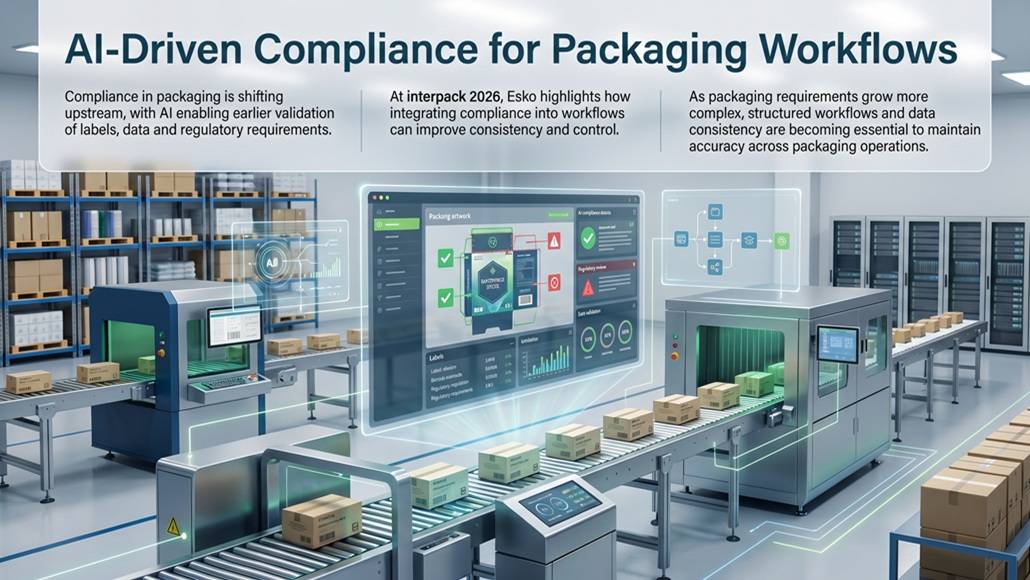

At interpack 2026, Esko is highlighting how AI-driven tools are beginning to reshape compliance in packaging workflows. As regulatory requirements expand across markets and product categories, the industry is moving away from manual validation toward more structured, intelligence-led systems that operate alongside design and production processes.
Discover more details and register here for a guided experience
This shift reflects a broader transition in packaging operations, where compliance is no longer treated as a final checkpoint but as a continuous requirement embedded within the lifecycle of packaging development.
Regulatory Complexity is Increasing Faster than Workflows can Adapt
Packaging today must respond to a growing number of regulatory frameworks, ranging from ingredient disclosures and safety labelling to recycling instructions and emerging digital identification standards. These requirements differ across regions and are frequently updated, making it increasingly difficult for companies to maintain consistency across packaging variants.
At the same time, product portfolios are expanding, with more SKUs, faster refresh cycles and greater localisation. This combination of regulatory pressure and operational complexity is exposing the limitations of traditional compliance approaches, which often rely on manual checks carried out late in the process.
The result is a higher risk of labelling errors, delayed approvals, and costly rework—particularly in environments where multiple stakeholders are involved across design, regulatory, and production teams.
AI is Reshaping Compliance from Manual Review to Assisted Validation
AI-assisted systems are beginning to address these challenges by supporting faster and more consistent validation of packaging artwork and labelling. Instead of relying entirely on manual inspection, these tools can analyse packaging data and highlight potential issues early in the workflow.
This includes identifying missing elements, flagging inconsistencies across variants, and supporting alignment with regulatory requirements. While not replacing human oversight, AI acts as a layer of assistance that improves both speed and accuracy in compliance processes.
The impact is particularly significant in high-volume environments, where even small inefficiencies can scale into substantial operational delays.
Embedding Compliance within the Packaging Workflow
A key structural change is the integration of compliance checks directly into packaging workflows. Rather than operating as a separate stage, compliance is increasingly embedded within systems used for design, artwork management, and production preparation.
This enables continuous validation as packaging evolves, ensuring that regulatory requirements remain aligned with design changes. It also improves coordination between teams, reducing the fragmentation that often leads to errors.
Platforms from Esko reflect this direction by combining artwork management with validation capabilities, allowing compliance to be handled alongside other packaging data within a unified environment.
Discover more details and register here for a guided experience
Data Consistency is Becoming Central to Compliance
As packaging becomes more data-driven, the ability to manage information consistently across formats and markets is becoming critical. Compliance is no longer just about checking labels—it is about ensuring that the underlying data is accurate, structured, and consistently applied.
This is particularly relevant as industry initiatives such as digital product passports and advanced traceability systems gain traction. These frameworks require packaging to carry reliable, machine-readable information that can be used across the supply chain.
Workflow platforms that centralise packaging data help address this need by ensuring that updates are reflected across all variants, reducing duplication and the risk of inconsistencies.
From Reactive Corrections to Proactive Control
The transition toward AI-driven compliance represents a broader shift in how packaging operations are managed. Instead of identifying issues after they occur, companies are increasingly looking to prevent them through earlier validation and better data control.
This reduces reliance on last-minute corrections, which are often more costly and disruptive. It also supports faster time-to-market, as packaging can move through development stages with fewer interruptions.
As regulatory demands continue to evolve, this proactive approach is likely to become a defining feature of packaging workflows.
Where this is Being Demonstrated
The Esko lead experience tour will take place at Messe Düsseldorf from 7 to 13 May 2026 in Hall 8b, Booth 8BC14 where AI-driven compliance capabilities within a broader packaging workflow are demonstrated.
Visitors can explore how compliance, data consistency, and workflow integration come together in practice at Messe Düsseldorf from 7 to 13 May 2026 in Hall 8b, Booth 8BC14.
Discover more details and register here for a guided experience