
















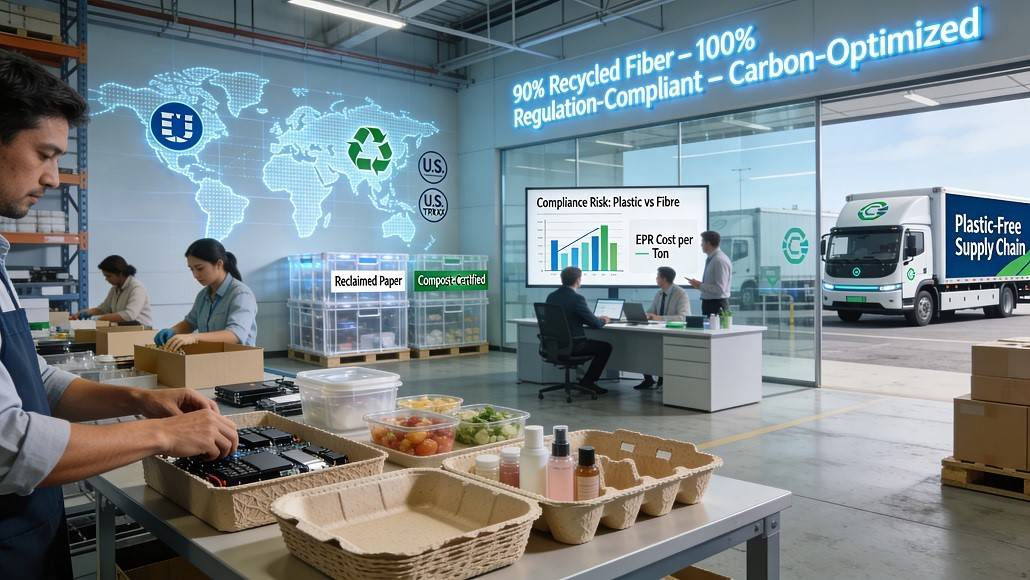

The global regulatory landscape for the packaging industry is currently undergoing its most significant transformation since the invention of plastic. For decades, the industry operated under a “voluntary” framework of sustainability, where green initiatives were often secondary to cost and convenience. However, a wave of stringent new legislation is now making the move toward sustainable materials a legal mandate. In this context, understanding the regulatory drivers shaping moulded fibre packaging adoption is no longer just a task for the compliance department it is a critical strategic requirement for the entire business. From the European Union’s Circular Economy Action Plan to India’s comprehensive plastic bans and the rising tide of Extended Producer Responsibility (EPR) laws in North America, the message is clear: the era of unregulated single-use plastic is coming to an end.
These regulations are not just about “banning” materials; they are about fundamentally restructuring the economy to favor circularity. Moulded fibre, as a renewable, recyclable, and compostable material, is the primary beneficiary of this legal shift. Because it aligns so perfectly with the goals of reducing ocean plastic and lowering carbon emissions, it is frequently cited as the gold standard for compliance in sectors ranging from foodservice to electronics. For companies that have historically relied on expanded polystyrene (EPS) or single-use polymers, the choice is becoming stark: adapt to the new regulatory reality by adopting fibre-based solutions, or face increasing taxes, fines, and the eventual total prohibition of their current packaging formats.
The Global Impact of Single-Use Plastic Bans
The most immediate regulatory driver is the proliferation of single-use plastic (SUP) bans. Over 170 countries have now pledged to significantly reduce their use of plastics, with many targeting specific items like cutlery, plates, and food containers. The European Union’s SUP Directive is perhaps the most well-known example, setting a high bar for the rest of the world. By prohibiting the sale of several high-volume plastic items and mandating significant reductions in others, the EU has created a massive, immediate demand for sustainable alternatives. Moulded fibre has stepped in to fill this gap, providing a high-performance replacement for plastic trays and containers that is fully compliant with these new standards.
This trend is not limited to Europe. In India, the Plastic Waste Management Amendment Rules have implemented a phased ban on numerous single-use items, driving a surge in the domestic moulded fibre market. In the United States, states like California and New York are leading the way with their own bans and “truth in labeling” laws that make it increasingly difficult for plastic producers to claim their products are recyclable. These legislative actions create a “domino effect,” where a ban in one major market forces global brands to standardize their packaging to avoid the complexity of managing different materials for different regions. This standardization is a powerful engine for moulded fibre packaging regulations adoption, as it provides the scale needed to lower production costs and improve availability worldwide.
Extended Producer Responsibility (EPR) and the Cost of Waste
Beyond direct bans, the rise of Extended Producer Responsibility (EPR) is fundamentally changing the economics of the packaging industry. EPR is a policy approach where producers are given significant responsibility financial and/or physical for the treatment or disposal of post-consumer products. In practice, this means that companies must pay “eco-fees” based on the amount and type of packaging they put onto the market. These fees are typically higher for materials that are difficult to recycle, such as multi-layer plastics and EPS, and significantly lower for materials with established recycling streams, such as paper and moulded fibre.
This economic pressure is a major driver of sustainable packaging laws compliance. By switching to moulded fibre, brands can drastically reduce their EPR liabilities, in some cases turning a significant cost into a competitive advantage. Furthermore, many EPR systems are moving toward “eco-modulation,” where fees are further reduced for products that incorporate recycled content or are certified as compostable. Moulded fibre, which is often made from 100% recycled paper and is naturally compostable, is perfectly positioned to take advantage of these financial incentives. This shift from “punishing” bad materials to “rewarding” good ones is a hallmark of modern eco packaging standards, and it is driving a rapid reallocation of capital toward fibre moulding infrastructure.
Carbon Taxes and the Price of Petroleum
The regulatory pressure on plastic is also coming from the perspective of climate change and carbon emissions. The production of plastic is an energy-intensive process that is almost entirely dependent on fossil fuels. As more countries implement carbon taxes or “cap-and-trade” systems, the cost of manufacturing and transporting plastic packaging is set to rise significantly. In contrast, moulded fibre has a much lower carbon footprint, especially when sourced from sustainable forests or recycled streams. Because it is bio-based, it also acts as a form of “carbon storage” throughout its useful life.
These carbon-related regulations are particularly impactful for global supply chains. The impending Carbon Border Adjustment Mechanism (CBAM) in the EU, for example, could see taxes applied to imported goods based on their carbon intensity, including their packaging. For a manufacturer in Asia shipping products to Europe, the move to moulded fibre is not just an environmental choice—it is a way to protect their margins against international carbon tariffs. This intersection of environmental law and international trade is a powerful motivator for the adoption of moulded fibre packaging regulations, as it creates a direct link between sustainability and global market access.
Truth in Labeling and the End of “Greenwashing”
A critical but often overlooked regulatory driver is the tightening of “truth in labeling” and anti-greenwashing laws. For years, the packaging industry has used vague terms like “biodegradable” or the “chasing arrows” recycling symbol on products that were effectively impossible to recycle in the real world. New regulations, such as the Green Claims Directive in the EU and the updated Green Guides from the FTC in the US, are setting much stricter standards for what can be claimed on a package. To claim a product is “recyclable,” producers must now prove that the infrastructure exists to actually recycle it in the majority of the markets where it is sold.
Moulded fibre excels under this increased scrutiny. Its status as a paper-based product means it is universally recognized as recyclable in existing curbside systems. Its compostability can be verified through established international standards like EN 13432. For brands, this regulatory clarity is a massive asset. It allows them to make strong, verifiable sustainability claims that resonate with consumers without the risk of legal challenges or reputational damage. In an era where “radical transparency” is becoming a legal requirement, the simple, honest nature of fibre is a major competitive advantage, providing a solid foundation for moulded fibre compliance in a skeptical marketplace.
Mandatory Recycled Content and the Supply Chain Push
Many new regulations are also mandating a minimum percentage of recycled content in all packaging. This is intended to stimulate the market for recycled materials and reduce the demand for virgin resources. Moulded fibre is inherently “recycled-ready,” as its manufacturing process is optimized for using post-consumer paper and cardboard. While some plastic producers are struggling to find high-quality, food-grade recycled resins, fibre manufacturers have a well-established and abundant supply of recycled feedstock.
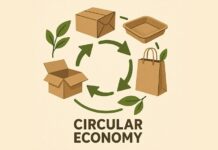
This regulatory push for recycled content is creating a “pull” effect throughout the supply chain. Brands are seeking out fibre moulding partners who can guarantee a high percentage of recycled material, often to meet their own public ESG (Environmental, Social, and Governance) commitments as well as legal requirements. This demand is driving innovation in “de-inking” and cleaning technologies, allowing lower-quality waste streams to be turned into high-quality packaging. This systemic integration of waste back into the production cycle is the very essence of the circular economy, and it is being driven by a sophisticated web of sustainable packaging laws that look beyond the point of sale to the entire material lifecycle.
Navigating the Patchwork of Global Compliance
For a multinational corporation, the biggest challenge is not just one regulation, but the “patchwork” of different laws across dozens of countries. This complexity is itself a driver for moulded fibre adoption. Because fibre is one of the few materials that is viewed positively by almost every environmental regulator in the world, it provides a “path of least resistance” for global compliance. Instead of managing fifty different types of plastic to meet fifty different local laws, a company can adopt a single, globally-compliant fibre solution.
This standardization leads to massive operational efficiencies. It simplifies the design process, reduces inventory complexity, and ensures that products can move across borders without being held up by local environmental bans. In this sense, moulded fibre is becoming the “universal language” of sustainable packaging. As more regions adopt eco packaging standards that mirror the EU or California models, the advantage of having a globally-accepted, fibre-based solution will only grow. For the strategic leader, the goal is not just to comply with the laws of today, but to anticipate the regulatory drivers shaping moulded fibre packaging adoption for the next decade.