
















The Automated Advantage: Robotics in Beverage Packaging Operations
The beverage industry is currently witnessing a technological revolution that is redefining the limits of production efficiency and workplace safety. Robotics in beverage packaging operations has moved from being a luxury for high-volume plants to an essential requirement for any facility looking to thrive in a globalized market. This shift is driven by a combination of factors, including the need for extreme precision, the rise of SKU complexity, and the ongoing challenge of labor availability. By integrating advanced robotics into the packaging line, beverage manufacturers are achieving a level of consistency and agility that was previously unattainable, ensuring that their products are handled with care and delivered with speed.
Precision Handling and the Rise of High-Speed Delta Robots
At the front end of the packaging process, robotics in beverage packaging operations is most visible in the form of high-speed “delta” or “spider” robots. These machines, often equipped with advanced vision systems, are designed to pick up individual bottles or cans from a moving conveyor and place them into carriers or cases with incredible speed and accuracy. Unlike mechanical systems that are fixed in their movements, these robots can adjust their grip and position based on real-time data, allowing them to handle a variety of container shapes and sizes on the same line.
This precision is particularly critical for lightweight and fragile packaging. As the industry moves toward thinner glass and plastic, the “soft touch” of a robot is essential for preventing breakage and ensuring that the product reaches the consumer in perfect condition. Furthermore, the use of vision-guided robotics in beverage packaging operations allows for integrated quality control. A robot can detect if a label is misaligned or if a cap is missing and instantly divert the defective unit without slowing down the rest of the line. This proactive approach to quality is a hallmark of the modern automated plant.
Transforming the Heavy Lifting: Automated Palletizing
As we move toward the end of the production line, the role of robotics in beverage packaging operations becomes even more significant. Palletizing the process of stacking cases or packs onto pallets for shipping has traditionally been a physically demanding and repetitive task for human workers. Today, robotic palletizers are taking over this role, handling thousands of cases per hour with a level of consistency that a human cannot match. These robots use specialized grippers and sophisticated software to build stable, optimized loads that maximize the use of space in trucks and warehouses.
The transition to automated palletizing not only increases throughput but also significantly improves workplace safety. By removing humans from the most ergonomically challenging tasks, beverage plants are reducing the risk of musculoskeletal injuries and long-term health issues. This allows the workforce to be redeployed to higher-value roles, such as machine maintenance, data analysis, and quality oversight. Robotics in beverage packaging operations is thus a tool for human empowerment, creating a safer and more rewarding work environment where technology handles the strain and humans handle the strategy.
The Collaborative Shift: Cobots in the Beverage Plant
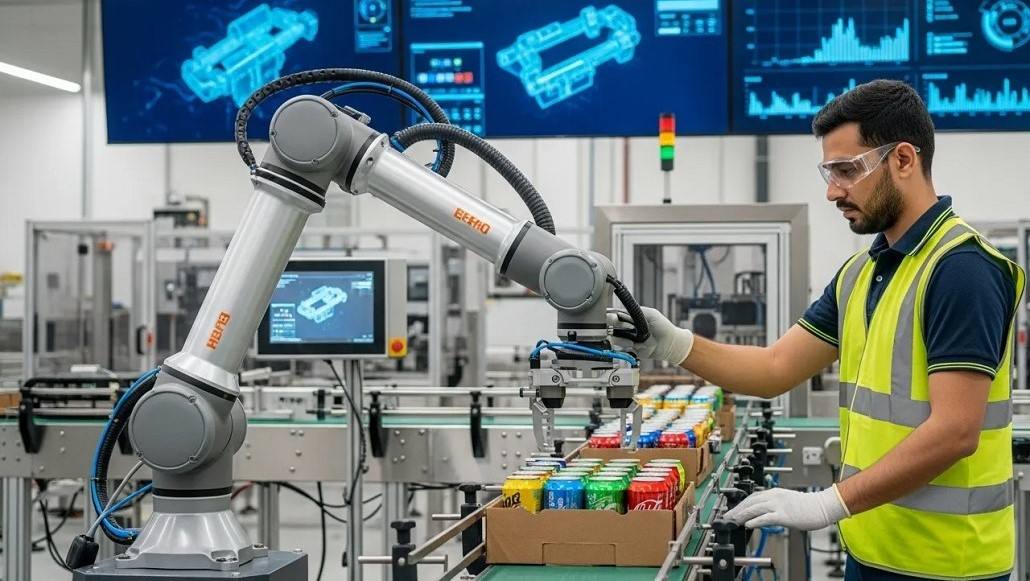
One of the most exciting developments in robotics in beverage packaging operations is the rise of Collaborative Robots, or “Cobots.” Unlike traditional industrial robots that must be isolated in safety cages, cobots are designed to work safely alongside human operators. They are equipped with sensors that detect human presence and automatically stop or slow down if they come into contact with a person. This allows for a more flexible and integrated approach to automation, where humans and machines collaborate on complex tasks.
In a beverage facility, a cobot might be used for “secondary packaging” tasks, such as applying specialized promotional stickers or building variety packs. These tasks often require a level of flexibility and judgment that is difficult for traditional robots to achieve. By combining the tireless consistency of the cobot with the problem-solving abilities of the human operator, beverage companies can handle small-batch runs and complex packaging configurations with ease. This hybrid model of robotics in beverage packaging operations is the key to managing the “mass customization” trend that is currently dominating the consumer market.
Flexibility in a Market of Fragmented SKUs
The beverage market is more diverse than ever before, with a constant stream of new flavors, sizes, and packaging formats being launched every year. This “SKU proliferation” is a nightmare for traditional, rigid packaging lines. However, robotics in beverage packaging operations provides the flexibility needed to manage this complexity. A robotic system can be reprogrammed or fitted with a new “End-of-Arm Tool” (EOAT) in a matter of minutes, allowing it to switch from handling 12-ounce cans to 2-liter bottles with minimal downtime.
This agility is a vital competitive advantage. Brands that can pivot quickly to meet new consumer trends are more likely to capture market share and avoid the costs of obsolete production equipment. Robotics in beverage packaging operations turns the packaging line into a dynamic asset that can grow and evolve with the brand. Whether it is a seasonal promotion or a completely new product category, an automated facility is always ready to adapt, ensuring that the brand remains at the cutting edge of consumer demand.
The Role of Digital Twins and Simulation
The successful implementation of robotics in beverage packaging operations is being supported by “Digital Twin” technology. Before a single robot is installed on the floor, engineers can create a virtual replica of the entire packaging line in a digital environment. This allows them to simulate different scenarios, identify potential bottlenecks, and optimize the robotic movements for maximum efficiency. This “virtual commissioning” reduces the risk of expensive errors and ensures that the system works perfectly from day one.
Furthermore, once the robots are operational, the digital twin can be used for real-time monitoring and predictive maintenance. By comparing the physical robot’s performance with its digital counterpart, technicians can identify signs of wear or misalignment before they lead to a failure. This data-driven approach to robotics in beverage packaging operations ensures the highest levels of uptime and maximizes the return on investment for the manufacturer. It is the marriage of physical mechanics and digital intelligence that characterizes the modern “Smart Factory.”
The Economic Reality of Robotic Automation
While the initial investment in robotics in beverage packaging operations can be significant, the long-term economic benefits are overwhelming. The reduction in labor costs, the elimination of product waste, and the increase in production speed all contribute to a rapid payback period. Furthermore, as the technology matures, the cost of robots and sensors is falling, making automation accessible to mid-sized and even craft beverage producers. The “democratization” of robotics is allowing a wider range of players to compete on the global stage.
Beyond direct costs, robotics also provides a level of operational resilience. In a world of fluctuating labor markets and global disruptions, an automated plant is a stable and predictable asset. It ensures that production can continue around the clock, regardless of external circumstances. This reliability is essential for maintaining supply chain commitments and building trust with retailers and consumers. Robotics in beverage packaging operations is thus not just a technical upgrade; it is a strategic insurance policy for the future of the business.
Future Trends: AI and Autonomous Mobility
Looking toward the next decade, we can expect robotics in beverage packaging operations to become even more intelligent and autonomous. Artificial Intelligence (AI) will enable robots to “learn” from their environment, adjusting their behavior to optimize for speed and energy use without human intervention. We will also see the rise of Autonomous Mobile Robots (AMRs) that can move pallets and supplies around the facility without the need for fixed conveyors or tracks. This will create a truly “liquid” factory layout that can be reconfigured on the fly to meet the changing needs of the market.
In conclusion, the integration of robotics in beverage packaging operations is a transformative movement that is enhancing every aspect of the production process. By combining precision, safety, and flexibility, robotics is empowering beverage brands to meet the challenges of a complex and fast-moving world. As the technology continues to evolve, the automated packaging line will become the heart of the modern beverage industry, driving the growth and sustainability of the brands we love. The future of beverage packaging is here, and it is robotic, responsive, and remarkably efficient.

