















The unprecedented surge in global e-commerce has fundamentally changed the requirements for protective packaging. In a world where a product may be handled twenty or more times between the warehouse and the doorstep, the traditional focus on “shelf presence” has been replaced by a focus on “transit resilience.” Historically, this resilience was provided by a combination of oversized cardboard boxes and a vast amount of plastic void-fill, such as air pillows, bubble wrap, and polystyrene “peanuts.” However, this model is no longer sustainable neither environmentally nor economically. As brands seek to reduce their carbon footprint and comply with increasing regulations, scaling moulded fibre ecommerce packaging has emerged as the most effective way to provide high-performance protection while embracing circular economy principles.
Moulded fibre is uniquely suited for the e-commerce environment because it is inherently structural. Unlike loose-fill materials that can shift during transit, a custom-designed fibre insert holds the product in a fixed position, creating a “suspension” effect that absorbs shocks and vibrations. This is particularly critical for fragile items like electronics, glassware, and cosmetics. By moving away from “one-size-fits-all” boxes toward “right-sized” fibre solutions, e-commerce giants and boutique brands alike are finding that they can significantly reduce damage rates while simultaneously lowering their shipping costs and material waste. This transition represents a shift from a “disposable” mindset to a “protective” one, where the packaging is as carefully engineered as the product itself.
Engineering the “Right-Sized” Shipping Experience
One of the primary drivers of waste in e-commerce is the shipping of air. We have all experienced the frustration of receiving a small item in a massive box filled with plastic pillows. This “over-packaging” is not only an environmental disaster but also a logistical nightmare, as it wastes space in delivery vehicles and increases shipping costs based on dimensional weight. Scaling moulded fibre ecommerce packaging allows for true “right-sizing.” Manufacturers can create bespoke fibre inserts that fit the product perfectly and integrate seamlessly with a smaller outer shipping carton. This reduces the overall volume of the package, leading to a direct reduction in the carbon emissions associated with every mile of the journey.
The engineering behind these inserts is increasingly sophisticated. Designers use 3D CAD modeling and drop-test simulations to ensure that the fibre structures can withstand specific impact forces. By varying the density of the fibre and the geometry of the ribs and arches, they can create a cushioning system that is tailored to the weight and fragility of the product. This precision-engineered approach means that moulded fibre protection can now compete with the most advanced plastic foams in terms of performance, providing a “cradle-to-cradle” solution that protects both the product and the planet. This focus on material efficiency is the cornerstone of modern ecommerce packaging solutions.
The Logistical Advantages of Nestable Design
In the world of high-volume logistics, the storage and handling of packaging material itself is a major operational challenge. Traditional protective materials like expanded polystyrene (EPS) or pre-inflated air pillows are incredibly bulky, taking up massive amounts of warehouse space before they are even used. Moulded fibre, however, is designed for “nestability.” Because the inserts are formed in a mould, they can be stacked tightly together, often taking up as little as 10% of the space required for their plastic equivalents. This allows e-commerce fulfillment centers to store ten times the amount of protective packaging in the same footprint, significantly improving operational efficiency and reducing the frequency of supplier deliveries.
This nestability also translates into shipping efficiencies. Because moulded fibre ecommerce packaging is lightweight and space-efficient, it contributes to a lower “landed cost” for the brand. In an industry where margins are often thin, these incremental savings in warehouse space and shipping volume can have a significant impact on the bottom line. Furthermore, the move toward localized production of moulded fibre means that the “packaging for the packaging” also has a lower carbon footprint. By sourcing fibre inserts from regional moulding facilities that use local recycled paper streams, brands can create a truly sustainable transit packaging network that is resilient to global supply chain disruptions.
Enhancing the Consumer “Unboxing” Experience
The customer’s journey does not end when they click “buy”; it ends when they open the package. In the age of social media, the “unboxing experience” has become a critical part of brand marketing. Receiving a box full of non-recyclable plastic waste creates a negative first impression and can lead to “packaging guilt.” On the other hand, opening a neatly organized box with custom-moulded fibre inserts conveys a sense of quality, care, and environmental stewardship. This positive emotional response is a powerful tool for building brand loyalty and encouraging repeat purchases. Moulded fibre has a warm, organic feel that aligns perfectly with the values of the modern “conscious consumer.”
Furthermore, moulded fibre simplifies the disposal process for the customer. Instead of having to separate plastic films from cardboard or deal with static-charged polystyrene peanuts, the consumer can simply place the entire packaging—box and insert—into their curbside paper recycling bin. This “frictionless” sustainability is highly valued by consumers who want to do the right thing but don’t want the hassle of complex waste sorting. By making it easy for the customer to be environmentally responsible, brands can turn a logistical necessity into a brand-strengthening asset. This focus on the “human” side of logistics is what sets plastic free ecommerce apart from traditional shipping methods.
Durability and Resilience in the Global Supply Chain
A common misconception is that fibre-based packaging is too fragile for the rigors of cross-border shipping. However, modern scaling moulded fibre ecommerce packaging techniques have produced materials that are remarkably tough. High-pressure thermoforming creates a dense fibre matrix that is resistant to crushing and tearing. Furthermore, the integration of bio-based moisture barriers ensures that the packaging maintains its structural integrity even in humid warehouse environments or during rainy deliveries. This durability is essential for global brands that need their products to arrive in pristine condition, regardless of whether they are being shipped across the city or across the ocean.
This resilience is also a key factor in the growing market for returned goods. E-commerce has a high rate of returns, and the packaging must often survive the return journey as well. Because moulded fibre inserts are durable and re-usable, they are ideal for this “reverse logistics” cycle. The customer can simply place the item back into its original fibre cradle, ensuring it is protected for the trip back to the warehouse. This reduces the likelihood of damage during the return process, protecting the brand’s assets and further reducing the environmental impact of the product’s lifecycle. The ability to survive multiple “trips” is a hallmark of high-quality fibre cushioning.
The Role of Material Circularity in Scaling
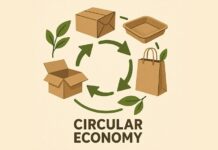
For e-commerce packaging to be truly sustainable, it must be part of a circular system. Moulded fibre is the gold standard in this regard. Most e-commerce inserts are made from 100% recycled paper and cardboard, which are themselves the most widely recycled materials in the world. This means that the “waste” from one e-commerce delivery becomes the “raw material” for the next. This closed-loop system reduces the need for virgin timber and prevents millions of tons of material from entering landfills. As more brands shift toward fibre, the demand for recycled feedstock increases, which in turn drives further investment in recycling infrastructure a virtuous cycle that supports the global circular economy.
Scaling this circularity requires a collaborative approach between brands, packaging manufacturers, and waste management providers. Brands must commit to using monomaterial designs that are easy to recycle. Manufacturers must continue to innovate in “green” chemistry to ensure that additives and coatings do not interfere with the pulping process. And waste management systems must be optimized to handle the increasing volume of fibre-based products. By working together, these stakeholders can ensure that scaling moulded fibre ecommerce packaging is not just a trend, but a permanent shift toward a more responsible and regenerative way of doing business on a global scale.