



















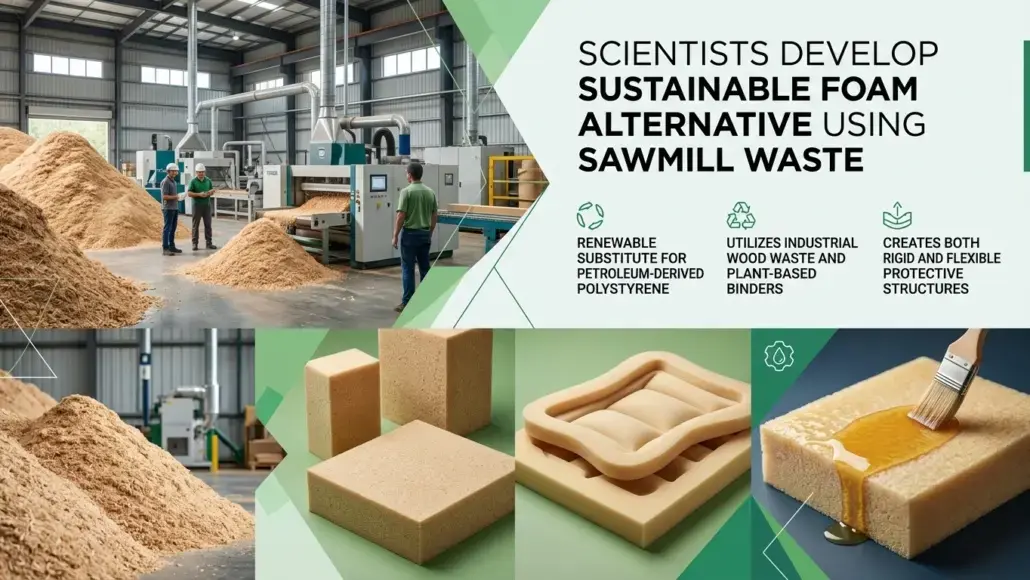
A research team has successfully developed a renewable substitute for petroleum-derived polystyrene by repurposing industrial wood waste and plant-derived binders. As detailed in a study published in ACS Applied Polymer Materials on June 23, 2026, the construction of this sawdust-based foam utilizes scraps collected from sawmill floors, combined with cellulose binders and a protective beeswax layer to create both rigid and flexible structures. The prototype aims to mitigate the environmental footprint associated with traditional fossil-fuel-based packing peanuts and shipping inserts. Todd Emrick, the study’s corresponding author, highlighted the innovative approach to material sourcing, stating, “It can be exciting to use waste products as a starting point for materials fabrication, rather than a chemical catalog.”
The development process, spearheaded by first author Isha Farook, involved gathering unprocessed mill waste and fine wood powder from local facilities. These raw materials were mixed with specialized cellulose binders specifically carbomethyl cellulose for firmer applications and hydroxypropyl cellulose for more pliable requirements and integrated with a citric acid cross-linker. The resulting mixtures were cast into molds, frozen, and subjected to a freeze-drying process to eliminate moisture before a final heat-drying stage activated the internal networks. To enhance durability, several samples were finished with a beeswax coating, which improved moisture resistance in humid environments without compromising the material’s structural integrity. Regarding the longevity of the material, Emrick noted, “We haven’t done a long-term stability study yet,” says Emrick. “But in the weeks-to-months time frame, the liquid stability appears to be excellent, which is a useful feature during shipping in case of leakage or spills, or simply for production and storage under different environmental conditions.”
Performance evaluations demonstrate that this sawdust-based foam provides superior shock absorption compared to conventional plastic alternatives. In experiments utilizing a 10-pound (4.5-kilogram) weight, the biobased material dispersed kinetic energy so effectively that the weight rebounded 21% less distance than it did on polystyrene of the same thickness. Furthermore, unlike its fossil-fuel counterparts, the sawdust prototypes maintained their form when exposed to acetone while effectively managing the absorption and release of moisture. Emrick elaborated on the potential market reach, saying, “The initial driver for this work was in packaging foams, which are used in abundance to protect materials in transit,” and added, “Because our initial assessment of mechanical properties appears promising, such sawdust-based foams may be examined further in all sorts of applications including construction materials and high-end packaging for consumer electronics, where lightweight and protective packaging is essential.”

