
























Fresh meat and seafood lose quality faster than almost any other chilled category, and packaging carries much of the responsibility for slowing that decline. Modified atmosphere packaging has become the dominant retail format for these products across Europe and North America precisely because gas composition can be tuned to the biology of each species. The right mixture preserves the red bloom that shoppers expect on fresh beef, suppresses the Gram-negative bacteria that spoil white fish, and extends chilled distribution windows by several days. Getting those mixtures right, and matching them to the correct barrier structure and filling equipment, separates successful protein brands from those fighting quality complaints week after week.
Why Gas Composition Decides Shelf Life in Protein Products
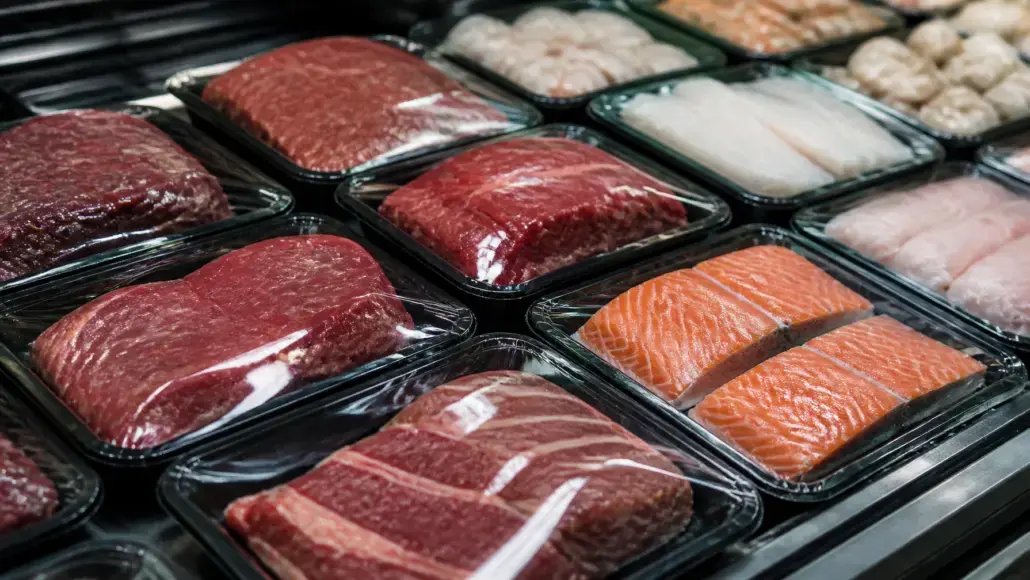
Color drives purchase decisions in the meat aisle, and oxygen sits at the center of that chemistry. Myoglobin, the pigment in red meat, binds oxygen to form bright oxymyoglobin, the cherry-red bloom consumers read as freshness. High-oxygen atmospheres, typically above 70 percent, maintain that bloom for the full retail life of the pack. Cured meats follow the opposite logic: their stable pink nitrosylmyoglobin bleaches under oxygen, so they require atmospheres with the lowest residual oxygen the process can achieve.
Seafood spoilage follows a different pattern. The Gram-negative bacteria that dominate spoilage on marine fish respond strongly to carbon dioxide, which dissolves into the surface moisture of the fillet and suppresses their growth. Lean white fish tolerate moderate carbon dioxide levels well, while fatty species such as salmon and mackerel are packed with little or no added oxygen because their lipids oxidize quickly. Poultry sits between the extremes, with carbon dioxide and nitrogen mixes that control odor development without the high oxygen that would accelerate lipid oxidation.
Temperature remains the overriding variable. Modified atmosphere packaging slows spoilage but cannot compensate for breaks in the cold chain, and every shelf-life claim assumes disciplined temperature control from the packing floor to the display cabinet. Packers who treat the gas mixture as a substitute for refrigeration rather than a complement consistently see shortened real-world performance.
Species biology sets the boundaries of every mixture decision. Beef tolerates and indeed requires high oxygen, pork sits lower, and lamb follows the beef pattern. Fish differ internally: cod and haddock, historically stored on ice, respond well to carbon dioxide enrichment, while oily species such as herring bring their own oxidation clock into the pack. Retailers encode these preferences in procurement specifications, and packers supplying multiple categories often run separate gas recipes for each product family on the same line.
Matching Gas Mixes and Barrier Structures to the Product
Standard commercial mixtures reflect decades of category-specific refinement. Red meat retail packs commonly use roughly 70 to 80 percent oxygen with 20 to 30 percent carbon dioxide to balance color and microbial control. Poultry packs typically run carbon dioxide and nitrogen in varying proportions, while bulk master bags may use near-pure carbon dioxide, relying on product absorption to create the final headspace. White fish follows the poultry pattern, and fatty fish use carbon dioxide with nitrogen as an inert balance. Shrimp and other crustaceans present a special case because carbon dioxide dissolves into their tissue, which can collapse the pack if the mixture is not corrected.
The barrier structure must hold that mixture for the product’s entire shelf life. Multilayer films with ethylene vinyl alcohol cores or high-barrier coatings limit gas exchange, and the required transmission rates differ between a five-day retail pack and a 21-day export pack. Headspace volume matters as much as film selection: red meat packs need headspace equal to or larger than the product volume so sufficient oxygen remains to sustain the bloom, while near-pure carbon dioxide systems depend on careful headspace calculation to avoid panel collapse as the gas dissolves.
Residual oxygen inside the finished pack deserves equal attention. Trace air left after flushing defeats the purpose of the design, so effective lines combine vacuum or repeated gas exchange cycles with measurement of oxygen residuals at the point of sealing.
Gas mixing equipment itself has matured into a precision discipline. Modern mixers blend oxygen, carbon dioxide and nitrogen from bulk supplies under continuous monitoring, with calibration checks scheduled against certified gas standards. Errors in mixing propagate directly into shelf-life failures, so packing plants treat gas analysis at the point of sealing as a critical control point, sampling packs on a defined frequency and recording results against specification.

Packaging Formats and Line Equipment Options
Equipment choice shapes what the gas mixture can achieve, and converters now support several established formats across the protein industry:
- Thermoforming machines with gas flushing produce bottom-web trays tailored to each cut, the standard route for bacon, sliced meats and portioned fish in mid-to-high volume plants.
- Traysealers running pre-made trays offer faster changeovers and support premium lidding options, making them common in retail case-ready operations.
- Horizontal form-fill-seal systems run flexible pouches with gas injection, a format favored for poultry portions and value-added marinated products.
- Skin packaging draws the film tight over the product under vacuum before sealing, delivering extended shelf life with a presentation increasingly popular for premium beef and fish.
- Master bags and bulk packs use high carbon dioxide atmospheres for primals and blocks destined for further processing, where appearance at the pack level matters less than microbial control.
Each format carries different gas consumption, film costs and speed characteristics. Case-ready retail programs tend toward traysealing for presentation flexibility, while export and industrial flows lean on skin and bulk formats where material efficiency and shelf life dominate the decision.
Color Management, Safety Controls and Validation
Color management extends beyond the gas ratio. Film oxygen transmission, headspace volume, lighting in the display cabinet and the cut’s own myoglobin content all influence how long the bloom holds. Retailers increasingly specify color stability measurements, and packers validate gas mixtures against their own product rather than adopting category defaults blindly.
Safety validation carries particular weight in low-oxygen systems. Anaerobic conditions, especially under refrigerated storage, raise the theoretical risk from psychrotrophic Clostridium botulinum, and regulators expect packers to demonstrate that shelf-life claims account for that risk. In practice, disciplined temperature control, carbon dioxide suppression and validated shelf-life studies form the accepted response, but the analysis must exist on file. High-oxygen red meat systems avoid that specific concern yet face oxidation-driven flavor limits, so validation covers sensory performance as well.
Routine process controls anchor the whole system: leak testing of sealed packs, verification of gas mixer calibration, residual oxygen measurement, and seal integrity audits. A modified atmosphere program is only as strong as its weakest seal, and defect rates on lidding seals translate directly into returns at the retail level.
Case-ready programs have sharpened the validation requirements. Centralized cutting plants ship retail packs to stores hundreds of kilometers away, and the gas mixture must perform through that journey without store-level repacking. Retailer audits now examine gas mixer logs, residual oxygen records and seal integrity data alongside microbiological results, and packers maintain rolling validation files updated at every film or tray change.
Cost, Waste Reduction and Sustainability Trade-offs
High-barrier structures and gas consumption make modified atmosphere packaging more expensive per pack than airflow or vacuum alternatives. The offset comes through waste reduction: longer retail life means fewer markdowns and disposal losses, and case-ready programs cut trim loss at the store. For most protein brands the equation favors the atmosphere system once volumes scale, which explains its near-universal adoption in European retail.
Sustainability pressure is reshaping the equipment mix. High-barrier multilayer films and PVC-based trays complicate recycling, and brands face growing requirements for mono-material and recyclable structures. Film producers have responded with polyolefin-based high-barrier grades, recyclable tray substrates and reduced film gauges, while skin packaging gains favor partly because it can deliver extended shelf life with less material than deep high-oxygen trays. The trend favors systems that extend shelf life and simplify end-of-life handling at the same time.
Economics also shift with format. Skin packs use less gas and less film per pack than deep high-oxygen trays, and their adoption in premium beef shows how presentation, shelf life and material efficiency can align. Bulk and industrial flows capture value differently: near-pure carbon dioxide master bags extend the storage of primals and blocks without retail presentation costs. Each format serves a different point on the cost-quality curve, and successful programs match format choice to channel requirements rather than defaulting to one design across a portfolio.
Combination technologies are widening the toolkit further. In parallel with gas flushing, oxygen scavenging films for advanced food preservation are increasingly laminated into lidding and closure structures, capturing the residual oxygen that even a well-executed flush cannot remove. For products that need both color protection and lipid stability, such paired systems are becoming the reference design for the next generation of chilled protein packaging.