
























Bakery and snack products live or die by their moisture content. A bread loaf stales as it dries, a cracker loses its snap as it gains moisture, and a filled pastry spoils when water migrates from the filling into the crust. Moisture regulating packaging addresses all three failure modes by managing humidity inside the pack instead of merely sealing it. The category has expanded from simple desiccant sachets into engineered films, pads and label systems that absorb, buffer or redirect water vapor, and bakers and snack manufacturers now select moisture control formats as deliberately as they select barrier films.
Water Activity: The Variable That Decides Bakery Shelf Life
Food scientists measure spoilage risk through water activity, the unbound water available for microbial growth and texture change. Soft breads sit in the range where mold flourishes, while crackers and crisps occupy the dry zone where microbes cannot grow but texture loss happens quickly. Neither extreme is stable on its own, and the difference between a product that reaches its best-before date in good condition and one that disappoints customers is usually a moisture balance problem rather than a formulation failure.
Moisture migration inside multi-component products compounds the challenge. In filled bakery goods, water moves from the moist filling toward the drier crust until the two reach equilibrium, leaving a soggy shell and a dry center. Packaging that simply traps the product cannot stop this migration, but structures that intercept the migrating vapor and hold it away from sensitive components can slow the outcome substantially.
Condensation creates a third failure mode that cold-chain exposure introduces. When chilled bakery products leave refrigerated storage and reach ambient shelves or consumers’ homes, moisture condenses on the inner packaging wall and on the product surface, forming the wet patches that accelerate mold growth. Effective moisture regulating packaging anticipates these temperature swings rather than assuming a stable ambient journey.
Staling adds a chemical dimension beyond simple moisture loss. Starch retrogradation rearranges amylopectin molecules as bread cools and ages, firming the crumb even where total water content stays constant, and moisture availability influences how quickly that recrystallization proceeds. Packaging cannot stop retrogradation, but by slowing moisture migration it delays the texture perception consumers associate with stale product, which is why buffering systems target the crumb’s local humidity rather than the pack average.
Humidity Buffer Films, Sachets and Absorber Chemistries
The chemistry of moisture control divides into three functional classes. Absorbers pull water vapor out of the headspace and lock it away: silica gel and calcium chloride desiccants represent the classic approach, while cellulose-based pads and humectant gels handle larger moisture loads in wet products. Emitters release controlled moisture to keep products from drying out, a function increasingly relevant to breads and tortillas where flexibility matters. Two-way buffers do both, holding headspace humidity near a set point through temperature and time, which suits products that must neither gain nor lose moisture.
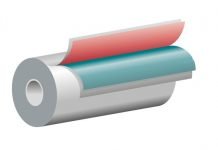
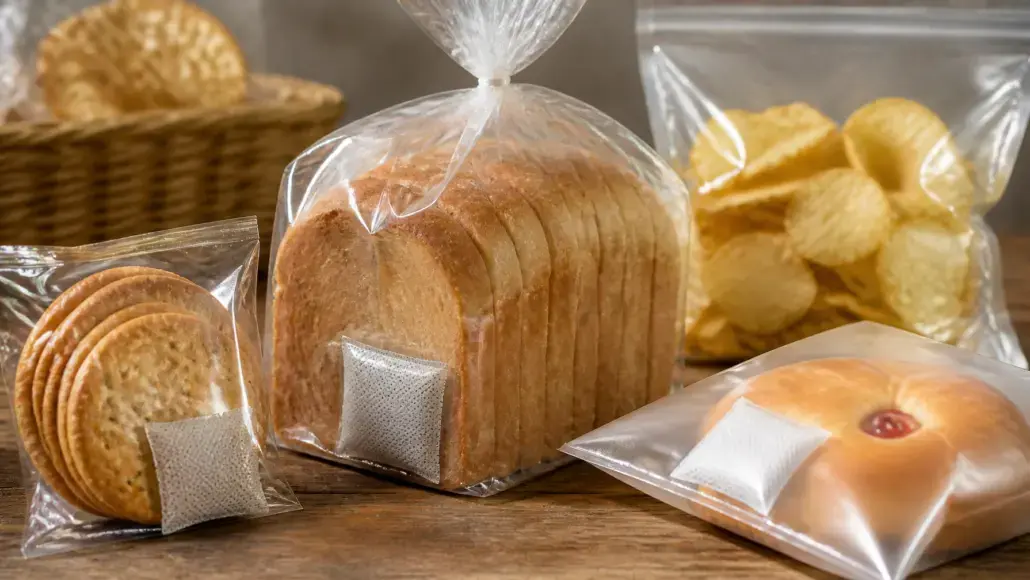
Formats have multiplied alongside the chemistry. Sachets and canisters remain the workhorse for dry mixes and snacks, pads and interceptor sheets sit under fresh pasta, pizza dough and cut fruit, and label-based absorbers stick onto the inner wall of cartons. The most significant recent development is the arrival of films with the moisture function built directly into the structure: humectant layers coextruded into the inner web of a bag, or coatings applied to the sealant layer, remove the loose component entirely and move the function into the packaging material itself. These film-integrated systems align with the same direction of travel seen across the wider functional packaging field, where loose sachets give way to engineered layers.
Sizing is the core engineering task. An undersized absorber saturates before the shelf life ends, and an oversized one can over-dry delicate products. Manufacturers calculate the required capacity from product weight, initial and target water activity, expected temperature history and pack permeability, then validate against real distribution trials rather than laboratory constants alone.
Testing protocols have risen to meet these conditions. Standard methods for water activity measurement, moisture vapor transmission and condensation cycling give packers and suppliers a shared technical language, and independent laboratories now offer distribution simulation that combines temperature cycling with humidity logging. Suppliers increasingly support customers with sizing software that ingests product data, route profiles and pack permeability, turning what was once a trial-and-error exercise into a quantified design step.

Format Selection Across Bakery and Snack Categories
Category needs diverge sharply, and format choice follows the product’s dominant failure mode:
- Crisp snacks and crackers rely on desiccant sachets or absorber films inside high-barrier bags, where the goal is holding moisture gain below the threshold that softens the texture.
- Soft breads and tortillas use humidity-buffering films or controlled emitters that slow moisture loss and keep the crumb flexible for longer retail windows.
- Fresh pasta, pizza bases and filled goods deploy absorber pads beneath the product to intercept weeping moisture and suppress the surface wetness that drives mold.
- Composite packs pair interceptor sheets with vented films that release excess vapor during temperature swings, a combination increasingly common for chilled bakery lines.
- Biscuit multipacks and cereal liners use thin absorber labels integrated into carton walls, adding moisture control without changing the primary bag specification.
Selection logic within these categories follows the product’s water activity gap. Products whose internal moisture differs sharply from their storage environment, such as crisp snacks in humid climates, need absorber capacity sized against atmospheric ingress through the film. Products that lose moisture internally, such as crusty breads, need buffering or emission instead. Suppliers typically begin a project with a moisture audit, measuring product weight change across storage conditions, before recommending a format, an approach that avoids the common mistake of applying absorbers where buffering is actually required.
Each format trades capacity against convenience and cost, and packers frequently combine two formats when a product faces both drying and condensation risks across its distribution route.
Performance Through Distribution and Cold-Chain Handoffs
Laboratory shelf-life studies rarely reproduce the stresses of real distribution, and moisture control systems face their sternest tests in transit. Palletized bread moving through summer heat, chilled pastry handed over between refrigerated trucks and ambient store shelves, and export snacks crossing humid climates all impose moisture loads that static laboratory conditions miss. Manufacturers therefore validate absorber capacities against simulated temperature cycling, and leading suppliers now publish performance curves tied to realistic distribution profiles rather than idealized constants.
The measurable outcomes justify the investment in most premium segments. Bakery producers adopting buffering films report shelf-life extensions of several days for artisan-style breads, allowing wider distribution without artificial preservatives. Snack manufacturers using absorber-integrated liners hold crispness through longer export routes that previously forced shorter best-before dates. Chilled dough producers credit interceptor pads with eliminating the soggy-surface complaints that once dominated their customer service logs. Such gains depend on correct sizing and disciplined application, and suppliers generally position published results as representative cases rather than guarantees for every formulation.
Sustainability, Cost and Clean-Label Pressure
Moisture control intersects with two currents reshaping the industry. Clean-label reformulation removes synthetic preservatives such as calcium propionate, which shifts more of the shelf-life burden onto packaging. In that context, moisture regulating packaging becomes an enabling technology: brands can extend natural shelf life without chemical additives by engineering the pack’s internal humidity instead. The economic logic works in premium and mainstream segments alike, because preservative removal and packaging upgrades offset one another in the cost structure.
Sustainability scrutiny falls hardest on single-use sachets and pads. Composite absorber materials raise recycling questions, and consumers dislike loose components for convenience and safety reasons. Suppliers have responded with paper-based pads compatible with organic waste streams, absorber films that avoid added components entirely, and mono-material bag structures with integrated humectant layers. The direction mirrors the wider packaging market: fewer loose pieces, more functionality inside recyclable structures.
Cost arithmetic favors film-integrated and label formats over sachets in most high-volume lines, since eliminating loose-component insertion speeds up packing and reduces foreign-object complaints. For bakery and snack producers weighing the investment, the practical benchmark is simple: compare the price of the moisture system against the cost of returns, markdowns and shortened distribution radii, then size the format to the product’s real moisture load.
Regulatory and consumer trends keep pushing in the same direction. Preservative reduction remains a stated objective across bakery retailers, and any technology that preserves quality without additives earns attention from procurement teams. Moisture control sits at the practical center of that push, because texture complaints, not microbial failures, drive most quality rejections in the category. Producers who treat the pack’s internal humidity as an engineered variable, specified and measured like any other formulation parameter, gain shelf life that marketing teams can defend with data. Converters supplying these systems increasingly operate across adjacent food categories as well, and the same functional-layer expertise now appears in active packaging materials for extending dairy product freshness, reflecting a broader consolidation of moisture, gas and antimicrobial functions into standardized film platforms.