
























Dairy presents packaging engineers with a demanding combination: products with short natural shelf lives, spoilage mechanisms that vary by format, and quality attributes that shoppers judge at a glance. Pasteurized milk spoils through psychrotrophic bacteria, cheese molds on its surface, yogurt suffers from yeast contamination, and butter and hard cheeses lose quality through fat oxidation. Active packaging materials respond to these mechanisms directly by adding functions such as antimicrobial release, oxygen absorption and light protection into the pack itself. Adoption has grown steadily in cheese and fresh dairy segments, supported by natural antimicrobial chemistries and improved film manufacturing, and the technology now shapes how premium dairy brands defend shelf life without additional processing.
Why Dairy Spoilage Resists Conventional Packaging
Standard dairy packaging performs two jobs well: containing the product and excluding contamination after filling. It does nothing about the spoilage agents already present. Pasteurized milk carries surviving psychrotrophic spores that multiply under refrigeration, and their enzymes survive pasteurization to cause off-flavors during storage. Cheese surfaces, particularly mold-ripened and soft varieties, provide ideal growth conditions for unwanted molds once the pack is opened or compromised. Yogurt and fermented products face yeast and mold contamination from filling lines, and their acidity does not prevent surface spoilage.
Oxidation and light exposure attack dairy quality through a separate route. Riboflavin in milk acts as a photosensitizer, and exposure to retail lighting generates the light-induced off-flavors that consumers detect within hours. Butter and hard cheeses oxidize their fat fractions, producing rancid notes even in vacuum packs where residual oxygen remains. Clear packaging, once favored for display appeal, made these problems worse, which pushed dairy brands toward opaque and light-barrier structures well before active functions arrived.
The economic stakes explain the urgency. Dairy carries some of the highest waste rates in food retail, with short date codes forcing markdowns and disposal losses. Extending usable freshness by even a few days changes the distribution economics of entire product lines.
Cheese illustrates how these mechanisms interact with packaging formats. Hard cheeses vacuum-packed for maturation face oxidation rather than microbial spoilage, semi-hard varieties face surface mold once packs are opened, and fresh cheeses spoil through bacterial growth within days. Each format therefore demands a different active strategy, and suppliers who offer a single chemistry across all dairy formats rarely meet the category’s full range of needs, which is why the specialist film segment has fragmented by product line rather than consolidating.
Antimicrobial and Scavenging Layers Built into Dairy Packs
Antimicrobial systems lead the active dairy field. Films and coatings incorporating natamycin, an antifungal agent long used on cheese surfaces, suppress unwanted mold growth on the product surface without touching fermentation cultures. Nisin-based layers inhibit Listeria and other Gram-positive bacteria in fresh and processed cheeses. Lysozyme, chitosan and plant-derived antimicrobials appear in systems where clean-label positioning matters, and silver-substituted zeolites are deployed in some markets where their regulatory status allows. The agents migrate gradually from the packaging layer onto the product surface, which is precisely where spoilage begins.
Oxygen scavenging structures address oxidation in hard cheeses, butter and cream-based products. Scavenger lids and strips pull residual oxygen from the headspace of vacuum and protective-atmosphere packs, slowing rancidity development and protecting color. Light protection has evolved in parallel: multilayer films with light-blocking cores, opaque cup materials and barrier sleeves now span the dairy cabinet, and combination structures pairing light barriers with scavengers target the most sensitive premium products.
Sizing and release control define the engineering. An antimicrobial layer must deliver enough agent across the full shelf life without exceeding migration limits, and scavenger capacity must match the headspace and permeation load of the specific pack format. Suppliers characterize these parameters in laboratory conditions and packers validate them against their own products, because fat content, surface moisture and storage temperature all alter real-world performance.

Packaging Formats Across the Dairy Cabinet
Active functions now appear across the full range of dairy pack formats, each matched to a distinct spoilage profile:
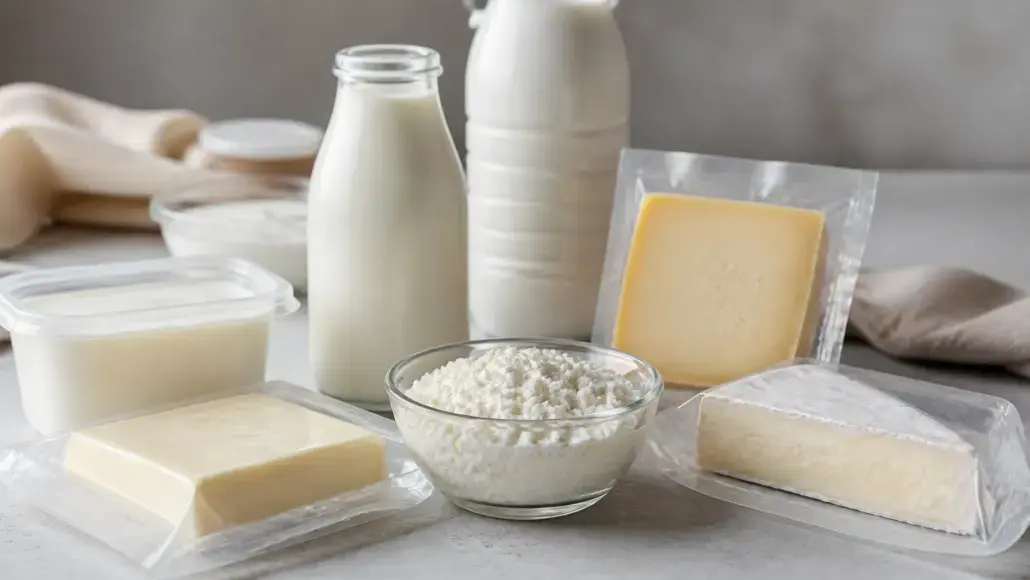
- Flexible films and wraps with natamycin or nisin layers serve cheese portions and blocks, where surface mold and Listeria control determine both shelf life and safety.
- Cup and tub lidding with integrated oxygen scavengers protects yogurt, cream and dessert products whose heads hold residual air after filling.
- Barrier bottles and cartons with light-blocking cores guard fluid milk against photooxidation, an area where packaging choices visibly change flavor performance.
- Vacuum and protective-atmosphere packs for hard and semi-hard cheeses combine scavenger strips or films with tight barrier webs to slow oxidation over long maturation and retail periods.
- Butter and spread wrappers with barrier layers pair grease resistance with oxygen and light protection, an area where foil-laminated structures remain the reference standard.
Format selection follows the product’s dominant spoilage mechanism rather than a single universal design, and converters increasingly offer the same active function across multiple substrates so packers can switch formats without changing protection strategies.
Fluid milk deserves particular attention because it represents the largest volume in the cabinet. Light protection remains its dominant active function, and the shift from clear PET bottles to light-blocking multilayer structures has accelerated as retailers document flavor differences in side-by-side comparisons. Scavenger closures are being tested where extended distribution applies, and these trials echo the same design logic applied elsewhere in the cabinet: identify the dominant spoilage route, then place the active function directly in its path.
Regulatory Pathways and Migration Compliance
Regulation shapes what active dairy packaging can claim and deliver. In the European Union, Framework Regulation (EC) No 1935/2004 governs food contact materials, and the plastics implementing measures set migration limits that antimicrobial and scavenging layers must respect. A claimed function must be technically demonstrable, and authorities have scrutinized antimicrobial packaging claims carefully where they might overlap with biocidal product rules. Natamycin’s status in cheese applications is well established, but novel antimicrobials face lengthier assessment.
In the United States, food-contact substance notifications under FDA processes provide the primary route for scavenger and antimicrobial components, and several iron-based and sorbate-based systems hold established status. Packers introducing active layers to existing structures typically commission supplementary migration testing rather than full reapproval, but any front-of-pack freshness claim must be substantiated with evidence.
Practical compliance extends beyond the approval file. Supply agreements increasingly require documentation of active-agent concentration, release behavior and batch consistency, and retailer codes of practice in several European markets add their own requirements for claims verification. Dairy brands that plan the regulatory workload early move faster than those treating it as an afterthought.
Enforcement experience is shaping best practice. Several retailers now require suppliers of active packaging materials to submit migration data and functional evidence per product line rather than per chemistry, tightening the documentation burden but giving compliant suppliers a market advantage. Industry associations have published guidance covering functional claims on dairy packs, and legal teams increasingly review front-of-pack wording before launch to keep freshness claims aligned with demonstrated pack performance.
Commercial Uptake and the Barriers That Remain
Adoption concentrates where the value case is strongest. Cheese brands use antimicrobial films to support longer maturation and retail windows, premium yogurt lines deploy scavenger lidding to protect fruit preparations, and fluid milk producers invest in light-barrier structures that demonstrably extend flavor quality. Manufacturer case work reports shelf-life gains ranging from several days to several weeks depending on product and format, with the largest gains in products whose spoilage is surface-driven.
Barriers remain real. Active structures cost more than conventional equivalents, and commodity dairy margins limit how much premium packers can absorb. Consumer perception adds a subtler constraint: shoppers accept preservatives inside the pack wall more readily than visible sachets or pads, but brands must still communicate the technology honestly on pack. Natural antimicrobials ease that conversation but cost more and work more slowly than synthetic alternatives.
Where active packaging materials have been introduced with clear retailer support, the commercial results have justified wider rollout. Cheese programs in several European markets show that active packaging materials can defend premium positioning as well as shelf life, since shoppers read the technology as a quality signal rather than a preservative substitute. The communication challenge, once solved through transparent on-pack explanation, tends to diminish as familiarity grows, and brand owners increasingly treat the pack itself as the proof point for their freshness claims.
The technology’s trajectory points toward integration rather than novelty. Cheese applications overlap closely with oxygen scavenging films for advanced food preservation, since vacuum-packed hard cheeses face the same oxidation chemistry that scavenging structures were designed to solve, and converters position their dairy offerings within that wider platform. As mono-material structures and bio-based antimicrobials mature, the expectation across the dairy industry is that active functions will migrate from premium niches into standard packaging specifications, the same path barrier films followed a generation earlier.