

















Few chemical compounds shape the economics of fruit distribution as powerfully as ethylene. The gas acts as a ripening hormone, and even trace concentrations trigger softening, color change and flavor decline in climacteric fruit during storage and transit. Ethylene absorbing technologies answer the problem inside the pack and the carton, capturing the ripening gas at its source and protecting produce that would otherwise age in the presence of its own emissions. Growers, packers and retailers now deploy absorbers across long-haul export chains, and the technology has become a standard component of premium produce logistics alongside cold chain and atmosphere control.
Ethylene’s Role in Ripening and Post-Harvest Loss
Ethylene functions as a plant hormone that coordinates ripening. Climacteric fruit such as bananas, apples, tomatoes, avocados and mangoes produce their own ethylene and respond to external sources, creating a self-reinforcing cycle: one ripening fruit accelerates its neighbors, and a pallet of mixed maturity ripens unevenly and unpredictably. Non-climacteric produce, including most berries and citrus, produces little ethylene but still suffers damage from exposure to gas released by neighboring commodities.
Sensitivity thresholds are low. Effects on ripening and quality become measurable at concentrations of roughly one part per million or below for sensitive commodities, and mixed-load shipping regularly exceeds such levels. A truck carrying bananas alongside avocados, or apples stored near cut flowers, exposes sensitive products to continuous ethylene exposure that cold temperatures slow but cannot stop.
The commercial consequences are substantial. Post-harvest losses in fruit and vegetables reach significant percentages of production value globally, with ethylene-driven over-ripening among the leading causes in distribution rather than in the field. Retailers absorb additional losses through markdowns on over-ripe stock, and export chains lose whole consignments when ripening accelerates inside sealed containers. Absorber technologies address the loss precisely where it happens, inside the pack and the transit environment.
Variety and harvest maturity shape the whole equation. Fruit picked at advanced maturity carries higher emission rates and shorter tolerance windows, while early-picked fruit tolerates distribution better but delivers less flavor at the shelf. Growers managing long export chains balance picking maturity against absorber capacity and transit time, and absorber suppliers increasingly participate in those decisions with capacity models matched to commodity, variety and route duration.
Absorber Chemistries: Permanganate, Zeolites and Photocatalysts
Three chemistry families dominate the absorber market. Potassium permanganate systems oxidize ethylene into carbon dioxide and water, consuming the gas irreversibly. The chemistry is proven and inexpensive, typically carried on inert alumina or vermiculite pellets, and permanganate absorbers remain the most widely deployed format in bulk shipping. Their limits are physical: capacity depends on airflow through the medium, and the purple oxidant must be contained carefully within the packaging.
Zeolite and activated carbon systems adsorb ethylene onto porous surfaces rather than destroying it. Natural and synthetic zeolites offer large surface areas and can be blended directly into films, Sachet powders and carton coatings, which spreads the function across the pack instead of concentrating it in one absorber point. Adsorption saturates over time, so these systems suit shorter distribution windows unless paired with regenerating conditions.
Photocatalytic systems use titanium dioxide and related catalysts, activated by UV or visible light, to decompose ethylene into water and carbon dioxide on the catalyst surface. They suit cold rooms and ripening chambers where light and airflow can be engineered, and commercial installations exist alongside conventional scrubbers. Research-stage chemistries, including metal-organic frameworks and engineered catalyst blends, promise higher capacities and selectivity, though packers should treat those as development stories rather than established supply options.
Choosing among chemistries follows the application. Long sealed-container export favors high-capacity permanganate, retail-ready packs favor film-integrated zeolites, and controlled-environment storage favors photocatalytic scrubbing.
Ripening rooms add a complementary dimension to absorption. Bananas, avocados and tomatoes are ripened deliberately at destination using controlled ethylene dosing, and absorber technologies protect fruit before and after that scheduled ripening rather than during it. The distinction matters operationally: packs intended for ripening on arrival must not suppress the gas the ripener will apply, so absorber formats are specified differently for fruit destined for ripening rooms than for fruit shipped to direct-sale shelves.

Absorber Formats Across the Produce Supply Chain
Absorbers appear in formats matched to each stage of the chain, and packers commonly layer several:
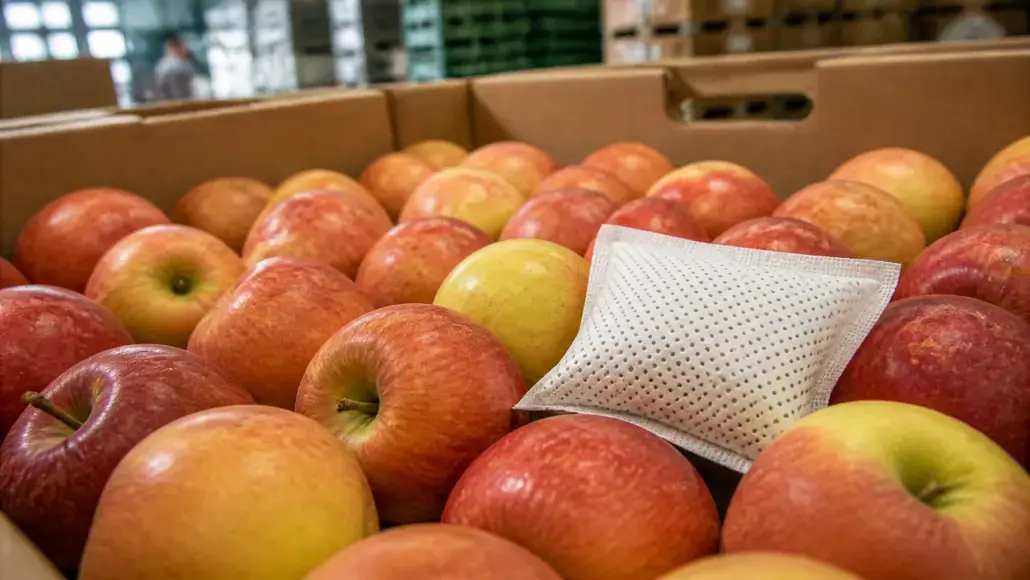
- Sachets and pouches placed inside shipping cartons offer the highest capacity route for long-haul export of bananas, avocados and other sensitive fruit.
- Absorber pads sit inside retail punnets and clamshells for berries, grapes and cut fruit, combining ethylene capture with moisture interception in a single component.
- Carton liners and blanket sheets coated with zeolite blends protect pallet-level loads while adding insulation value during transit.
- Labels and stickers with embedded absorber media serve retail-ready packs where visible sachets are unwanted, keeping the function while preserving presentation.
- Cold room filters and photocatalytic scrubbers protect bulk storage and ripening chambers, complementing pack-level absorbers downstream.
Format economics scale with capacity. Carton-level and room-level systems cost cents per kilogram of fruit handled, while pack-level formats carry higher unit costs justified by premium retail positioning. Growers exporting long distances generally begin with carton sachets and add pack-level formats where retail quality demands them.
Measuring Effectiveness Alongside Cold Chain and Atmosphere Control
Temperature remains the primary lever for fruit quality, and absorbers work within that hierarchy rather than replacing it. Ethylene production and sensitivity both fall sharply at recommended storage temperatures, and no absorber compensates for a broken cold chain. Effective deployments combine disciplined temperature management, ethylene absorbers and, where the commodity allows, controlled or modified atmosphere storage.
Atmosphere control and ethylene management interact closely. For respiring produce the absorbers work beside modified atmosphere packaging technologies for meat and seafood, adapted to high-permeability films that prevent anaerobic conditions while holding low oxygen and elevated carbon dioxide around the fruit. In that combination the absorber handles the ethylene the film cannot, while the atmosphere suppresses respiration, and the two functions together extend shelf life beyond what either achieves alone.
Measurement discipline separates serious programs from marketing claims. Packers validate absorber performance by monitoring headspace ethylene concentrations with portable sensors, tracking firmness, color and defect rates through simulated and real shipments, and comparing treated loads against controls. Manufacturer capacity ratings describe ideal conditions, and real-world performance varies with temperature, humidity and load configuration, so internal trial data should guide purchasing decisions and claimed shelf-life extensions.
Mixed-load planning extends absorber value beyond individual packs. Distribution centers segregate ethylene-producing and ethylene-sensitive commodities, yet retail mixed displays, home deliveries and mixed pallets still create exposure, and pack-level absorber formats protect fruit through those final links. Exporters shipping multi-commodity containers treat absorber placement as part of load planning, calculating capacity against the combined emission profile of the cargo rather than against a single product. Sensor-based monitoring inside containers is making that calculation continuous rather than predictive, letting operators intervene with additional absorbers or ventilation when readings climb, and the resulting data feeds back into absorber sizing for future consignments.
Adoption Barriers and Sustainability Questions
Adoption obstacles are practical rather than technical. Visible sachets in retail packs attract consumer complaints and removal, which pushed the industry toward films, liners and labels that hide the function. Capacity claims vary between suppliers, and inconsistent media quality produces uneven field results, prompting larger growers to qualify suppliers through their own trials. Cost sensitivity in commodity fruit limits premium formats, though the arithmetic improves as waste rates fall.
Sustainability scrutiny follows the wider packaging debate. Permanganate media raises disposal questions, and mixed-material absorber pads complicate recycling streams, so suppliers have developed paper-based pads, bio-based zeolite composites and regenerable media for room-level systems. Film-integrated formats reduce loose components and align with mono-material packaging strategies, a direction consistent with how the industry has handled other active functions.
Ethylene absorbing technologies continue to expand into adjacent formats as these questions settle. Regenerable media for cold rooms, absorber liners made from recycled fiber and sensor-equipped labels that display cumulative ethylene exposure are moving from prototypes into commercial trials. For growers weighing the investment, the deciding evidence remains field data: controlled comparisons that track firmness, color and rejection rates across treated and untreated shipments, the same standard by which every other preservation technology in the produce industry is judged.
The forward trajectory combines absorption with measurement. Ethylene indicators that display accumulated exposure, sensors embedded in cartons transmitting ripening data to logistics platforms, and absorbers sized dynamically to predicted load emissions are all in active development. For an industry that loses a meaningful share of fruit value after harvest, technologies that manage the ripening gas at its source, reliably and measurably, will remain central to maintaining quality from the packing house to the shelf, and to the export economics that depend on it.