






















The European Commission has released new implementation guidance for the EU packaging regulation, aimed at ensuring uniform application of the Packaging and Packaging Waste Regulation (PPWR) across Member States while easing compliance for businesses operating within the Single Market. The move is positioned to address regulatory fragmentation, reduce administrative burdens, and support a more competitive and sustainable packaging sector.
The guidance follows continued growth in packaging waste across Europe. In 2023, average packaging waste reached 178kg per person, with projections indicating a potential 19% increase by 2030 compared to 2018 levels. Plastic packaging waste could rise by as much as 46% over the same period, reinforcing the urgency behind harmonised regulatory implementation.
Clarifying Scope and Compliance Obligations
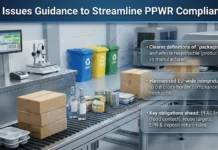
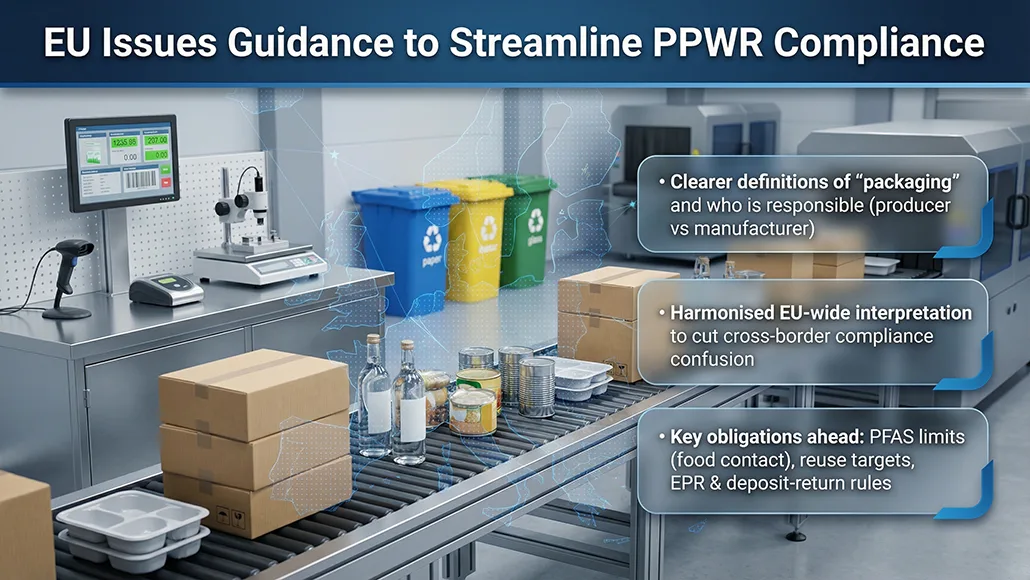
A central element of the guidance is the clarification of definitions and responsibilities under the EU packaging regulation. The document outlines when companies are classified as manufacturers or producers, a distinction that determines legal accountability across supply chains. It also provides detailed interpretation of what constitutes packaging, addressing long-standing ambiguities affecting complex product and logistics systems.
The Commission notes that the guidance is based on stakeholder queries and is intended to improve legal certainty without altering the regulation itself. The accompanying Frequently Asked Questions (FAQs) further address operational concerns raised since the PPWR entered into force on 11 February 2025.
Regulatory Measures and Material Restrictions
The guidance details several regulatory provisions, including restrictions on single-use packaging and the enforcement of limits on PFAS (perfluoroalkyl and polyfluoroalkyl substances) in food contact packaging. These measures introduce tighter controls on substances linked to environmental persistence, with compliance requirements becoming applicable from 12 August 2026.
In addition, the document outlines the implementation of reuse targets and clarifies extended producer responsibility (EPR) obligations. Under these rules, producers are required to finance the collection and treatment of packaging waste in the Member State where the packaging becomes waste, reinforcing lifecycle accountability across the value chain.
The guidance also confirms obligations related to deposit and return systems, which are expected to be established or expanded across Member States to improve collection rates.
Operational Impact on Packaging Value Chains
From an operational standpoint, the guidance aims to reduce inconsistencies caused by divergent national interpretations. Businesses operating across multiple EU markets are expected to benefit from clearer definitions and harmonised compliance expectations.
The Commission further highlights that packaging classification must be assessed based on function and intended use rather than solely on indicative lists, reinforcing a case-by-case evaluation approach. This is particularly relevant for industries managing multi-component or reusable packaging systems.
Packaging World Insights observes that the clarification of roles such as manufacturer and producer reflects the increasing complexity of packaging supply chains, where responsibility is distributed across multiple economic operators.
Implementation Roadmap and Future Measures
The guidance will be translated into all official EU languages before formal adoption. The Commission will continue to monitor implementation and update supporting materials, including FAQs, as additional stakeholder input emerges.
Several delegated and implementing acts are currently under development to support the rollout of the regulation. These include harmonised registration and reporting formats for EPR, standardised labelling to improve waste sorting, and criteria for recyclability and recycled content in plastic packaging.
The PPWR introduces broader structural measures, including mandatory recyclability by 2030, minimum recycled content requirements, and provisions to reduce excessive packaging. These are expected to contribute to reduced greenhouse gas emissions, lower resource consumption, and improved environmental outcomes across the packaging sector.
From an industry standpoint, Packaging World Insights notes that the guidance helps bridge regulatory intent with operational implementation, providing greater clarity for companies aligning with evolving EU-wide packaging requirements.