

















Key Takeaways
- The EU’s PPWR is entering into force in 2025 and becoming fully binding in August 2026 with uniform standards across all 27 member states.
- PFAS (“forever chemicals”) are being phased out of all food contact packaging.
- Plastic food packaging will need mandatory recycled content, including 30% for PET by 2030 and increasing targets through 2040.
- A fully harmonized EU-wide labeling system will replace scattered formats.
The European Union has embarked on an ambitious regulatory transformation that fundamentally reshapes how food products are packaged, distributed, and disposed of across its member states. At the heart of this transformation lies the Packaging and Packaging Waste Regulation, commonly known as PPWR, which entered into force on 11 February 2025 and becomes legally binding from 12 August 2026. This landmark legislation represents the most comprehensive overhaul of food packaging regulations in the EU’s history, establishing binding standards that directly apply across all 27 member states without requiring national transposition.
The new EU food packaging regulations address mounting environmental concerns as packaging waste continues to rise across Europe. Current data indicates that packaging waste has reached alarming levels, with nearly 60 million tonnes generated annually across the EU, equivalent to approximately 132 kilograms per person. The PPWR responds to this challenge by introducing stringent requirements that span the entire lifecycle of food packaging, from design and material selection to end-of-life management and recycling. Unlike the previous Packaging and Packaging Waste Directive from 1994, which proved insufficient to curb rising waste volumes, the new regulation establishes directly enforceable standards that leave little room for national interpretation.
Prohibition of Hazardous Substances in Food Contact Materials
Among the most significant provisions within the EU food packaging regulations is the prohibition of per- and polyfluorinated alkyl substances, commonly known as PFAS, in food contact packaging. Starting from 12 August 2026, food packaging containing PFAS above specific concentration limits will be banned from the EU market. The regulation sets strict thresholds at 25 parts per billion for individual PFAS compounds, 250 ppb for the sum of PFAS measured through targeted analysis, and 50 parts per million for total fluorine content, including polymeric PFAS.
This prohibition stems from overwhelming scientific evidence demonstrating that PFAS exposure through food packaging presents unacceptable risks to human health. These synthetic chemicals, often referred to as “forever chemicals” due to their extreme persistence in the environment, have been linked to serious health issues, including carcinogenicity, mutagenicity, reproductive toxicity, and specific organ damage. The ban applies comprehensively to all food contact packaging, including coatings and additives containing PFAS components, with no exceptions for multilayer structures with virgin inner layers.
Simultaneously, the EU has adopted strict measures targeting bisphenol A and related compounds in food contact materials. Adopted in December 2024 and entering into force in January 2025, Commission Regulation 2024/3190 prohibits BPA and its salts in the manufacture of food-contact plastics, varnishes, coatings, printing inks, adhesives, ion-exchange resins, silicones, and rubber. This comprehensive ban follows the European Food Safety Authority’s 2023 reassessment, which concluded that BPA has potentially harmful effects on the immune system and proposed reducing the tolerable daily intake by 20,000 times compared to previous safety thresholds.
Mandatory Recyclability and Design Requirements
The EU food packaging regulations establish unprecedented requirements for recyclability, mandating that all packaging placed on the EU market must be recyclable by 2030. This requirement goes beyond aspirational targets, establishing strict design-for-recycling criteria that will grade packaging on its recyclability performance from A to E. From 2030 onwards, only packaging classified as grade C or higher, representing at least 70 percent recyclability, will be permitted on the market. By 2038, this threshold increases to grade B, requiring 80 percent recyclability, with eventual progression toward grade A standards of 95 percent or above.
These recyclability standards require packaging to be designed so that all components can be collected separately, sorted into defined waste streams without affecting other materials, and recycled into secondary raw materials of sufficient quality to substitute primary materials. The European Commission will establish detailed criteria through implementing acts by January 2028, defining recyclability performance grades for different packaging categories. This systematic approach ensures that recycling moves beyond mere downcycling to lower-grade applications, instead creating closed-loop systems where food packaging materials can repeatedly return to food-grade applications.
Recycled Content Mandates
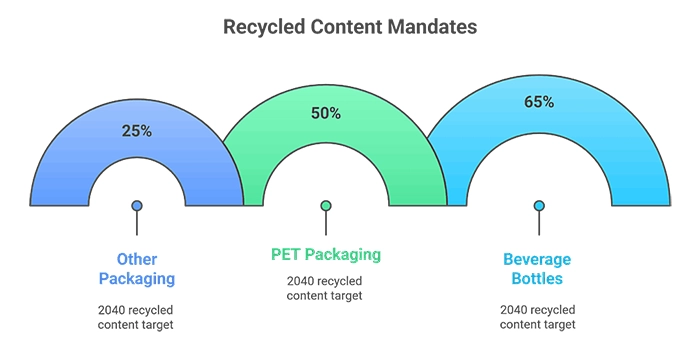
Complementing recyclability requirements, the food packaging regulations establish binding minimum recycled content targets for plastic packaging. From 1 January 2030, plastic food packaging must incorporate specific percentages of post-consumer recycled content by weight. For contact-sensitive packaging made primarily from PET, excluding single-use beverage bottles, the minimum recycled content requirement stands at 30 percent in 2030, increasing to 50 percent by 2040. Food packaging made from plastics other than PET must contain at least 10 percent recycled content by 2030, rising to 25 percent by 2040. Single-use plastic beverage bottles face even stricter requirements, maintaining the 30 percent target for 2030 but escalating to 65 percent by 2040.
These recycled content mandates create stable demand for recycled materials, incentivizing investment in recycling infrastructure and technology across member states. The regulation allows recycled content to be sourced from third countries outside the EU, provided the material has been separately collected and meets equivalent specifications to those required under EU waste management directives. This provision enables global supply chains while maintaining quality standards. Importantly, the recycled content requirements apply equally to packaging manufactured within the EU and imported packaged products, ensuring competitive equity.
Waste Reduction and Reuse Targets
The EU food packaging regulations establish binding waste reduction targets requiring member states to reduce packaging waste per capita by 5 percent by 2030, 10 percent by 2035, and 15 percent by 2040, compared to 2018 baseline levels. While a 5 percent reduction may appear modest, it represents a significant reversal of current growth trends and equals approximately a 37 percent reduction compared to a no-action scenario by 2040.
To achieve these reductions, the regulation introduces specific reuse targets particularly relevant to the food and beverage sector. From 1 January 2030, final distributors of alcoholic and non-alcoholic beverages must ensure that at least 10 percent of products are made available in reusable packaging within established reuse systems, with exceptions for certain beverages including wine, spirits, and milk. This target increases to 40 percent by 2040. The hospitality, restaurant, and catering sectors face similar obligations, with requirements that takeaway operators offer 10 percent of products in reusable packaging formats by 2030.
Additionally, from 12 February 2028, food service providers serving beverages or ready-prepared food in takeaway packaging must provide reusable options at no additional charge and inform consumers about these alternatives. From the same date, such establishments must allow customers to bring their own containers for food and beverages without extra cost. These provisions fundamentally reshape consumer expectations and business operations in food service sectors.
Single-Use Packaging Restrictions
The food packaging regulations impose targeted bans on specific single-use plastic packaging formats, taking effect from 1 January 2030. Prohibited items include single-use plastic packaging for unprocessed fresh fruits and vegetables weighing less than 1.5 kilograms, with limited exceptions where demonstrated needs exist to prevent water loss, microbiological hazards, physical damage, or oxidation. Single-use packaging for food and beverages consumed on-site at hotels, restaurants, and catering establishments will also be banned, as will individual portions of condiments, sauces, and similar products. Small, single-use cosmetic and toiletry packaging in accommodation sectors, such as mini hotel shampoo bottles, similarly face prohibition.
These bans complement existing EU single-use plastics directives while expanding restrictions beyond items already regulated. The prohibition on fresh produce packaging under 1.5 kilograms alone will significantly impact retail practices across Europe, requiring fundamental rethinking of display and preservation strategies. The regulation’s provisions for HORECA sectors will eliminate billions of single-serve packaging units annually, driving substantial waste reduction while pushing the industry toward bulk dispensing and reusable container systems.
Harmonized Labeling Requirements
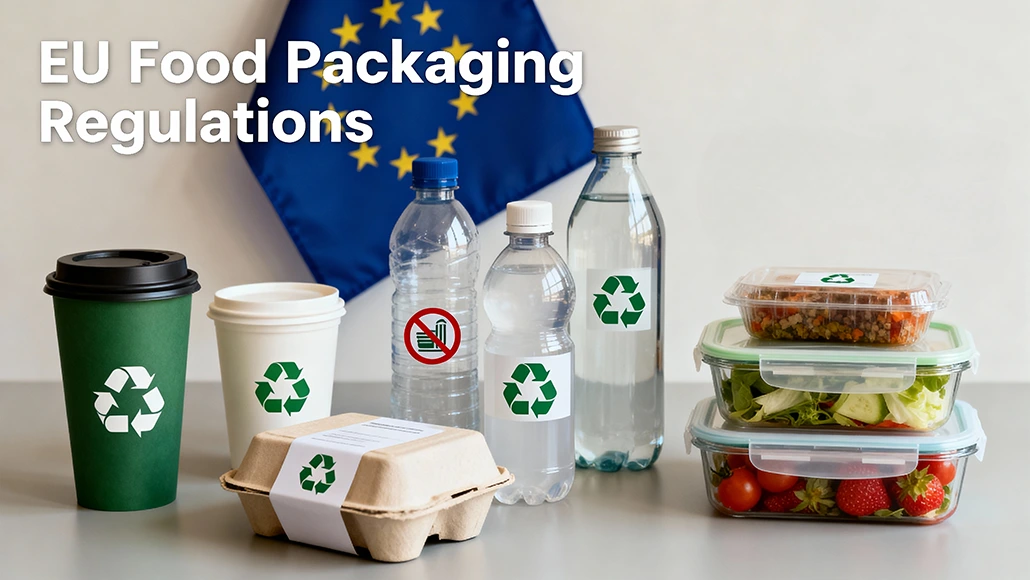
Recognizing that consumer understanding drives proper waste sorting and recycling, the EU food packaging regulations mandate harmonized labeling systems across all member states. From 12 August 2028, all packaging must display standardized labels clearly identifying material composition through pictogram-based symbols. These intuitive visual indicators will replace the inconsistent triangular codes and abbreviations currently used across different countries, providing accessible information regardless of language barriers.
The labels must indicate whether packaging is compostable and, if so, whether it is suitable for home composting or requires industrial composting facilities. For reusable packaging, labels must clearly indicate reusability and provide instructions for return within established collection systems. Many packages will incorporate QR codes or digital markers providing detailed information about material composition, recyclability, reusability, and collection or return instructions. This digital dimension enables dynamic information provision while maintaining clean physical package design.
Extended Producer Responsibility Framework
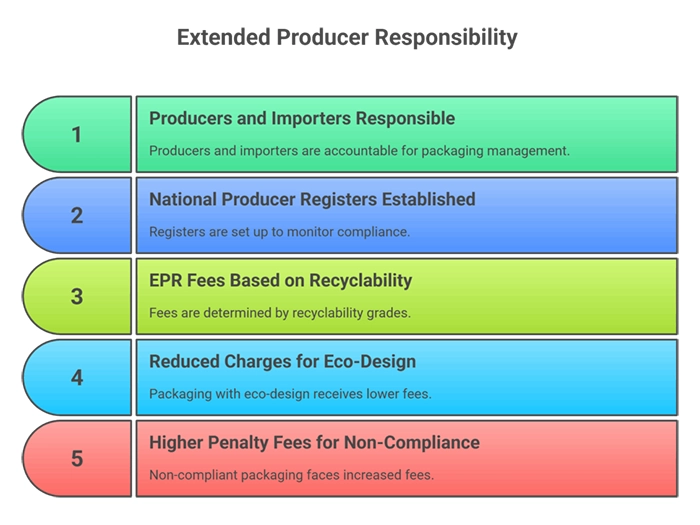
Underpinning the implementation of these food packaging regulations is an enhanced extended producer responsibility framework. EPR systems place financial and operational responsibility for packaging’s post-consumer management on producers and importers who place packaging on the market. The PPWR mandates the establishment of national producer registers to monitor compliance and requires modulation of EPR fees based on packaging recyclability performance grades. This fee modulation creates direct economic incentives for improved packaging design, with higher recyclability grades resulting in lower EPR contributions.
Producers must register their packaging volumes, report them to national authorities, and provide documentation proving compliance and recyclability. They bear financial responsibility for end-of-life costs, including collection, sorting, recycling, and disposal. This financial burden is modulated through eco-design principles, where packaging that exceeds minimum recyclability standards or incorporates higher recycled content receives reduced fees, while difficult-to-recycle or non-compliant packaging faces premium charges.
Deposit Return Schemes
To achieve ambitious collection targets, the EU food packaging regulations require member states to establish deposit return schemes for single-use plastic and metal beverage containers. By 2029, member states must achieve 90 percent separate collection of single-use plastic and metal beverage containers up to three liters in capacity through DRS or alternative solutions demonstrating equivalent collection performance. Countries already achieving 80 percent separate collection rates by 2025 and submitting credible implementation plans may receive exemptions from mandatory DRS requirements.
Deposit return schemes require consumers to pay small refundable deposits when purchasing beverages, which they reclaim upon returning empty containers to designated collection points, including reverse vending machines or retail locations. This financial incentive dramatically increases return rates, with existing European DRS achieving collection rates between 82 percent in Estonia and 98 percent in Germany. The schemes create clean, single-stream material flows of high-quality food-grade recyclate suitable for closed-loop recycling back into food contact applications.
Conclusion
The comprehensive food packaging regulations now entering force across the European Union represent a paradigm shift in how food products are packaged, consumed, and managed at end-of-life. Through stringent prohibitions on hazardous substances, mandatory recyclability and recycled content requirements, waste reduction and reuse targets, strategic single-use packaging bans, harmonized labeling systems, enhanced extended producer responsibility, and deposit return schemes, the PPWR establishes an integrated framework designed to transition Europe toward a truly circular economy for food packaging. As these food packaging regulations progressively take effect through 2030 and beyond, they will fundamentally reshape business practices, consumer behaviors, and environmental outcomes across the continent, positioning the EU as a global leader in sustainable packaging policy. The success of these ambitious EU food packaging regulations will depend on coordinated action from policymakers, industry stakeholders, and consumers working collectively toward the shared goal of drastically reducing packaging waste while maintaining food safety, quality, and accessibility for all Europeans.