

















The European Commission has adopted a Delegated Act exempting pallet wrapping and straps used to secure goods during transport from the 100% reuse requirement under the EU’s Packaging and Packaging Waste Regulation (PPWR), a move with compliance and logistics implications for the power sector.
Delegated Act Removes 100% Reuse Obligation
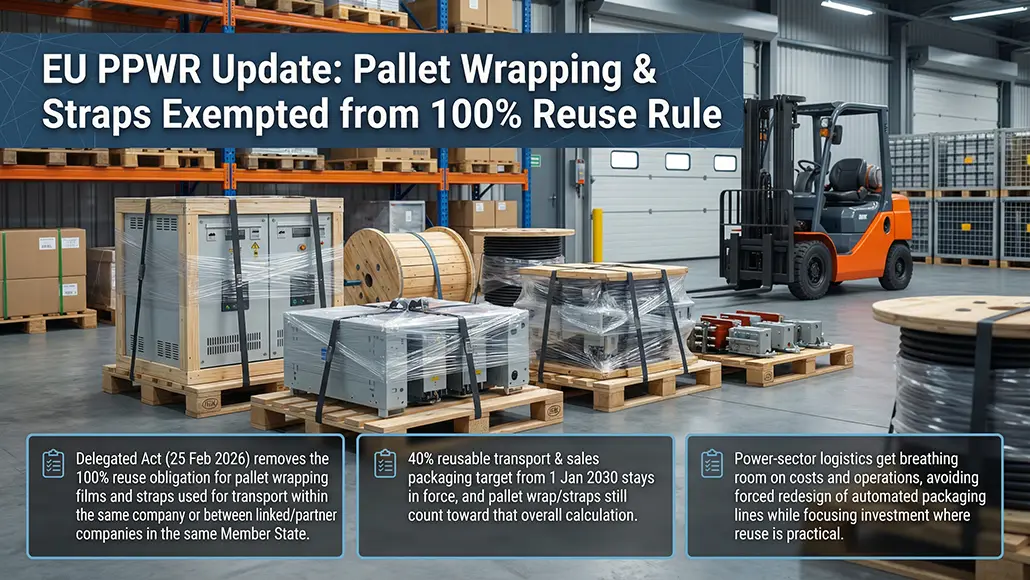
The Delegated Act, adopted on 25 February 2026, removes the obligation for pallet wrapping films and straps to achieve full reuse when used within the same company or between linked or partner companies in the same Member State. The decision follows stakeholder feedback and a Commission feasibility study which concluded that enforcing exclusive use of reusable pallet wrappings and straps in such transport operations could lead to disproportionate adaptation costs.
The PPWR, which entered into force on 11 February 2025, had previously established an aspirational 100% reuse target for these load-securing components under specific intra-company and domestic transport scenarios. Under the broader framework of the Regulation, economic operators must ensure that at least 40% of transport and sales packaging is reusable from 1 January 2030.
40% Reuse Target Remains in Force
The 40% requirement applies to formats including pallets, foldable-plastic boxes, boxes, trays, plastic crates, intermediate bulk containers, pails, drums and canisters, as well as pallet wrapping and straps. The exemption does not remove these components from the overall 40% calculation but relieves operators from achieving full reuse exclusively for pallet wrapping and straps.
For power sector operators, particularly those managing generation assets, grid infrastructure projects and heavy equipment logistics the distinction is significant. Large components such as transformers, switchgear, cables and substation equipment are routinely transported on pallets secured with wrapping films and straps. The exemption reduces the compliance burden associated with redesigning internal transport and packaging systems solely to meet a 100% reuse threshold for these specific items.
Cost and Operational Considerations
The Commission’s feasibility study found that replacing single-use wrapping and straps with reusable systems in internal transport operations could entail high adaptation costs. These costs are particularly relevant where automated packaging processes are integrated into logistics operations.
Industry feedback cited potential capital expenditure for new equipment, system redesign and staff training. In large-scale infrastructure supply chains, including those supporting power generation and transmission projects, such changes could have required material operational adjustments. By granting the exemption, the Commission allows companies to allocate investments toward areas where reusable solutions are technically and economically feasible.
Broader Regulatory Context
The PPWR represents a comprehensive overhaul of EU packaging legislation, replacing earlier directives with harmonised European packaging rules applicable across all Member States. In addition to reuse targets, the Regulation introduces mandatory recyclability by 2030 and minimum recycled content in plastic packaging.
According to the Commission, these measures are intended to reduce greenhouse gas emissions, water use and environmental costs associated with packaging, while creating opportunities for businesses involved in recycling and sustainable packaging solutions.
Harmonisation is also designed to reduce regulatory fragmentation. Companies operating across multiple Member States will comply with a single set of rules rather than navigating differing national frameworks. For power utilities and engineering, procurement and construction contractors engaged in cross-border infrastructure development, this alignment provides greater legal clarity as implementation advances.
Implementation Timeline and Consultation Process
The Delegated Act was open for public feedback between 10 December 2025 and 9 January 2026 in line with EU decision-making procedures before its final adoption on 25 February 2026.
The broader PPWR provisions will begin implementation from August 2026, with reuse and recycling targets extending toward the 2030 deadlines.
While some stakeholders focused on plastic pollution have raised concerns about exemptions within EU reuse rules, the Commission has characterised the measure as a balanced approach that maintains circular economy objectives while recognising operational feasibility. For the power sector, the decision clarifies compliance pathways as companies align procurement, logistics and infrastructure delivery processes with the EU’s evolving sustainability framework.