


























The European Union’s evolving packaging regulation framework is steadily moving from broad sustainability ambition to operational enforcement and nowhere is this shift more visible than in e-commerce packaging. What was once a largely logistics-driven function is now becoming a regulated cost and compliance centre. For online retailers, fulfilment operators, and packaging suppliers, the implications are structural rather than incremental.
From an industry standpoint, Packaging World Insights observes that the EU’s latest guidance under the Packaging and Packaging Waste Regulation (PPWR) does not merely refine existing expectations it introduces measurable thresholds, removes long-standing design justifications, and redistributes accountability across the value chain. The result is a regulatory environment that will fundamentally reshape how e-commerce packaging is designed, filled, and optimised.
A Structural Shift: From Flexibility to Measurable Limits
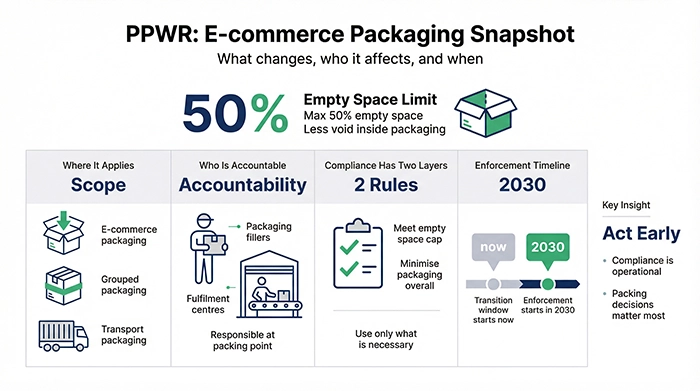
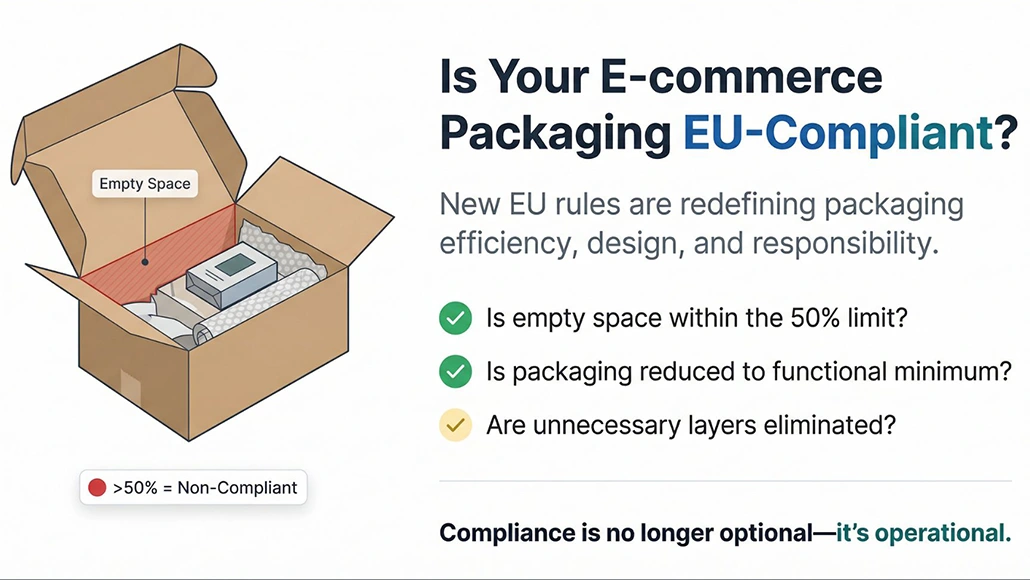
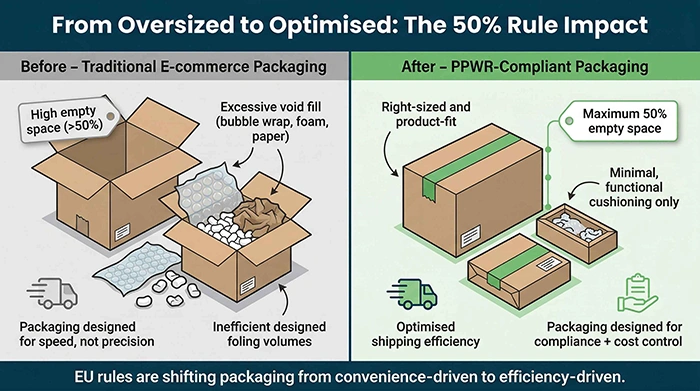
At the core of this transformation lies a clear and enforceable requirement: a maximum empty space ratio of 50% for e-commerce, grouped, and transport packaging. This threshold, expected to apply from January 2030 (or later depending on implementing acts), directly targets one of the most persistent inefficiencies in online retail oversized packaging.
In practical terms, empty space includes all voids within a package that are not occupied by the product itself, including air and filler materials such as bubble wrap, foam, or paper padding. While void fill has historically been justified for protection and presentation, the regulation reframes it as a measurable inefficiency rather than a necessary trade-off.
What makes this particularly significant is that the rule applies not at the design stage alone, but at the point where packaging is filled. This shifts the compliance burden away from packaging manufacturers and onto economic operators primarily fulfilment centres and e-commerce retailers who are responsible for packing the final shipment.
The End of Oversized Packaging Economics
For years, e-commerce packaging has operated on a model that prioritised speed, standardisation, and damage prevention. Standard box sizes, combined with generous void fill, allowed fulfilment operations to scale rapidly without needing product-specific packaging configurations.
The EU’s 50% cap effectively disrupts this model.
Under the new framework, practices such as:
- Using universally sized boxes regardless of product dimensions
- Adding excessive filler materials to stabilise products
- Designing packaging to enhance perceived value or “unboxing experience”
will increasingly fall outside compliance boundaries.
Crucially, the regulation goes further by explicitly prohibiting packaging features designed to artificially increase perceived volume such as double walls, false bottoms, or unnecessary layers. These design elements, often used in premium packaging strategies, are now categorised as non-functional and therefore non-compliant unless justified by strict performance criteria.
Minimisation Rules: Removing Marketing from the Equation
The empty space rule does not operate in isolation. It is reinforced by broader packaging minimisation requirements, which mandate that packaging weight and volume must be reduced to the minimum necessary to ensure functionality.
This introduces a fundamental shift in design philosophy.
Historically, packaging decisions often balanced:
- Protection
- Logistics efficiency
- Branding and consumer experience
Under the new rules, marketing and consumer perception are explicitly excluded as valid justifications for additional packaging volume or weight. Only functional requirements such as product protection, hygiene, and transport integrity remain acceptable.
For e-commerce businesses, this signals the beginning of a more constrained design environment where packaging must justify its existence in purely operational terms.
Dual Compliance: Quantitative Meets Qualitative
One of the more complex aspects of the regulation is the requirement for dual compliance.
E-commerce packaging must simultaneously meet:
- A quantitative threshold (maximum 50% empty space)
- A qualitative requirement (overall minimisation of weight and volume)
This layered approach introduces both measurement and interpretation challenges. A package may technically fall within the 50% empty space limit but still be deemed non-compliant if it is not optimised to the minimum necessary volume.
For industry players, this creates a need for more sophisticated packaging validation processes moving beyond simple dimensional checks to holistic design assessments.
A Regulatory Gap: Measurement Still Undefined
Despite the clarity of the 50% threshold, a critical component remains unresolved: how exactly empty space will be measured.
The European Commission is expected to define a formal calculation methodology by February 2028, leaving a transitional period where companies must prepare without fully standardised metrics.
This creates a strategic dilemma for businesses:
- Delay investments until standards are finalised
- Or proactively redesign packaging systems based on anticipated requirements
Given the scale of operational change required, early movers are likely to gain an advantage, particularly in integrating automation and right-sizing technologies.
Operational Impact: Fulfilment Takes Centre Stage
A notable shift in the regulation is the relocation of compliance responsibility to the entity filling the packaging. In the context of e-commerce, this places fulfilment centres at the centre of regulatory exposure.
This has several implications:
- Logistics providers must now integrate compliance into packing workflows
- Retailers outsourcing fulfilment will need tighter contractual oversight
- Packaging decisions become operational decisions, not just procurement choices
In effect, packaging is no longer a static input it becomes a dynamic, process-driven component of fulfilment strategy.
Technology as a Compliance Enabler
Meeting the new requirements at scale will be difficult without technological intervention. As a result, the regulation is expected to accelerate adoption of:
- Automated right-sizing systems
- AI-driven packaging optimisation tools
- On-demand box creation technologies
- Advanced packaging analytics
These systems enable real-time adjustment of packaging dimensions to match product size, reducing empty space without compromising throughput.
From an economic perspective, this represents a shift from labour-driven packing models to technology-enabled precision packaging.
Cost Dynamics: Pressure and Opportunity
While the regulation introduces a clear layer of compliance-driven costs, it simultaneously creates a pathway for operational efficiencies that can reshape cost structures over time. In the near term, businesses will face tangible financial pressure, particularly through capital investment in right-sizing and automated packaging systems, the redesign of existing packaging portfolios to meet stricter requirements, and the integration of compliance monitoring tools within fulfilment operations.
However, these upfront costs are counterbalanced by longer-term efficiencies. As packaging becomes more precise and material use is reduced, companies can lower input costs while also benefiting from decreased shipping volumes and reduced dimensional weight charges an especially critical factor in e-commerce logistics. Additionally, more optimised packaging can streamline warehouse operations, improving storage density and handling efficiency. Over time, organisations that proactively adapt are likely to transition from compliance-driven expenditure to measurable cost advantages, particularly in logistics-intensive business models where packaging directly influences operational economics.
E-commerce vs Traditional Packaging: A Targeted Approach
An important nuance in the regulation is that not all packaging is treated equally.
- Sales packaging does not have a fixed empty space threshold
- E-commerce and transport packaging are explicitly subject to the 50% rule
This indicates a deliberate regulatory focus on e-commerce, reflecting its rapid growth and its disproportionate contribution to packaging waste.
A Redefined Role for Packaging in E-commerce
The cumulative effect of these regulatory measures signals a fundamental shift in how packaging is positioned within the e-commerce ecosystem. Packaging is no longer simply a branding tool, a buffer for operational inefficiencies, or a secondary consideration within fulfilment processes. Instead, it is emerging as a regulated performance component that must meet strict compliance requirements, a cost optimisation lever influencing materials and logistics efficiency, and a compliance-critical function embedded directly into operational decision-making.
Conclusion: From Convenience to Compliance
As the EU moves toward full implementation of the PPWR, e-commerce packaging is entering a new phase one defined by precision, accountability, and measurable efficiency.
From an analytical perspective, Packaging World Insights notes that the regulation effectively dismantles the legacy model of oversized, filler-heavy packaging. In its place, it establishes a system where every cubic centimetre must be justified, measured, and optimised.
For businesses, the message is clear:
Packaging is no longer just about delivering products it is about delivering compliance, efficiency, and long-term economic resilience.