










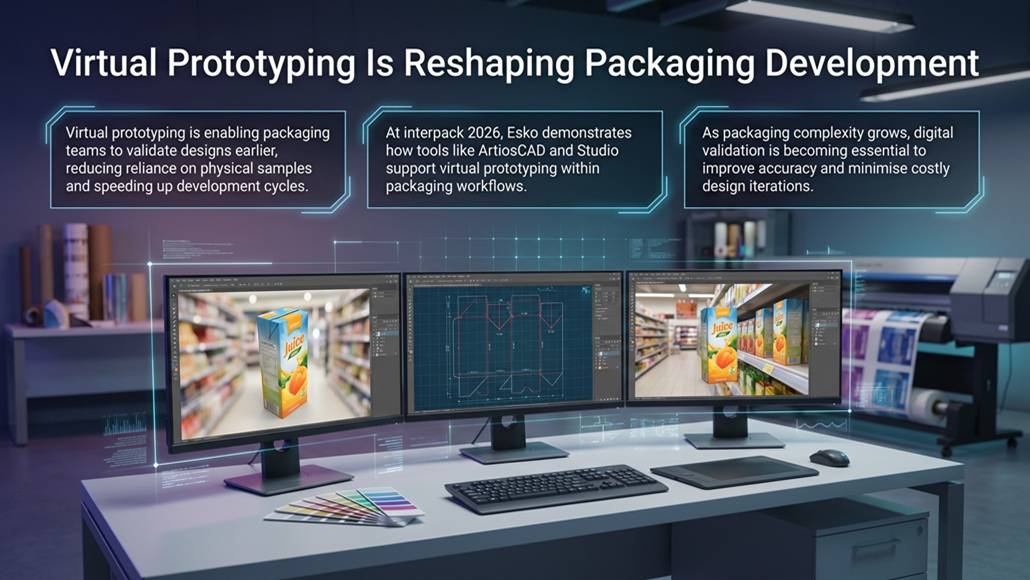

As packaging development cycles become shorter and more complex, the industry is increasingly turning to virtual prototyping to reduce reliance on physical samples. The ability to evaluate packaging concepts digitally before committing to materials or production has become a critical factor in improving speed, accuracy, and cost efficiency.
At interpack 2026, this shift is being reflected in how Esko and its ecosystem are demonstrating packaging development workflows that move seamlessly from concept to production, with digital validation playing a central role.
Register here for guided experience
Why Physical Prototyping Is No Longer Enough
Traditional packaging development has relied heavily on physical prototypes to validate structure, design, and shelf presence. While effective, this approach introduces several challenges – longer development timelines, higher material costs, and repeated iterations that slow down product launches.
As SKU counts increase and packaging formats diversify, these inefficiencies become more pronounced. Each variation requires validation, often leading to multiple rounds of prototyping before final approval. In fast-moving markets, this model is becoming increasingly difficult to sustain.
Virtual Prototyping Enables Earlier Decision-Making
Virtual prototyping allows packaging teams to simulate and evaluate designs digitally, enabling decisions to be made earlier in the development process. Structural design, visual appearance, and packaging configurations can be reviewed without the need for physical samples.
This approach supports:
- Faster design validation
- Reduced material usage during development
- Improved alignment between design and production
By identifying potential issues at the digital stage, companies can avoid costly revisions later in the process.
From 2D Concepts to 3D Packaging Environments
One of the key shifts in packaging design is the transition from flat, 2D artwork to fully realised 3D packaging models. This allows teams to understand how packaging will perform not just visually, but structurally and contextually.
Solutions such as ArtiosCAD and Studio from Esko support this transition by enabling structural design and high-fidelity 3D visualisation. Packaging concepts can be developed, resized, and tested digitally, ensuring that both primary and secondary packaging formats are aligned before production begins.
Register here for guided experience
In addition, virtual retail environments allow teams to evaluate how packaging appears on shelf, helping refine positioning and visibility without requiring physical mock-ups.
Reducing Iterations Across the Development Cycle
One of the primary benefits of virtual prototyping is the reduction in iterative cycles. When design, structure, and visualisation are aligned digitally, the number of physical revisions required can be significantly reduced.
This improves coordination between design, marketing, and production teams, ensuring that packaging moves through approval stages more efficiently. It also reduces the risk of late-stage changes, which often result in delays and additional costs.
Linking Virtual Design to Production Readiness
Virtual prototyping is most effective when it is connected to broader packaging workflows. By linking digital design outputs with production preparation, companies can ensure that what is validated virtually translates accurately into physical packaging.
At interpack 2026, Esko’s approach reflects this connection, demonstrating how digital design, artwork, and production processes can be aligned within a single workflow. This ensures that virtual validation is not an isolated step, but part of a continuous packaging development process.
A Structural Shift in Packaging Development
The growing adoption of virtual prototyping signals a broader transformation in how packaging is developed. Instead of relying on physical validation at multiple stages, companies are moving toward digital-first approaches that prioritise accuracy, efficiency, and scalability.
As packaging complexity continues to increase, virtual prototyping is likely to play a more central role in enabling faster, more controlled development processes.
Where to See it in Practice
At interpack 2026, Esko will demonstrate how virtual prototyping fits within a connected packaging workflow, linking structural design, visualisation, and production preparation.
Visitors can explore these capabilities at Messe Düsseldorf from 7 to 13 May 2026 in Hall 8b, Booth 8BC14.