

















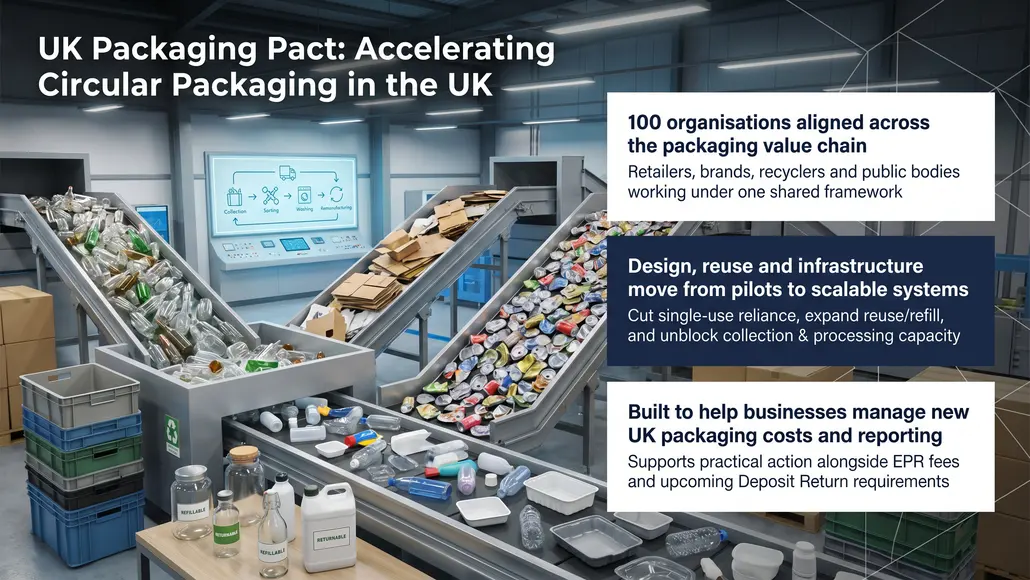
The launch of the UK Packaging Pact by WRAP marks a significant shift in the country’s packaging sustainability framework, bringing together around 100 organisations under a ten-year voluntary agreement to accelerate circular packaging systems. Positioned as an evolution of the earlier UK Plastics Pact, the new programme broadens its scope beyond plastics to address the full spectrum of packaging materials, aligning industry efforts with increasingly complex regulatory and cost pressures.
Formally introduced on 21 April at Sustainable Ventures in London, the initiative includes participation from major corporates such as Lidl, Unilever, Danone, and Biffa, alongside retailers like Marks and Spencer and Tesco, and public bodies including Department for Environment, Food and Rural Affairs and PackUK. The breadth of this coalition reflects a coordinated push across the packaging value chain, spanning material suppliers, converters, retailers, recyclers, and policymakers.
Strategic goals driving system-wide packaging change
The UK Packaging Pact is structured around four core priorities aimed at enabling measurable progress in circularity:
- Optimising packaging design to reduce reliance on fossil-derived and single-use materials
- Scaling reuse and refill systems to increase the share of reusable packaging
- Supporting infrastructure investment to address bottlenecks in collection and processing
- Harmonising data to improve traceability and streamline reporting requirements
These objectives are intended to address persistent operational barriers, particularly fragmentation in data systems and lack of standardisation, which have historically slowed progress in packaging redesign and recovery systems.
According to WRAP CEO Catherine David, the programme is designed to complement regulatory frameworks by providing a flexible mechanism for implementation. She noted that while policy frameworks are essential, coordinated industry action is required to deliver practical outcomes at scale.
Regulatory alignment and financial implications
The timing of the UK Packaging Pact aligns with a tightening regulatory environment in the UK packaging sector. The upcoming Deposit Return Scheme, scheduled for October 2027, will introduce financial incentives for returning beverage containers made from metal and plastic. In parallel, the Extended Producer Responsibility framework is already reshaping cost structures, requiring producers to pay material- and weight-based fees for packaging waste management.
Initial invoices under the EPR system were issued in October 2025, signalling a shift toward greater financial accountability for packaging producers and distributors. The UK Packaging Pact is positioned as a mechanism to help businesses navigate these cost pressures by identifying opportunities to reduce material usage, increase recyclability, and optimise packaging formats.
As observed by Packaging World Insights, the alignment between voluntary industry frameworks and regulatory mandates reflects a broader transition in the sector, where compliance, cost management, and sustainability objectives are increasingly interconnected.
Expanding beyond plastics to full material coverage
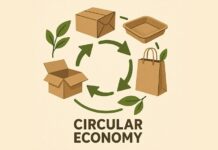
A defining feature of the UK Packaging Pact is its expansion beyond plastics to include all major packaging materials, including glass, paper, card, metals, and bio-based alternatives. This shift acknowledges that addressing packaging waste requires a system-wide approach rather than material-specific interventions.
The broader scope also responds to projections from WRAP indicating that global waste generation could rise by more than 80% from 2020 levels by mid-century. By integrating multiple material streams into a single framework, the Pact aims to support more holistic design strategies and reduce reliance on virgin materials across the packaging ecosystem.
Industry-wide collaboration as an operational necessity
The programme emphasises collaboration across interconnected stakeholders, recognising that packaging reform depends on coordinated action between suppliers, manufacturers, retailers, recyclers, and public authorities. By creating a shared platform for alignment on design standards, infrastructure investment, and reporting methodologies, the UK Packaging Pact seeks to accelerate implementation timelines and reduce fragmentation.
In practical terms, this collaborative model is expected to facilitate interoperable reuse systems, improve recycling efficiency, and support investment in collection and processing infrastructure, areas that have historically faced delays due to misaligned incentives and lack of coordination.
From an industry standpoint, Packaging World Insights notes that the UK Packaging Pact signals a transition toward more operationally integrated sustainability strategies, where circularity is embedded across the value chain rather than addressed through isolated initiatives.
Strategic relevance for the packaging sector
The UK Packaging Pact represents a structural shift in how packaging sustainability is approached in the UK, moving from material-specific targets to a comprehensive, system-based framework. With participation from 100 organisations at launch, the initiative begins with substantial industry backing, positioning it as a central mechanism for navigating regulatory change, cost pressures, and evolving sustainability expectations.
The long-term impact of the UK Packaging Pact will depend on how effectively its commitments translate into tangible changes in packaging design, material usage, and recovery systems. However, its emphasis on collaboration, data harmonisation, and infrastructure investment underscores a broader industry recognition that circular packaging requires coordinated, system-level transformation rather than incremental adjustments.

