























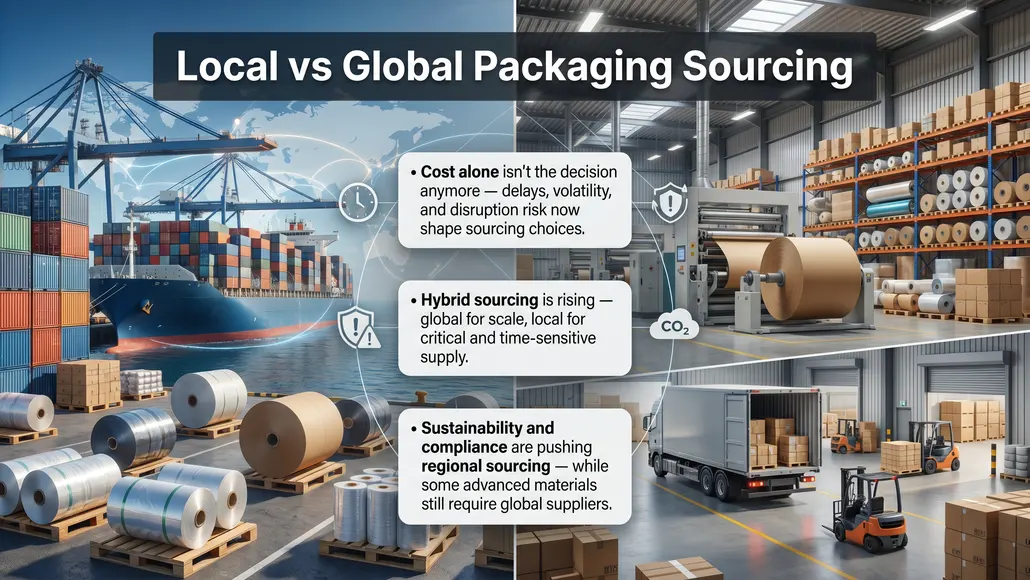
The packaging industry is entering a phase where procurement decisions are no longer driven by cost alone. What was once a straightforward equation of source globally for lower prices has evolved into a far more complex strategic consideration. Today, the debate around local vs global packaging sourcing reflects deeper shifts in supply chain resilience, sustainability expectations, and operational flexibility.
For packaging manufacturers, converters, and FMCG companies, sourcing strategy is increasingly influencing not just margins, but also reliability, compliance, and long-term competitiveness.
Why Global Procurement Became the Industry Standard
For decades, global sourcing defined packaging procurement strategies. The rationale was clear and commercially sound.
International markets offered:
- Lower raw material costs due to large-scale production
- Access to specialized materials not available locally
- Established supplier ecosystems with competitive pricing
- Flexibility in sourcing across regions
Materials such as polymers, specialty films, and coatings often flowed through global supply chains, enabling companies to optimize costs at scale. This model worked efficiently under stable conditions, where logistics were predictable and trade flows remained uninterrupted.
However, that stability has been challenged.
Disruptions Are Redefining Procurement Priorities
The last few years have exposed structural weaknesses in global supply chains. Delays at ports, fluctuations in freight rates, geopolitical tensions, and currency volatility have all impacted procurement timelines and costs.
These disruptions have introduced a critical variable into decision-making: risk.
Companies are now reassessing sourcing strategies through a broader lens. The focus is shifting from minimizing cost to managing uncertainty. This is where the conversation around local vs global packaging sourcing becomes central to strategic planning.
Local Sourcing: A Shift Toward Regional Resilience
Local sourcing is gaining traction, but not simply because of proximity. It represents a move toward regionalized and more controllable supply chains.
Its advantages are increasingly evident:
- Shorter lead times, allowing faster response to demand changes
- Improved coordination with suppliers due to geographic proximity
- Reduced logistics dependency, lowering exposure to global disruptions
- Lower transportation emissions, supporting sustainability targets
At the same time, local sourcing introduces its own constraints. Costs can be higher in certain regions, supplier networks may be less developed, and access to advanced materials can be limited.
This creates a clear trade-off. While local sourcing enhances reliability, it may not always deliver the same cost efficiencies as global procurement.
Cost vs Risk: A More Balanced Equation
The core challenge in local vs global packaging sourcing lies in balancing cost efficiency with supply chain resilience.
Traditionally, procurement teams focused on unit pricing. Today, the evaluation is more comprehensive, incorporating:
- Total landed cost, including freight and duties
- Cost of delays and production disruptions
- Inventory holding costs due to longer lead times
- Exposure to price volatility
This broader approach is reshaping procurement strategies. A lower-cost supplier may no longer be the most economical choice if it introduces higher operational risk.
Hybrid Sourcing Models Are Gaining Ground
Rather than choosing between local and global sourcing, many companies are adopting hybrid models.
These strategies typically involve:
- Continuing global sourcing for high-volume, cost-sensitive materials
- Developing local supplier bases for critical or time-sensitive inputs
- Diversifying sourcing across multiple regions to reduce dependency
This approach allows organizations to maintain cost advantages while improving resilience. It also provides greater flexibility in responding to market fluctuations and supply chain disruptions.
The shift toward hybrid sourcing reflects a more sophisticated understanding of procurement one that treats sourcing as a dynamic portfolio rather than a fixed strategy.
Material-Specific Considerations Shape Strategy
Not all packaging materials can be sourced in the same way, and this significantly influences procurement decisions.
- Polymers and plastics are often globally traded, making international sourcing more viable
- Paper and board tend to have stronger regional supply chains, supporting local sourcing
- Specialty materials, such as high-barrier films, may require global suppliers due to limited availability
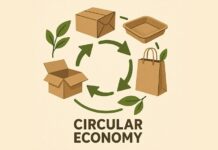
- Recycled materials are increasingly localized, driven by circular economy initiatives
These differences highlight the need for material-specific sourcing strategies, rather than a uniform approach across all inputs.
Sustainability Is Reshaping Procurement Decisions
Environmental considerations are becoming a key factor in sourcing strategies.
Local sourcing aligns well with sustainability goals by:
- Reducing transportation-related emissions
- Supporting regional recycling and circular economy systems
- Improving traceability and compliance with local regulations
At the same time, global suppliers may offer advanced sustainable materials and technologies that are not yet available locally.
This creates a dual challenge for procurement teams: balancing environmental impact with material performance and cost competitiveness.
Operational Implications Go Beyond Procurement
The choice between local and global sourcing affects multiple aspects of business operations.
It influences:
- Inventory strategies and safety stock levels
- Production planning and scheduling flexibility
- Supplier relationship management
- Risk mitigation frameworks
Companies shifting toward local sourcing often need to invest in supplier development and adapt internal processes to align with new supply chain structures.
This reinforces a broader reality: local vs global packaging sourcing is not just a purchasing decision it is an operational strategy.
The Strategic Shift in Packaging Procurement
The industry is moving away from purely efficiency-driven sourcing models toward more balanced, resilience-focused approaches.
Key trends include:
- Increased regionalization of supply chains
- Greater emphasis on supplier diversification
- Integration of sustainability into procurement frameworks
- Use of digital tools to improve supply chain visibility
As increasingly discussed across industry platforms such as Packaging World Insights, sourcing decisions are now closely tied to long-term business strategy rather than short-term cost optimization.
Conclusion: Redefining Value in Sourcing Decisions
The debate around local vs global packaging sourcing ultimately comes down to how value is defined.
Cost remains important, but it is no longer the only metric. Reliability, flexibility, sustainability, and risk management are becoming equally critical in shaping procurement strategies.
For packaging professionals, the path forward lies in developing sourcing models that are:
- Adaptive to changing market conditions
- Aligned with business and sustainability goals
- Structured to balance efficiency with resilience
In this evolving landscape, procurement is no longer a support function. It is a strategic driver that can determine how well companies navigate uncertainty and position themselves for long-term growth.

