










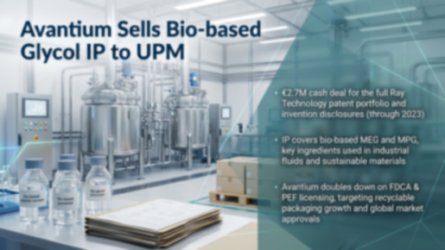

Avantium, a Dutch developer of renewable polymer materials, has finalized an agreement with UPM for the divestment of its Ray Technology intellectual property. This Bio-based Glycol IP Sale, valued at €2.7 million in cash, includes the complete patent portfolio and invention disclosures developed through late 2023. The transaction aligns with the company’s current focus on capital discipline and the commercialization of its core technology platforms.
The intellectual property involved in the sale relates specifically to bio-based MEG production and mono-propylene glycol (MPG). These chemical building blocks are utilized across various industrial fluid applications and are vital for the development of sustainable packaging solutions. Bio-based mono-ethylene glycol is a primary component in the manufacturing of PE furanoate (PEF), a recyclable polymer. The versatility of these materials ensures their continued relevance in industrial fluid applications and high-performance textile manufacturing.
Tom van Aken, CEO of Avantium, stated that the agreement supports the company’s strategic priorities. He expressed satisfaction that the Ray Technology IP would remain with a strong European partner, noting the potential for future collaboration. Within the context of this Bio-based Glycol IP Sale, the company determined that the efficiency of bio-based MEG production at a commercial scale would have necessitated substantial further investment, leading to the decision to divest the assets.
Currently, the organization is concentrating its resources on the licensing of its FDCA and PEF technology platform. By advancing its circular economy technology, the firm aims to meet the growing demand for sustainable packaging solutions in the healthcare and consumer sectors. Despite recent construction-related delays at its flagship plant in Delfzijl, the company continues to progress with its renewable polymer materials strategy. This is evidenced by the recent recycling approval for its plant-based PEF in the Japanese market, marking a significant step for the integration of circular economy technology within global supply chains.