


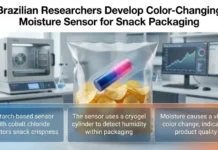





















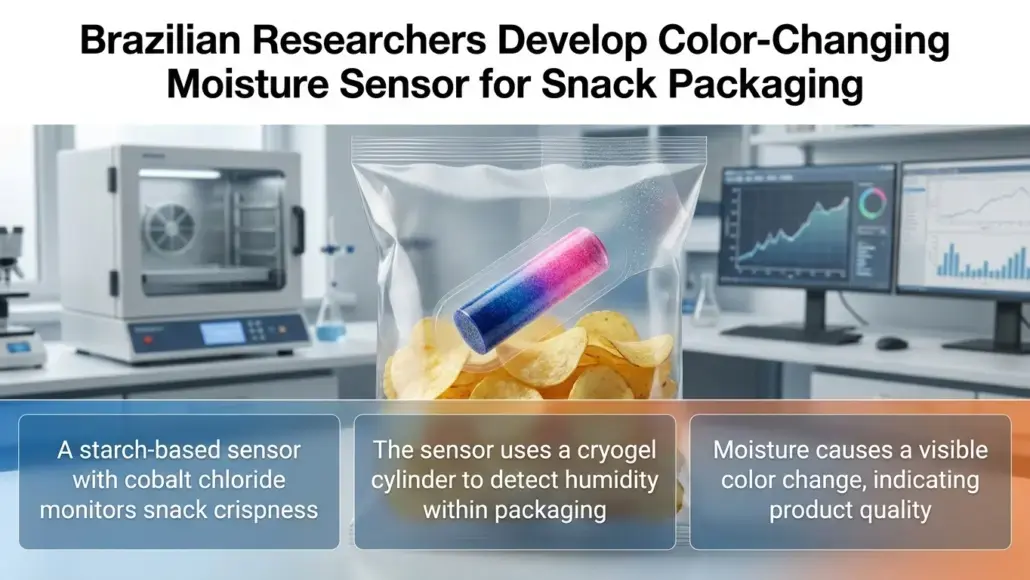

Researchers at the São Carlos Institute of Chemistry at the University of São Paulo (IQSC-USP) in Brazil have developed a starch-based moisture sensor in packaging designed to monitor the quality and crispness of snack products. The sensor utilizes cobalt chloride integrated into a starch-based cryogel cylinder to detect humidity levels within food containers. In the presence of moisture, the salt in the sensor undergoes a visual transition, changing color from blue when dry to pink when hydrated. This highly sensitive mechanism allows both manufacturers and consumers to track internal atmospheric conditions using mobile devices, ensuring that products such as cookies and crackers maintain their intended texture.
The technology behind the sensor involves a highly porous starch-based cryogel manufactured through a specific freeze-drying process. During production, polymers are frozen and the resulting ice is removed via sublimation, which preserves a complex porous structure that maximizes the surface area for environmental interaction. This structural design enables the sensor to respond accurately to both extremely dry and highly humid environments. The research project, supported by the São Paulo Research Foundation, emphasizes a functional approach to food quality monitoring inspired by traditional weather-indicating instruments.
While the technical performance of the moisture sensor in packaging has been demonstrated, commercial implementation currently faces limitations due to the toxicity of cobalt chloride. As the chemical cannot come into direct contact with food, researchers are evaluating alternative materials and redesigning conventional packaging structures to accommodate the technology safely. Current studies are exploring the use of bioactive compounds derived from fruit by-products, such as jabuticaba peel, as safer, natural pigments. These natural alternatives are also being tested for their sensitivity to pH variations, which could expand the application of the sensors to monitor spoilage processes in products like meat.