


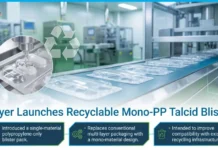















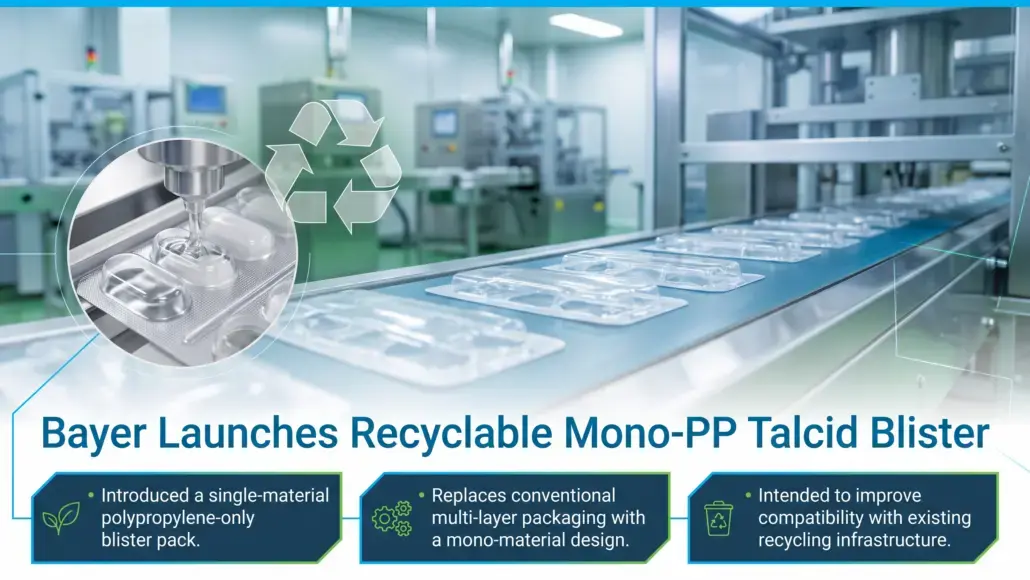

Bayer has introduced a polypropylene-only blister pack for its antacid product Talcid in Germany, following the format’s initial launch in Slovenia in late 2025. The mono-PP Talcid blister replaces a conventional multi-layer packaging structure with a single-material polypropylene design intended to improve compatibility with existing recycling infrastructure.
A Single-Material Design Built for Recycling
The revised blister pack is constructed entirely from polypropylene, making it a mono-material format that still meets the product protection, safety, and quality standards required for consumer health products. Talcid, which is used for heartburn and other acid-related symptoms, continues to be delivered with the same user experience despite the packaging change.
The recyclable blister pack has received RecyClass Design for Recycling certification, achieving a Recyclability Class A rating and a recyclable plastic content score of 98.86%. Bayer stated that the format is intended to support recycling in markets where the necessary collection, sorting, and processing infrastructure is already in place.
Planned Expansion Across European Markets
Bayer plans to extend the new blister format to 11 additional European markets during 2026 and 2027. The German launch marks a significant step in that rollout, building on the earlier introduction in Slovenia.
The Talcid launch also follows Bayer’s broader work on mono-material blister packaging solutions. In 2024, the company introduced a PVC-free polyethylene terephthalate (PET) single-material blister for Aleve in the Netherlands, reflecting a continued direction across its Consumer Health packaging portfolio toward materials that are more compatible with recycling systems.
Bayer’s Position on Scalable Packaging Innovation
Bayer Vice President Chris Padain commented on the development: “The promise of this mono-material polypropylene design is that it can improve compatibility with recycling processes where appropriate systems exist, while continuing to provide a strong consumer experience. Its push-through performance supports intuitive use, while the mono-material structure simplifies the packaging design. This is the kind of practical, scalable innovation that can make a meaningful difference across our portfolio.”
Bayer confirmed that the mono-PP Talcid blister forms part of its wider Consumer Health packaging plans, with the RecyClass-certified design offering a format the company sees as both practically functional and compatible with evolving recycling capabilities across European markets.