























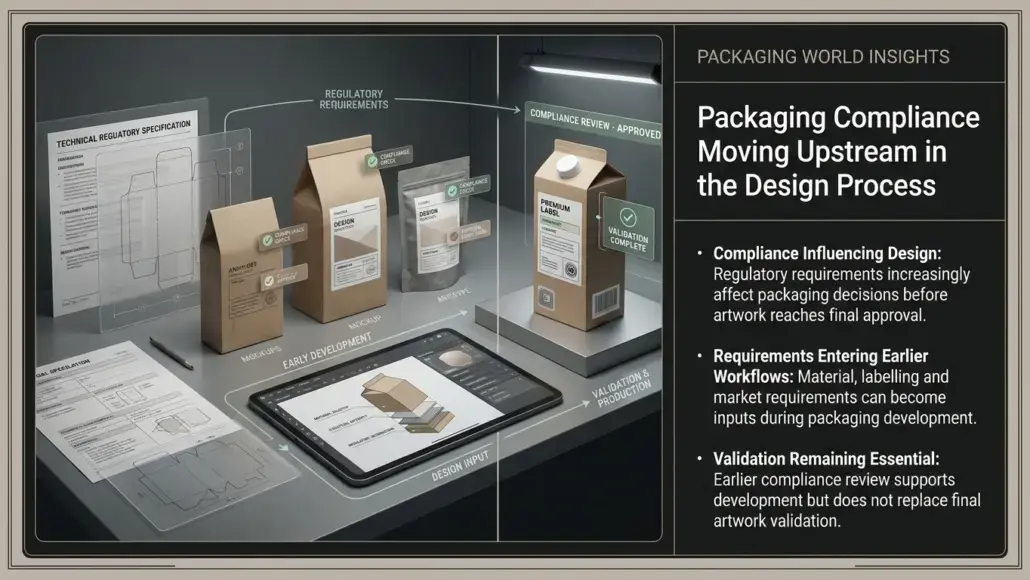

Packaging compliance is increasingly becoming a design consideration rather than a final-stage review. New requirements covering packaging materials, recyclability, labelling and information disclosure can affect decisions before an artwork file reaches approval. This is particularly visible in the European Union, where the Packaging and Packaging Waste Regulation (PPWR), Regulation (EU) 2025/40, began applying on 12 August 2026. The regulation links packaging design with compliance requirements and establishes provisions covering recyclability, labelling and information supplied with packaging. For companies managing products across markets, this means packaging compliance can influence the specification of a pack before designers begin finalising its visual elements. A requirement may affect the format selected, the amount of space available for mandatory information, the materials used, or the information that must be communicated to consumers.
Upstream Compliance Inputs
Several requirements can therefore enter the packaging workflow earlier:
- Packaging format: Structural choices can determine whether a package meets applicable design and material requirements.
- Mandatory information: Regulatory text, symbols, identification details and other information can influence the available design space.
- Market requirements: Different jurisdictions can require different information, classifications or packaging treatments.
- Material considerations: Environmental and producer-responsibility rules can make material selection relevant to compliance from the outset.
This is changing the role of compliance from checking a completed package to helping establish the conditions under which that package can be designed.
Regulatory Requirements Extending Beyond Final Artwork Review
The change is not limited to the PPWR. In the United Kingdom, packaging Extended Producer Responsibility (EPR) requirements place greater emphasis on collecting, validating and reporting structured packaging information. In California, regulations under SB 54 also classify covered packaging using characteristics including material type and packaging form. These examples show how compliance can depend on underlying packaging decisions, not simply the wording printed on the finished pack. At the same time, implementation is continuing to evolve. The European Commission issued guidance in June 2026 and additional FAQ material later in the year to support interpretation of the PPWR, indicating that companies need to account for changing regulatory information rather than rely on a single static compliance check. For organisations handling more complex packaging portfolios, bringing these requirements into the development process earlier can provide a clearer connection between regulatory interpretation, packaging specifications and artwork decisions.
Workflow Implications
- Requirement identification: Regulatory obligations are identified before design is finalised.
- Design integration: Relevant requirements become inputs to packaging and artwork decisions.
- Validation: Artwork and packaging can still undergo formal compliance checks before production.
- Documentation: Decisions and supporting information can be retained as part of the approval process.
The final compliance review therefore remains important, but it increasingly sits within a broader process where packaging compliance begins much earlier in packaging development.
Compliance Across Markets Entering the Packaging Workflow
For companies selling the same product across multiple jurisdictions, regulatory requirements can affect packaging development at several points rather than at a single approval stage. Differences in mandatory information, language requirements, material rules and producer-responsibility obligations can create separate conditions for otherwise similar packages. The European Union’s Packaging and Packaging Waste Regulation (PPWR), for example, introduces requirements covering packaging design, labelling and information, while the United Kingdom’s packaging Extended Producer Responsibility (EPR) framework places greater emphasis on structured packaging data and reporting. As these requirements are considered alongside packaging compliance, packaging teams have to account for regulatory inputs while defining specifications and developing artwork. The effect becomes more pronounced when organisations manage packaging portfolios across markets, where the same product may require multiple packaging versions to accommodate different regulatory conditions.
Cross-Market Compliance Variables
The main variables that can enter the process before final artwork approval include:
- Language and mandatory information: Required statements and consumer information can differ by market and affect available design space.
- Packaging classification: Material and packaging-form requirements can determine how a pack is treated under producer-responsibility rules.
- Design and material choices: Environmental requirements can influence decisions about packaging structure and materials before production.
- Market-specific versions: A core design may need controlled variations for different jurisdictions without losing consistency across the wider product range.
Earlier Validation Changing Approval and Production Decisions
Moving compliance upstream does not remove the need for final validation. Instead, it changes when potential issues are identified. The PPWR establishes requirements that connect packaging design with applicable legal obligations, while the European Commission has issued implementation guidance and additional clarification as organisations work through the regulation. This creates a workflow in which regulatory interpretation can inform packaging specifications before an artwork file is considered production-ready. The objective is not to assume that an earlier review guarantees compliance, but to reduce the likelihood that a requirement is discovered only after significant design or approval work has been completed.
Earlier-Stage Workflow
- Regulatory assessment: Identify the requirements that apply to the product and market.
- Specification development: Translate relevant requirements into packaging and artwork considerations.
- Design and artwork: Build mandatory information and applicable constraints into the package.
- Validation and approval: Check the completed design before it moves into production.
- Record keeping: Retain relevant packaging and compliance information for reporting and future updates.
This makes packaging compliance part of a connected development process extending from regulatory interpretation to production readiness, rather than a checkpoint applied only to finished artwork. 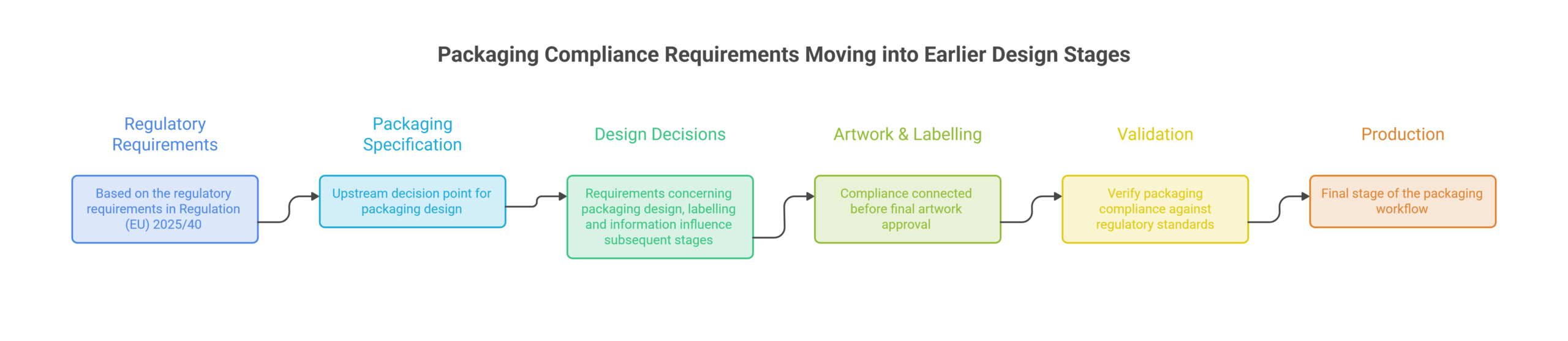 The regulatory requirements increasingly connect packaging decisions with compliance before final artwork approval.
Compliance Becoming Part of Packaging Development
The shift toward earlier regulatory involvement does not make final approval unnecessary. Instead, it changes compliance into a continuous process that can begin when packaging requirements are defined and continue through artwork validation and production. This approach becomes more important as regulations evolve and companies manage different requirements across markets.
Key Areas Requiring Earlier Attention
- Regulatory interpretation: Requirements need to be assessed before design decisions are fixed.
- Packaging specifications: Material, format and information requirements can influence the package itself.
- Artwork validation: Final files still require formal checks before production.
- Documentation: Compliance-related information needs to remain traceable as packaging changes.
For packaging teams, packaging compliance is therefore becoming less of a final inspection and more of an input throughout packaging development. The precise workflow will vary by market, product and organisation, but the direction is increasingly toward earlier identification of regulatory requirements and their integration into packaging decisions.
References
- European Union – Regulation (EU) 2025/40 on Packaging and Packaging Waste – 2025
- European Commission – Commission Guidance Document on Regulation (EU) 2025/40 on Packaging and Packaging Waste – 2026
- UK Government – Report packaging data: Create your reporting file – 2026
- California Department of Resources Recycling and Recovery (CalRecycle) – Packaging Extended Producer Responsibility: SB 54 Regulations – 2026
- Esko – How to Improve Packaging Compliance with Integrated Artwork Management and Regulatory InPackaging compliance is moving earlier into packaging design as regulations increasingly influence materials, labelling, information and market requirements.telligence – 2026