






















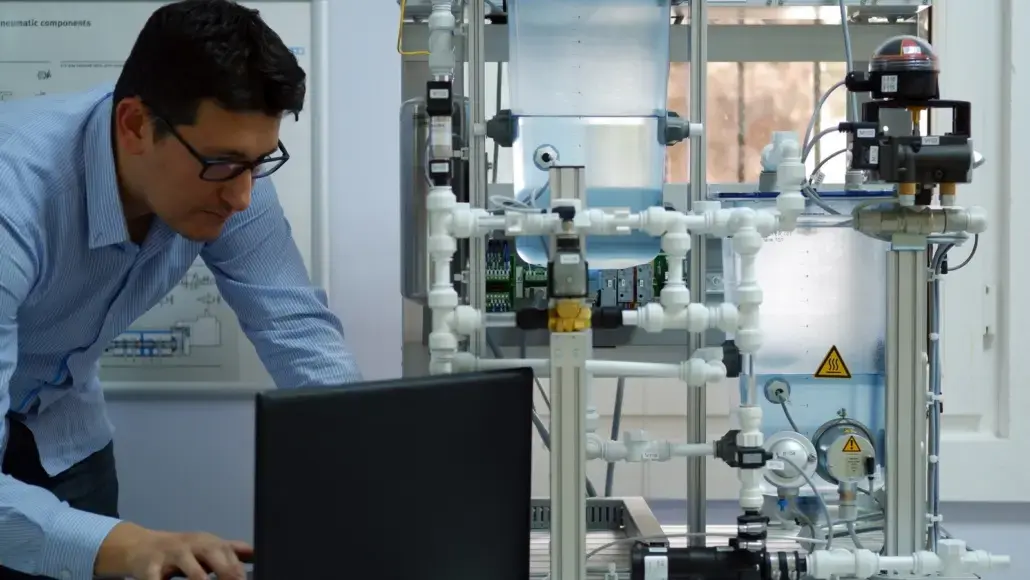

A controller replacement, remote service session or restored backup may look like routine maintenance. On a packaging line, however, a software change can alter the conditions under which sealing jaws stop, a carriage slows or an interlocked guard permits access. The engineering task is to trace that change from its access route to the physical commissioning test that confirms what the machine actually does.
Start with the operator’s task, not the network diagram
Consider an operator opening a guard to remove film trapped between sealing jaws. The physical hazard has not changed: closing movement can crush fingers. The relevant safety function must stop hazardous motion and prevent unexpected start-up while access remains possible. The cyber question is narrower and practical: which software, parameter or communication path could stop that function from behaving as assessed?
Begin with the ISO 12100 risk assessment. Record the task, exposed person, hazardous situation, expected protective measure and consequence if that measure is lost. Then trace every route by which the safety-related behaviour can change: a cabinet USB port, memory card, engineering laptop, remote connection, controller replacement or parameter download at start-up. A socket alone says little; its privileges and the values it can modify matter far more.
Trace the change from service access to harm
For each route, define who can connect, from where, for how long and with which authority. Include temporary service connections and ordinary errors. A genuine backup restored to the wrong station may be as consequential as a deliberate intervention, even though the file, engineer and maintenance tool are all authorised.
A structured machinery cybersecurity assessment under prEN 50742 can connect these access conditions to the machine risk assessment. The enquiry draft describes a process for identifying connections through which protection could be compromised, assessing threats and selecting measures that can later be tested. As a draft, it should be treated as a technical specification rather than an automatic route to conformity.
The threat record should name the intervention and its route. For example: a service account writes a safety-controller program that allows sealing motion while the guard is open. The hazard remains the moving jaws; the software change creates the route by which the operator can be exposed. Existing independent measures must be checked for genuine independence from the same data, controller or communication channel.
Control valid files, not only malicious ones
Packaging lines often contain repeated machine modules using similar drives and controllers. This makes backup management efficient, but it also creates a credible wrong-file scenario. A valid parameter set for station A may contain a higher permitted speed than station B, where an operator adjusts a guide with the guard open. Two healthy channels can still agree on the wrong value if both receive the same incorrect parameter.
Controls should therefore address identity, authorisation, file authenticity and destination. Depending on the assessed requirement, this may mean separating diagnostic and write privileges, checking a package signature, comparing a station identifier with protected machine data, or inhibiting safety-dependent motion until the correct configuration is accepted. Removing an unnecessary external programming socket can eliminate one path, but any remaining internal or remote path still needs assessment.
Turn the assessment into commissioning tests
A software security control is incomplete until its effect at the machine has been verified. Before testing, specify the attempted change, expected response, active configuration and restart conditions. For a guard-interlocked packer, an unauthorised program write should be rejected, the approved version should remain active, and opening the guard should still stop hazardous movement and prevent restart.
For a speed-monitored carriage, try writing the limit through a read-only account, restoring another station’s backup and restarting the controller. Record whether the write was rejected, whether motion remained inhibited and which value became active after power-up. Then perform a controlled overspeed test against the safety requirements specification, including defined load and stopping-time criteria.
Do not rely solely on a successful network or file-integrity test. A correctly rejected message does not prove adequate stopping performance, while a successful stop test does not prove that the next boot will load the same configuration. Cybersecurity evidence and functional validation answer different questions and must be reviewed together.
Preserve the decision history
Commissioning evidence should identify the machine or station, software and configuration versions, account privileges, connection route, test conditions, expected result and observed response. If timing changes after a security measure is introduced, return to the machine risk assessment and check whether the original risk-reduction assumptions still hold.
A technical decision history with the full context of changes helps prevent an approved conclusion from becoming an unexplained current-state snapshot. Status changes, reviewers, timestamps and engineering notes can show why a threat was closed, reopened or sent back for further risk reduction. Access to these records should itself be controlled, and the retention approach should follow the applicable project and regulatory requirements.
Define what reopens the assessment
The assessment remains valid only within its stated security context. A new remote-service route, changed backup process, replacement controller, revised recipe authority or altered site access arrangement can invalidate earlier assumptions. Change control should therefore identify which safety functions may be affected and which acceptance tests must be repeated.
Residual risk also needs operational treatment. If an authorised service session could be misused while unattended, require the engineer to close it before leaving. If interference is suspected, keep the machine out of service until the active program, parameters and affected safety functions have been checked. Instructions cannot compensate for a technically inadequate design, but they can define the controlled response to risks that remain.
The final question is not whether the software update completed successfully. It is whether the guard, monitored speed or other protective measure still provides the required risk reduction under real machine conditions. Following the path from access to configuration, hazardous event and physical test gives plant managers, safety engineers and machine buyers evidence they can examine rather than reassurance they must simply accept.