


















Packaging lines lose more time to jams, tipped product, and awkward hand-offs between stations than most operations teams like to admit, and a lot of that loss traces back to the conveyor doing the actual moving. When products slide, tip, or bind on the way from filling to labeling to casing, every station downstream feels it within minutes, and a small stall at one point in the line can snowball into a full stop by the time it reaches packing. So the question worth asking before the next line audit is: how do tabletop conveyor systems reduce downtime on packaging lines?
Tabletop conveyor systems cut packaging line downtime by moving products across a flat, low-friction surface that reduces tipping and jamming, and by using modular sections that are quick to reconfigure or repair.
That answer covers the mechanics, but it does not explain why some tabletop systems solve the problem, and others just move it further down the line. The difference usually shows up in scrap counts and unscheduled stops, not on a spec sheet, which is worth understanding before specifying the next system.
Why Product Handling Matters More Than Conveyor Speed
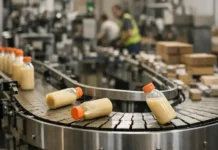
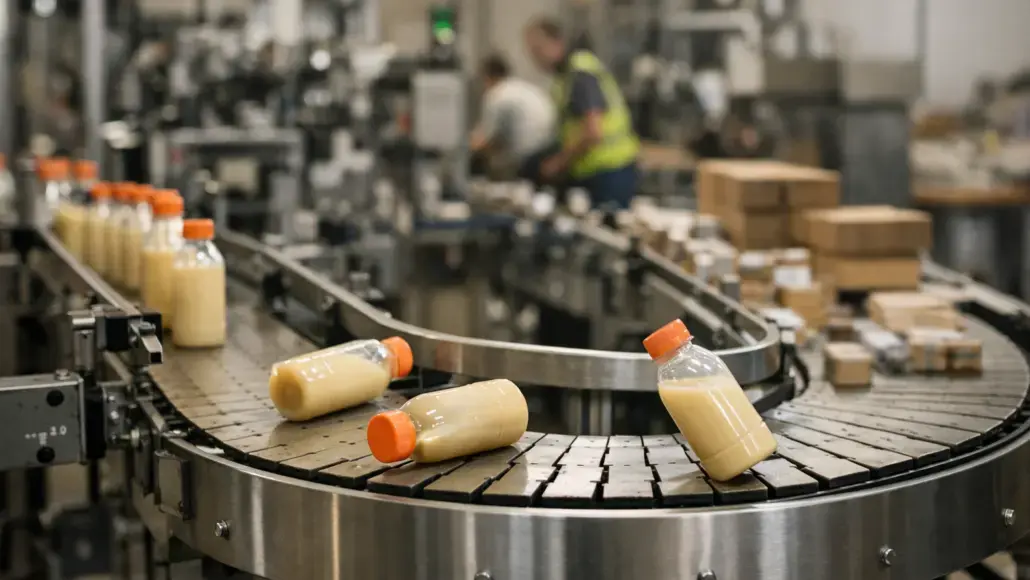
It is tempting to shop for a tabletop conveyor on belt speed alone, but speed is not what causes most packaging line stoppages. Unstable, delicate, or oddly shaped products, think glass bottles, filled pouches, cartons, or lightweight plastics, are more likely to tip or jam than to simply run too slowly.
A tabletop conveyor with a flat, sanitary top plate and a low-friction surface keeps products upright and moving as a single, controlled flow instead of colliding or backing up. That single change removes a large share of the manual clearing and restart cycles that eat into uptime on food, beverage, and pharmaceutical lines.
The cost of getting this wrong is not limited to the stopped line. A tipped bottle or a crushed carton often means scrapped product, a mislabeled unit that has to be pulled downstream, or, in a regulated environment, a quality hold while the team documents what happened. Those secondary costs add up faster than the minutes on the stoppage report suggest, which is why handling stability tends to matter more than raw throughput numbers when a line keeps underperforming.
Where Tabletop Conveyors Fit Into a Packaging Line
Tabletop conveyors rarely operate alone. They sit between filling, capping, labeling, casing, and bundling or banding equipment, and they are often the piece that has to accommodate a 90-degree or 180-degree transfer, merge two lines into one, or briefly buffer product without disturbing it.
Modular tabletop sections make that kind of layout change practical. Instead of redesigning an entire line to add a station or reroute product flow, a manufacturer can add, swap, or reposition sections to match the new configuration. That flexibility matters most during a product launch, a line speed increase, or a shift to a new package format, when the line cannot afford weeks of downtime for a rebuild.
It also matters when a line has to run more than one product. A facility switching between bottle sizes, carton formats, or pouch weights on the same shift needs a conveyor that adjusts with minimal changeover time. A rigid, purpose-built conveyor forces a choice between a slow manual changeover and a permanent compromise that runs every product a little worse than it should. A modular tabletop system avoids that trade-off by letting guide rails, transfer points, and section lengths adjust to the product actually running that day.
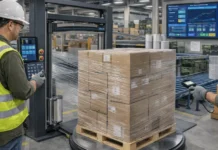
That bundling or banding step deserves the same attention as the conveyor feeding it, since a bottleneck there erases whatever time was gained upstream. For manufacturers weighing that piece of equipment, a look at how Felins banding machines handle high-volume banding is a useful reference point, since conveying and banding tend to work best when they are planned together rather than sourced as an afterthought.
What to Look For in a Tabletop Conveyor System
Not every tabletop conveyor is built for the same environment, and the features that matter most rarely show up until the line has been running for a few months. A few features separate a system that holds up on a demanding line from one that turns into the next maintenance headache:
- Sanitary, stainless steel construction that meets FDA and USDA expectations for food, beverage, and pharmaceutical environments
- Tool-free access for cleaning and maintenance, so a changeover or wash-down does not turn into an extended stop
- Zero-pressure or low-backpressure transport that protects delicate or labeled products from scuffing and damage
- Modular design that supports quick reconfiguration as products, speeds, or layouts change
Well-built tabletop conveyor systems are designed around exactly these requirements, pairing sanitary construction with configurations built for fast layout changes rather than one fixed setup. The point is not to collect every feature on the list, but to weigh which ones actually apply to the product, the plant’s sanitation standard, and how often the line is expected to change.
How a Line Analysis Prevents Costly Guesswork
Specifying a tabletop conveyor from a catalog is a gamble if nobody has tested how the actual product behaves on that surface. Product weight, center of gravity, container material, and even how full a container is at transfer speed all affect whether a given conveyor design will run clean or cause problems at speed.
This is why established conveyor and accumulation manufacturers offer free line analysis and in-house product testing before a system ships. That step catches handling issues on a test line instead of on the production floor, where a bad fit turns into scrapped product and an emergency service call. It also gives an engineering team a chance to catch a transfer point or guide rail setting that looks fine on paper but causes a product to tip at full speed, long before that mistake shows up as a line stoppage.
Skipping that step to save a few weeks of lead time is one of the more common ways a new conveyor ends up under-performing from day one. A short validation run against real product is a small investment compared to the cost of retrofitting a line that is already installed and running behind target.
Where to Start if Downtime Keeps Coming Back
If a packaging line is losing time to jams, tipped product, or awkward transfers, the tabletop conveyor is one of the first places to look, not the last. Before specifying a replacement, pull the stoppage data for the last few months and see how much of it traces back to product handling rather than upstream or downstream equipment. Then request a line analysis so the recommendation is based on how your actual product behaves rather than a generic spec sheet.