






















The global manufacturing sector is currently experiencing a profound transition toward intelligent, decentralized production systems, and the moulded fibre packaging industry is no exception. Historically, the production of moulded pulp was a labor-intensive, relatively slow process characterized by manual handling and inconsistent quality control. However, the surge in demand for plastic alternatives has necessitated a radical rethink of the production floor. Today, moulded fibre packaging automation has moved from being a luxury for large-scale players to a fundamental requirement for anyone seeking to compete in the modern circular economy. This shift is driven by a convergence of advanced robotics, high-speed sensor technology, and the principles of Industry 4.0, which collectively allow for the creation of complex, high-performance packaging at speeds and costs that were previously unimaginable.
At the core of this automation revolution is the need for absolute consistency. In high-speed packaging lines, even a millimeter of deviation in a tray’s dimensions can lead to mechanical failure or product damage. Automation removes the variability inherent in human labor, ensuring that every cycle of the moulding machine is identical to the last. This precision is not just about aesthetics; it is about the structural integrity of the final product. By automating the slurry preparation, the vacuum forming, and the subsequent drying stages, manufacturers can maintain precise control over the fibre distribution and wall thickness of every container. This technical mastery is what allows moulded fibre to compete directly with the exacting standards of injection-moulded plastics, providing a sustainable solution that does not compromise on industrial performance.
The Integration of Robotics in the Wet-End and Forming Stages
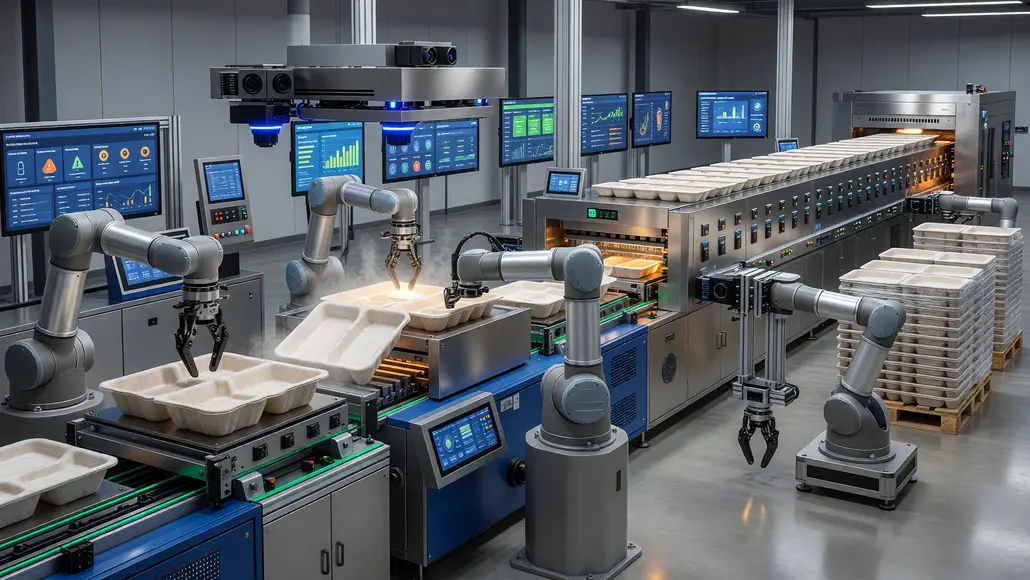
The initial stages of fibre moulding involve the management of a complex slurry of water and cellulose. Automating the preparation of this “wet-end” is critical for ensuring material homogeneity. Modern systems utilize intelligent dosing pumps and real-time viscosity sensors to maintain the perfect balance of fibre, water, and additives. Once the slurry is prepared, the forming process itself is increasingly managed by high-speed robotic systems. These robots can transfer wet “pre-forms” from the forming mould to the drying press with a level of delicacy and speed that manual labor cannot match. This reduces the risk of deformation or tearing of the fragile wet fibre, leading to a significant decrease in waste and a corresponding increase in overall facility yield.
Beyond simple transfer, robotics are being used to perform complex in-mould operations. For instance, some advanced machines now incorporate robotic inserts that can create deep-draw geometries or complex undercuts that were previously impossible to achieve. This flexibility is a hallmark of smart manufacturing packaging, where the production line can be reconfigured in minutes to handle different designs rather than requiring hours of manual tooling adjustments. The ability to switch between production runs with minimal downtime is a major competitive advantage in an era where brand owners are demanding smaller, more frequent batches of customized packaging.
Intelligent Drying and Thermal Energy Management
The drying stage has traditionally been the most energy-intensive and time-consuming part of fibre packaging production. Automation is playing a pivotal role in optimizing this process through the use of intelligent thermal management systems. Modern drying tunnels are equipped with arrays of moisture sensors and infrared cameras that monitor the state of each product in real-time. This data is fed back into a central control system that adjusts the temperature and airflow in each zone of the oven to ensure uniform drying. This prevent “hot spots” that can cause warping or charring, while also significantly reducing the amount of energy wasted on over-drying.
The integration of heat recovery systems is another critical trend. By automating the capture and recirculation of hot air, manufacturers can significantly lower their carbon footprint and operational costs. Some “smart” drying systems even utilize artificial intelligence to predict the ideal drying profile based on the ambient humidity and the specific characteristics of the fibre slurry being used. This predictive capability is a key component of packaging efficiency, allowing for a faster throughput without the risk of internal moisture being trapped in the material, which could lead to structural failure later in the supply chain.
Real-Time Quality Control and Vision Systems
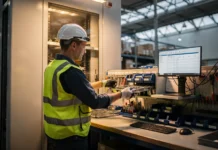
Perhaps the most impactful application of moulded fibre packaging automation is in the area of quality assurance. High-resolution vision systems, powered by machine learning algorithms, are now capable of inspecting thousands of units per minute as they emerge from the production line. these systems can detect microscopic cracks, surface irregularities, or subtle color shifts that would be invisible to the human eye. When a defect is identified, the system can automatically divert the faulty product back into the pulper for recycling, ensuring that only 100% compliant goods reach the final packing stage. This level of automated inspection is essential for the high-volume manufacturing environments required by global food and electronics brands.
In addition to visual inspection, automated systems are increasingly used to perform “destructive” testing on a statistical basis. Robotic arms can periodically pull a sample from the line and subject it to compression, burst, or moisture-resistance tests. The results of these tests are recorded digitally, providing a complete “quality trail” for every production run. This transparency is highly valued by brand owners who must ensure their packaging meets strict international standards for product protection and safety. By automating the quality control process, manufacturers can guarantee a level of moulded fibre packaging quality that was simply not possible in the era of manual spot-checks.
The Role of Digital Twins and Predictive Maintenance
As moulded fibre machinery becomes more complex, the cost of unplanned downtime becomes exponentially higher. To combat this, leading manufacturers are adopting “Digital Twin” technology. A digital twin is a virtual replica of the physical production line that receives real-time data from sensors embedded in the machinery. By analyzing this data, engineers can simulate different production scenarios and identify potential bottlenecks before they occur. This virtual environment also allows for the training of operators in a risk-free setting, further improving the overall efficiency of the facility.
Predictive maintenance is another major benefit of this digital connectivity. Instead of following a rigid maintenance schedule, automated systems can monitor the “health” of critical components such as vacuum pumps, hydraulic cylinders, and heating elements and alert the team only when a part is approaching its failure point. This just-in-time maintenance strategy maximizes the lifespan of the equipment and minimizes the risk of costly, unexpected breakdowns. In the high-pressure world of fibre packaging production, where machines often run 24/7, the ability to predict and prevent failures is the difference between a profitable operation and a failing one.
End-of-Line Automation and Logistical Integration
The final stage of the production process packing and palletizing is also seeing a wave of automation. Robotic arms equipped with specialized vacuum or mechanical grippers can denest, stack, and wrap finished products with incredible speed and accuracy. These robots can be integrated directly with the facility’s warehouse management system, allowing for the automatic tracking of inventory and the generation of shipping documents. This end-to-end automation ensures that the efficiency gains achieved in the moulding process are not lost in the logistics phase.
End-of-line automation also improves the safety of the working environment by removing human operators from repetitive, heavy-lifting tasks. This reduction in physical strain leads to a more stable and satisfied workforce, while also lowering the risk of workplace injuries. Furthermore, automated palletizing ensures that the finished goods are stacked in a way that maximizes space in delivery vehicles, further reducing the carbon footprint of the distribution cycle. This holistic approach to automation is what defines a truly “smart” manufacturing facility, where every movement of material is optimized for speed, safety, and sustainability.
Future Outlook: AI-Driven Autonomous Factories
Looking ahead, the next frontier for moulded fibre packaging automation is the transition to fully autonomous, AI-driven factories. These “lights-out” facilities would be capable of managing the entire production cycle from the sourcing of raw pulp to the final delivery of finished goods with minimal human intervention. AI algorithms will manage the complex interactions between machine speed, energy consumption, and material quality, constantly optimizing the system for the best possible results. This level of autonomy will allow the industry to achieve the massive scale needed to replace millions of tons of plastic on a global basis.
The globalization of automation technology will also play a key role. As high-speed, automated moulding machines become more affordable and easier to operate, we will see a proliferation of smaller, localized production hubs. These facilities can be located near the source of raw materials or the end-customer, further reducing the environmental impact of transport. By combining the power of global technology with the resilience of local production, the moulded fibre industry is positioning itself as a leader in the next industrial revolution one that is defined by intelligence, efficiency, and a deep commitment to the planet.