







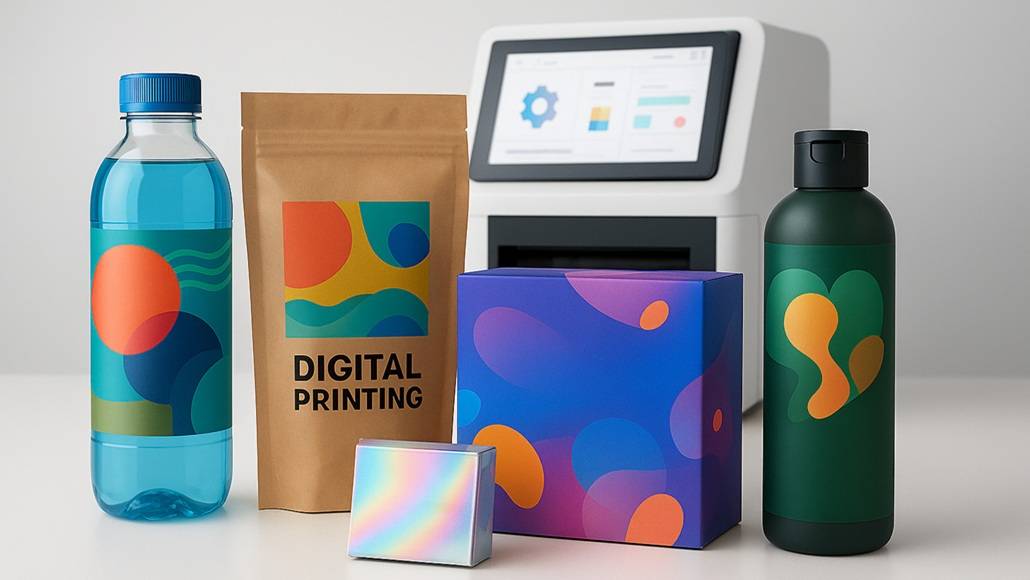
If you’re in packaging, you already know digital printing isn’t a “future” technology anymore — it’s today’s competitive edge. Customers expect personalization, brands are under pressure to meet ambitious sustainability targets and supply chains require faster turnaround times on shorter print runs. This reality has pushed digital printing from a supplemental tool to the core of packaging strategy.
So, what are the latest trends in digital printing technology? They’re not just about faster presses or sharper colors. These trends are changing how you design, source and deliver packaging, and they’ll influence whether your business stays competitive in the next decade.
1. Water-Based Printing for Flexible Plastics
Flexible plastics dominate many packaging categories, from snacks to personal care products. Balancing durability with environmental responsibility remains a challenge.
The newest generation of water-based inks and printing presses, like Fujifilm’s J Press FP790, changes the equation. These inks bond effectively to flexible films, maintain durability in shipping and storage, and meet stricter safety standards for food-contact packaging.
Switching to water-based systems cuts emissions and simplifies compliance with international market standards where solvent restrictions are tightening. For your clients, that means packaging that looks sharp, performs reliably and supports their sustainability goals. For your operation, it means fewer regulatory headaches and a stronger competitive edge.
2. Advances in Ink Jet and Hybrid Solutions
Leaders and innovators in digital printing regularly showcase various new inkjet and hybrid press technologies. The latest and most talked-about new systems deliver speed, high resolution and broader substrate compatibility, reducing the need for frequent press changes.
Hybrid technology, like the Fujifilm DE1024 digital embellishment printbar, is another step forward. Instead of choosing between analog and digital, you can optimize both. For example, long runs that benefit from analog efficiency can pair with digital technology for short runs, personalization and regional variations. Ultimately, digital printing will continue dominating the market because of its cost-effectiveness and versatility.
For packaging leaders, Fujifilm’s advancements highlight where the industry is heading — sustainable, versatile and scalable solutions. And these industry leaders are a key part of creating a production line that grows with evolving customer demands.
3. Eco-Friendly Printing as the Standard
Sustainability has moved from optional to mandatory. With packaging materials often singled out in environmental debates, the way you print carries as much weight as how you pack. Advances in eco-friendly inks — including water-based, low-grade volatile organic compounds (VOCs) and bio-based formulations — give you performance that rivals solvent-based systems without the same environmental drawbacks. You’re reducing hazardous waste and creating packaging that integrates better with recycling streams.
In a market where consumers and regulators watch closely, eco-friendly printing helps you build credibility and align with environmental, social and governance reporting requirements. For many consumer packaging goods companies, sustainability is no longer about standing out — it’s a baseline expectation. If you want to remain in the global brand supply chain, then using greener printing practices, such as using recyclable inks with a rosin resin binder, is essential.
4. UV Printing for Labels and Packaging
Labeling and packaging often demand durability, fast curing and sharp color reproduction. UV printing meets those needs while speeding up your workflow.
UV-curable inks harden instantly under ultraviolet light, eliminating long drying times and reducing energy use compared to traditional heat-based curing. That means you can complete short runs more efficiently while maintaining durability against abrasion and moisture.
For packaging, the payoff is clear — faster turnaround times, lower operational costs and the ability to deliver vibrant, shelf-ready designs. As consumer products cycle through seasonal promotions and limited editions faster than ever, UV printing gives you the agility to keep up.
It is such a versatile approach that the UV printing market should increase from $50.61 billion in 2025 to $87.62 billion in 2032.
5. AI-Driven Automation in Print Workflows
Artificial intelligence technology is no longer confined to futuristic case studies. AI tools now manage color consistency, predict maintenance needs and optimize workflow scheduling.
For packaging operations, this translates to fewer breakdowns, less downtime, and more reliable brand color reproduction across multiple runs and regions. Color consistency isn’t optional if you’re handling packaging for multinational brands. AI-driven automation gives you that consistency without constant manual intervention.
Beyond managing presses, AI also provides demand forecasting. By analyzing past orders and seasonal patterns, systems can help you anticipate runs, reduce waste and better align with your clients’ supply chains.
6. Web-to-Print Platforms Streamline Orders
Ordering processes have evolved. Instead of back-and-forth emails, web-to-print systems give clients a digital portal to upload artwork, customize orders and approve proofs instantly.
For you, this streamlines job intake, reduces prepress errors and cuts lead times. This offers clients more control and transparency.
As packaging becomes increasingly localized and personalized, web-to-print solutions position you as a more responsive partner. You’re not just selling print capacity — you’re giving clients a digital-first experience that mirrors how they interact with other vendors.
7. 3D Visualization Enhances Design Prototyping
Physical prototypes are costly and time-consuming. Virtual mockups and 3D visualization tools now let you create lifelike packaging previews without consuming materials.
Easily share these visualizations across teams and stakeholders, speeding up approval processes and reducing the risk of costly redesigns after production starts. For packaging companies working with global clients, this means fewer shipping delays for samples and smoother cross-border collaboration.
Augmented reality tools add another layer. Imagine showing a client how their package will look on a shelf, in multiple SKUs, without printing a single mock-up. That capability reduces waste while increasing customer confidence in your design process.
8. Optimized Design Software Reduces Waste
The design phase is critical to production efficiency. New prepress and design software integrates waste-reduction analytics and automation into the workflow. You can simulate print layouts, detect potential issues and calculate material usage before you even start a run. By catching errors early, you reduce the likelihood of reprints, save on materials and labor, and save up to 37% on energy use while boosting your sustainability profile.
For packaging professionals, this is where cost savings align with sustainability. Less waste isn’t just environmentally friendly — it’s operationally lean. Optimized software pays for itself when margins are tight by eliminating wastage through better workflow design.
9. Erasable Printing as a Circular Economy Enabler
Erasable printing is one of the more experimental but promising innovations. This technology removes printed images from special substrates, leaving the material ready for reuse.
Imagine shipping boxes or return packaging with photochromic properties that let you erase the printing and rebrand them repeatedly without new material costs. For closed-loop supply chains, erasable printing has the potential to cut packaging waste dramatically.
While this is still in early adoption stages, it’s worth watching. As regulations around single-use packaging intensify, erasable printing could become part of your sustainability strategy.
10. IoT Integration for Smarter Printing Systems
The Internet of Things (IoT) intelligently connects printing presses. Sensors and connectivity features now let you monitor performance, track consumables and receive real-time alerts on production lines.
IoT-enabled presses offer centralized visibility in multisite operations. You can track output across facilities, standardize quality and proactively schedule maintenance.
The data advantage extends beyond operations. The IoT enables you to provide clients with traceability and verification, showing them the results and the process. That transparency can be a deciding factor in winning contracts with global brands.
11. Smart Packaging With Active Embedded Sensors
Packing is no longer passive. With advances in printed electronics and sensor integration, you can now offer “smart packaging” that actively monitors product conditions. Tags and sensors allow you to track freshness, temperature changes and tampering. Some research prototypes go further, embedding battery-free, stretchable sensors that detect biometrics and take remedial action to extend freshness.
Smart packaging improves safety, reduces waste and allows brands to build trust with consumers who want more transparency. In categories like pharmaceuticals, fresh foods and luxury goods, embedded sensors could soon shift from novelty to necessity.
12. 4D Printing for Changing Packaging
If 3D printing expands your production capabilities, 4D printing takes it a step further. The fourth dimension is time — meaning the packaging can change shape or function after production, triggered by environmental factors like heat, humidity or voltage.
The possibilities for packaging are groundbreaking. Imagine flat-packed boxes that self-assemble in transit, tamper-evident seals that morph when opened or containers that adjust to temperature changes to protect their contents. These shape-shifting properties can reduce logistics costs, improve product security and create outstanding consumer experiences.
For you, 4D printing offers efficiency and innovation. It cuts shipping volumes, streamlines assembly and gives your clients packaging that feels futuristic yet practical. While still in the early stages, it’s an area you’ll want to watch closely. Once it scales, it could rewrite how packaging is designed, delivered and experienced.
What Are the Latest Trends in Digital Printing Technology?
Digital printing has outgrown its role as a “special projects” tool — it’s now central to meeting consumer demands, sustainability regulations and supply chain pressures. These trends are paving the way for the future of packaging. Your competitors are already adopting them, so what about you?
If you want to stay relevant, the choice isn’t whether to adopt these technologies — it’s how quickly you can integrate them into your packaging strategy. The companies that move first will set the standards, while late adopters risk falling behind. Make sure your business is a leader and not a follower.