






















Key Takeaways
- Precision Engineering and CAD/CAM Integration: Modern custom tooling for moulded fibre is a result of advanced digital design and CNC machining, ensuring that complex shapes and high tolerances are consistently achieved. This technological shift allows for the production of premium-grade packaging that rivals plastic in terms of fit and finish.
- Efficiency Through Thermal and Vacuum Management: The performance of a mould is defined by its ability to manage water drainage and heat distribution. Specialized designs with optimized vacuum channels and integrated heating elements are essential for reducing cycle times and ensuring high-speed, cost-effective production in large-scale manufacturing environments.
In the rapidly evolving world of sustainable manufacturing, the quality of the final product is inextricably linked to the sophistication of the tools used to create it. For the moulded pulp industry, this means that custom tooling development for moulded fibre packaging is the most critical factor in achieving high-performance results. While the raw material cellulose fibre is abundant and simple, the process of transforming that fibre into a precise, structural, and aesthetically pleasing package requires highly engineered moulds. Modern tooling is no longer just a cast of a shape; it is a complex assembly of precision-machined components, drainage systems, and thermal management features that dictate everything from production speed to the surface finish of the packaging. At Packaging World Insights, this evolution in tooling is seen as a defining shift where precision engineering is no longer a differentiator but a baseline expectation for scalable, high-performance sustainable packaging.
The Lifecycle of a Custom Mould Project
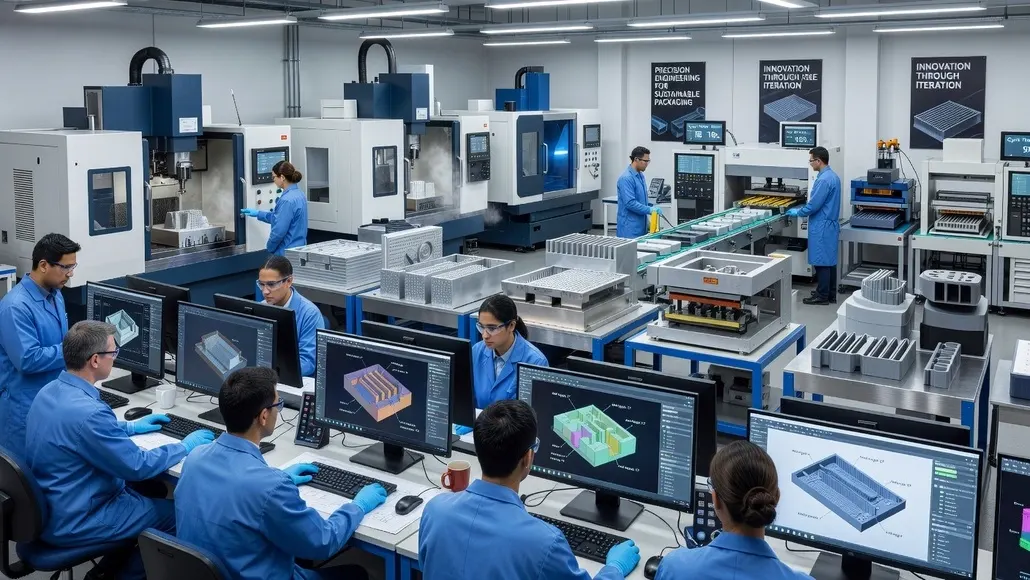
The journey of moulded fibre tooling development begins long before any metal is cut. It starts in the digital realm with collaborative design sessions between packaging engineers and tooling specialists. Using advanced Computer-Aided Design (CAD) software, engineers create a 3D model of the packaging part. This model must account for “draft angles” to ensure the part can be easily removed from the mould, and “shrinkage factors” as the fibre dries and contracts.
Once the design is finalized, it undergoes Computer-Aided Manufacturing (CAM) processing. This stage translates the digital model into precise instructions for CNC (Computer Numerical Control) machines. The transition from traditional hand-crafted moulds to CNC-machined tooling has revolutionized the industry. It has enabled a level of accuracy and repeatability that was previously impossible, allowing for the creation of intricate packaging tooling design features such as thin walls, sharp corners, and integrated logos. This precision is essential for products in the electronics, medical, and cosmetics sectors, where a fraction of a millimeter can be the difference between a perfect fit and a shipping disaster.
Materials and Construction of High-Performance Tools
The selection of materials for fibre mould tools is a specialized science. Unlike plastic injection moulds, moulded fibre tools operate in a wet, abrasive, and often high-temperature environment. Traditionally, tools were made from cast aluminum, but today’s high-output facilities often utilize specialized alloys or stainless steel to ensure longevity. Aluminum remains popular for its excellent thermal conductivity, which is vital for the drying phase of the process, while stainless steel is preferred for its resistance to corrosion and wear over millions of cycles.
A complete tooling set typically consists of several parts: the forming mould, the transfer mould, and the hot-press or finishing mould. The forming mould is the primary tool that pulls the pulp slurry using vacuum pressure. This tool is covered with a fine stainless steel mesh or a specialized micro-perforated surface that allows water to pass through while retaining the fibres. The engineering of this mesh or perforated screen is a masterpiece of manufacturing manufacturing tools, as it must be perfectly contoured to the tool’s shape to prevent “pulp buildup” or uneven wall thickness.
Optimizing Drainage and Vacuum Distribution
One of the most complex aspects of custom tooling development for moulded fibre packaging is the design of the internal vacuum and drainage channels. For the packaging to form correctly, the vacuum must be distributed evenly across the entire surface of the tool. If there are “dead spots” or areas with poor suction, the part will have weak points or inconsistent density.
Engineers use fluid dynamics simulations to map the flow of water through the tool. By optimizing the placement and size of the drainage holes, they can maximize the speed at which water is removed from the pulp slurry. This directly impacts the “cycle time” the time it takes to produce one part. Faster drainage means faster production cycles, which translates to lower costs for the brand owner. This focus on efficiency is what makes moulded fibre tooling development a high-stakes engineering discipline.
The Role of Finishing and Hot-Press Tooling
For high-end applications, such as retail packaging for perfumes or premium consumer electronics, the “Type 3” or smooth-wall process is used. This requires an additional set of tools known as hot-press or finishing moulds. After the part is formed and partially dried, it is placed into a heated metal mould that presses the part at high pressure.
This stage is where the “branding” happens. The hot-press tool smooths out the rough texture of the fibres, giving the packaging a plastic-like finish that is silky to the touch and ready for high-quality printing. The development of these tools requires extreme precision in thermal management. The heat must be uniform across the entire surface to prevent warping or scorching of the fibres. Custom packaging molds designed for hot-pressing are often equipped with integrated heating elements and sensors to maintain the exact temperatures required for a flawless finish.
Scalability and Maintenance of Tooling Assets
In a global supply chain, consistency is king. A brand may need to produce the same moulded fibre insert in factories in Europe, Asia, and North America. Custom tooling development for moulded fibre packaging ensures that every set of tools produced regardless of where they are used is identical. CNC machining and digital blueprints allow for the rapid duplication of tools with zero variation.
However, even the best tools require maintenance. The abrasive nature of wood pulp and the high-pressure environment of the press can lead to wear over time. Modern tooling design now incorporates “replaceable inserts” for high-wear areas. Instead of replacing an entire expensive mould, a technician can simply swap out a specific section, reducing downtime and extending the life of the asset. This approach to fibre production tooling management is essential for large-scale operations where equipment uptime is critical to profitability.
Innovation in Additive Manufacturing and 3D Printing
The latest frontier in moulded fibre tooling is the integration of 3D printing or additive manufacturing. While metal 3D printing is still in its early stages for large-scale moulds, it is already being used to create incredibly complex internal cooling and vacuum channels that are impossible to machine with traditional tools. Furthermore, 3D printing allows for rapid prototyping. Instead of waiting weeks for a metal tool, a designer can print a “soft tool” in a matter of days to test a new concept or verify a fit.
This agility is transforming the market, allowing brands to move from concept to mass production in record time. As the technology matures, we can expect to see “hybrid” tools that combine the durability of CNC-machined alloys with the intricate internal structures made possible by additive manufacturing. This will further enhance the precision and efficiency of custom tooling development for moulded fibre packaging, solidifying its place as a cornerstone of modern eco-friendly manufacturing. From the Packaging World Insights perspective, the convergence of digital design, advanced materials, and hybrid manufacturing approaches is not just enhancing tooling capabilities but redefining how packaging innovation is engineered, scaled, and delivered globally.