











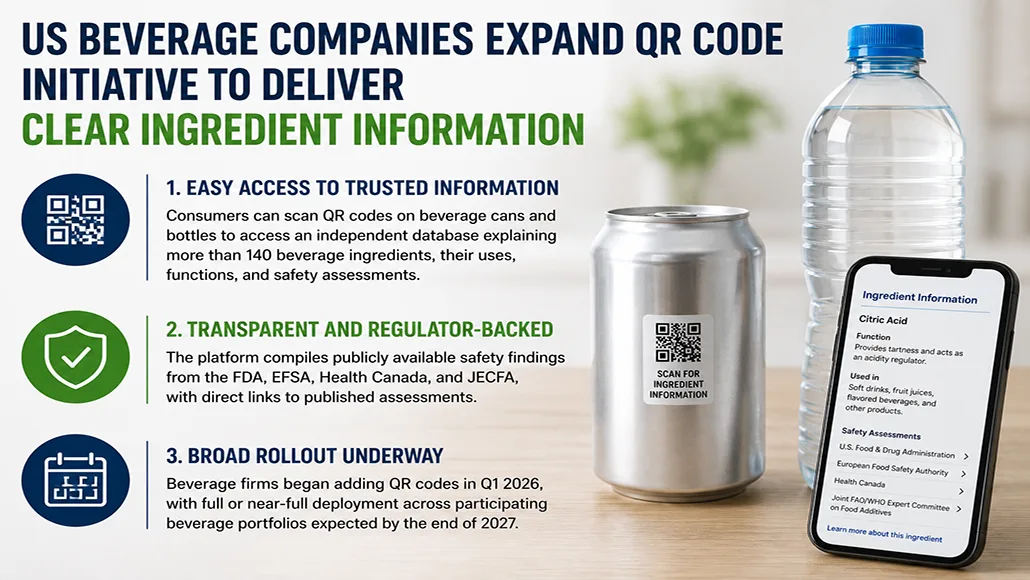

The Coca-Cola Company, Keurig Dr Pepper, PepsiCo, and other US beverage companies are expanding a shared digital infrastructure that gives consumers easier access to detailed ingredient information through QR codes printed on beverage cans and bottles. The initiative connects users to Good to Know Facts, an online database developed by American Beverage, the trade association representing the US non-alcoholic beverage industry. The platform contains factual, non-industry information covering more than 140 beverage ingredients, explaining how they are used, the functions they perform, and the safety assessments issued by independent regulatory authorities. Beverage Firms began incorporating the QR codes into products during the first quarter of 2026, with full or near-full deployment expected across participating beverage portfolios by the end of 2027.
According to American Beverage, the platform is designed to serve as a central source of accessible ingredient information for consumers navigating an expanding range of beverage choices. The database compiles publicly available safety findings from international food safety agencies and provides links to published assessments from the US Food & Drug Administration, the European Food Safety Authority, and Health Canada. Where applicable, it also includes evaluations from the Joint Food and the Agriculture Organization’s and World Health Organization’s Expert Committee on Food Additives. Kevin Keane, president and CEO at American Beverage, says: “Consumers want greater transparency and deserve to have confidence in the safety of their foods and beverages. Transparency means more than simply listing ingredients it means providing relevant context that helps people understand where specific ingredients are used, what function they serve, and how regulators in different countries view them.”
Keane adds: “By integrating Good to Know into QR codes, we’re making it easier than ever for consumers to have clear and reliable information right at their fingertips.” The rollout reflects broader momentum behind connected packaging technologies worldwide. Earlier this year, research from Appetite Creative and Koenig & Bauer found that confidence in connected packaging across the packaging industry had risen to 92.3%. Similar initiatives are also emerging internationally. Last year, the South Korean government required bottled water sold in the country to become label-free throughout manufacturing and distribution, with product information delivered through QR codes placed on bottle caps. This week, Twinings also introduced accessible QR codes and GS1 Digital Link QR codes across its packaging to improve access to product information for blind and partially sighted consumers. These developments reinforce how Beverage Firms are increasingly using digital packaging tools to improve transparency and consumer access to trusted product information.