


















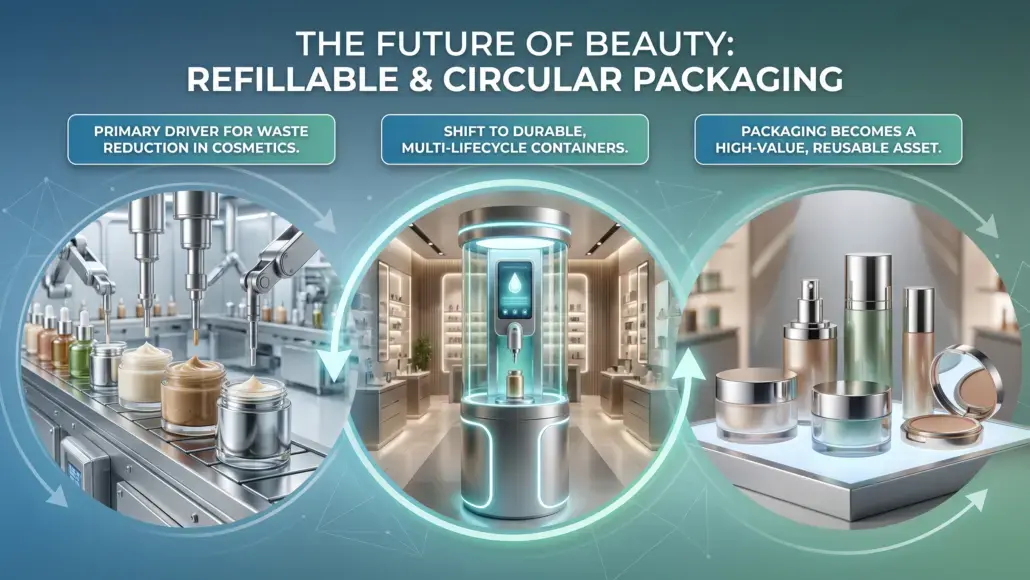

The adoption of refillable beauty packaging supporting circular consumption models is now the primary driver for waste reduction and resource management within the global cosmetics industry. Organizations are moving away from single-use plastics toward durable architectures that facilitate multiple lifecycle cycles for a single primary container. This transition necessitates a fundamental shift in how packaging is engineered, moving from disposable commodities to high-value assets that remain within the consumption loop. The integration of these systems is not merely a response to consumer pressure but a strategic realignment of production methodologies that prioritize long-term material retention. By focusing on refillable beauty packaging supporting circular consumption models, manufacturers are creating closed-loop systems that mitigate environmental impact while stabilizing material costs against volatile virgin resin markets.
Strategic Integration of Reusable Systems in Cosmetic Supply Chains
The logistical framework required to support refillable beauty packaging supporting circular consumption models involves a comprehensive redesign of the distribution network. Traditional linear supply chains are optimized for one-way movement, where products reach the end-user and the packaging enters the waste stream. Circular models require a dual-pathway approach where the primary vessel is retained by the consumer or returned for professional cleaning and replenishment. This operational complexity demands high levels of synchronization between packaging manufacturers and beauty brands to ensure that the refill units, often pouches or lightweight cartridges, are compatible with the durable outer shells. The economic viability of these systems depends on the number of reuse cycles a container can withstand, making the initial engineering investment a critical factor in the overall return on investment for circular initiatives.
Supply chain managers are focusing on the reduction of secondary packaging when shipping refill components. The goal is to minimize the total carbon footprint of the refill process, ensuring that the environmental benefits of the reusable shell are not offset by inefficient transportation of the replacement product. Refillable beauty packaging supporting circular consumption models relies on the ability to provide consumers with a convenient and hygienic method of replenishment. Whether through in-store refill stations or home-delivered pouches, the mechanical interface between the refill and the host container must be foolproof to prevent contamination and leakage. This necessitates tight tolerances in injection molding and assembly, ensuring that every refill interaction maintains the integrity of the cosmetic formulation.
Material Selection and Durability Standards for Multi-Use Containers
Selecting materials for refillable beauty packaging supporting circular consumption models requires a departure from standard cosmetic grade plastics. Engineers must utilize high-performance polymers such as Tritan, glass, or aluminum that can resist chemical degradation from repeated contact with active cosmetic ingredients. These materials must also possess the structural resilience to survive daily handling, cleaning protocols, and potential drops without compromising their aesthetic or functional properties. The surface finish of reusable containers is subjected to significant wear, so coatings and colorants must be integrated within the material matrix or applied with high-adhesion techniques to prevent peeling and fading over time.
Durability testing protocols for these circular assets are becoming increasingly rigorous. Manufacturers simulate years of usage through accelerated aging and mechanical stress tests, ensuring that hinges, pumps, and closures remain functional throughout the intended lifespan of the product. In the context of refillable beauty packaging supporting circular consumption models, the choice of material also impacts the end-of-life recyclability. Even though the primary goal is reuse, the container must eventually be processed back into raw materials. Therefore, mono-material designs are preferred to avoid the complexities of separating bonded components, which often leads to contamination in recycling streams and reduces the quality of the resulting recyclate.
Engineering Precision in Refill Mechanisms and Hermetic Seals
The functional success of refillable beauty packaging supporting circular consumption models hinges on the precision of the mechanical interface between the reusable shell and the replaceable unit. Engineers are developing sophisticated click-in-place systems and magnetic closures that provide tactile feedback to the user, ensuring a secure connection. These mechanisms must be robust enough to endure hundreds of refill cycles without losing their tension or alignment. The challenge lies in creating a system that is easy for the consumer to operate while maintaining a high level of air-tight integrity. Hermetic seals are essential for preserving the efficacy of cosmetic formulas, particularly those containing volatile organic compounds or natural preservatives that are sensitive to oxidation.
Airless pump systems are being adapted for circular models through the use of replaceable interior bags or rigid cartridges. In these designs, the outer bottle serves as a decorative and structural housing, while the inner component contains the product and the dispensing mechanism. When the product is exhausted, only the inner cartridge is replaced, significantly reducing the mass of plastic discarded. Refillable beauty packaging supporting circular consumption models often employs standardized neck finishes and coupling designs to allow for cross-brand compatibility in the future, although many manufacturers currently use proprietary systems to maintain brand loyalty. The technical development of these seals involves extensive testing with various viscosities, ensuring that the refill process does not introduce air bubbles or contaminants that could lead to microbial growth.
Lifecycle Assessment and Environmental Impact of Refillable Architectures
Quantifying the environmental benefits of refillable beauty packaging supporting circular consumption models requires a detailed lifecycle assessment that accounts for every stage of production and usage. While a durable glass or metal container has a higher initial carbon footprint than a thin plastic bottle, the cumulative impact decreases significantly with each refill cycle. Analytical data suggests that after three to five refills, the circular model becomes more carbon-efficient than the linear equivalent. This data is vital for brands that must justify the higher upfront cost of reusable packaging to stakeholders and consumers. The assessment also includes the impact of cleaning processes, as the energy and water used in sanitizing containers must be weighed against the savings in raw material extraction.
Packaging engineers are utilizing advanced modeling software to optimize the weight-to-use ratio of refillable systems. By reducing the mass of the refill unit, they can maximize the environmental gains of the overall system. Refillable beauty packaging supporting circular consumption models is most effective when the refill component is lightweight and easily recyclable, such as a mono-material PE pouch or a thin-walled PP cartridge. The industry is also exploring the use of bio-based materials for these refill units to further decouple the packaging process from fossil fuel dependencies. The transition to circularity is not just about changing the physical product but about re-evaluating the entire economic model of the beauty industry, moving toward a service-oriented approach where the brand provides the formula and the consumer manages the delivery vehicle.
Consumer Interaction Protocols and Sanitization Requirements in Circularity
The human element is a significant factor in the success of refillable beauty packaging supporting circular consumption models. Design teams are focusing on the ergonomics of the refill process, ensuring that it is intuitive and mess-free. If the refill process is perceived as difficult or unhygienic, the circular model will fail to gain mass-market adoption. Clear labeling and instructional iconography are used to guide the consumer through the assembly and disassembly of the container. Furthermore, the issue of sanitization is paramount. In professional refill settings, automated cleaning systems must be integrated into the retail environment to ensure that containers are sterile before being replenished. For home-based refill models, the design must minimize areas where product residue can accumulate, facilitating easy cleaning by the end-user.
Regulatory bodies are closely monitoring the safety implications of refillable beauty packaging supporting circular consumption models. Standards for microbial safety and chemical migration are being updated to address the unique challenges of multi-use cosmetic containers. Brands must provide clear guidance on when a reusable container should be retired and recycled, as material fatigue can eventually lead to breaches in the barrier properties. The development of smart packaging features, such as QR codes or NFC tags, can help track the number of refill cycles and alert the consumer when it is time for a replacement. This level of data integration ensures that the circular consumption model remains safe and effective, providing a high-quality experience that encourages long-term participation in sustainable packaging initiatives.