
















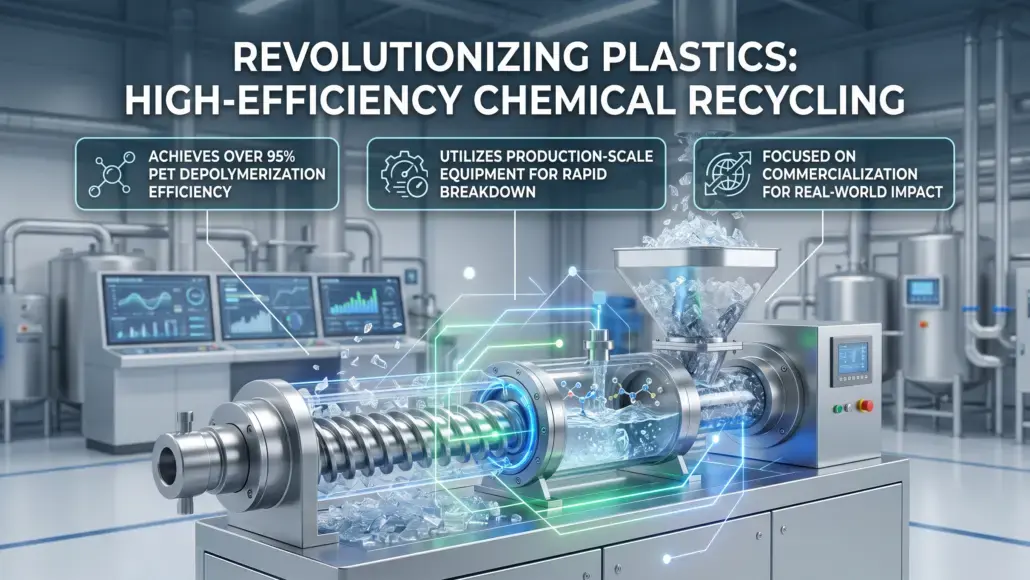
Kirin Holdings’ Packaging Innovation Institute and The Japan Steel Works (JSW) have successfully developed and tested a PET chemical recycling technology that achieves over 95% depolymerization, demonstrating the process using production-scale equipment with commercialization firmly in focus.
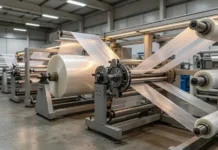
The demonstration test centred on an alkaline depolymerization technology that rapidly breaks down PET materials. JSW’s Twin Screw Extruder TEX αⅢ series — a co-rotating processing system designed for advanced polymer compounding, reactive extrusion, and recycling — was central to the test, with Kirin having developed the underlying alkaline depolymerization technology that the extruder facilitated.
Conventional PET chemical recycling approaches have long been held back by the need for high temperatures and extended reaction times, both of which drive up energy consumption and operational costs. The solution developed by Kirin and JSW directly addresses these challenges.
Rather than relying solely on heat to accelerate the chemical reaction, the technology also applies mechanical forces — including strong mixing and friction generated by the machinery itself. This combined approach allows the depolymerization reaction to proceed in a shorter time with less energy, which the companies say helps reduce environmental impact.
The partners established operating conditions that allow stable PET depolymerization at a throughput of 250 kg/h or greater. According to Kirin and JSW, the results of the demonstration test provided “valuable knowledge” on equipment specifications and operating conditions for the design of commercial-scale processes, while establishing a foundation for commercialization.
As a major beverage producer, Kirin acknowledges that the use of PET bottles continues to increase globally, making resource circularity ever more vital. The company notes that mechanical recycling currently remains the dominant method for PET bottle recycling, but argues it has limitations.
“Chemical recycling depolymerizes and purifies PET feedstocks, creating the potential to recycle a broader range of PET materials into high-quality PET, not limited to beverage bottles,” Kirin states. “However, conventional technologies have faced challenges related to energy efficiency and cost due to the need for high-temperature and long-duration reaction conditions.”
The company adds that the solution it developed alongside JSW is also low-energy and highly efficient, presenting it as a more viable pathway toward scalable PET chemical recycling.
Kirin and JSW have confirmed plans to continue developing their technology by working toward an integrated recycling process that covers the entire value chain — from PET collection and depolymerization through to resource recovery. The companies will also evaluate whether their solution is suitable for a wide range of PET packaging feedstocks, including non-food contact material grade PET materials.
Through collaborations with other corporations, local governments, research institutions, and other partners, Kirin and JSW intend to promote the development, practical implementation, and eventual commercialization of the technology.
Kirin and JSW plan to present more detailed results of the demonstration test at the 57th Autumn Meeting of the Society of Chemical Engineers in Japan later this month. The presentation is expected to provide further insight into the technical parameters and operating conditions established during testing.

