


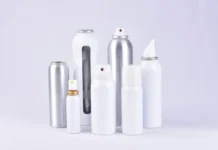





















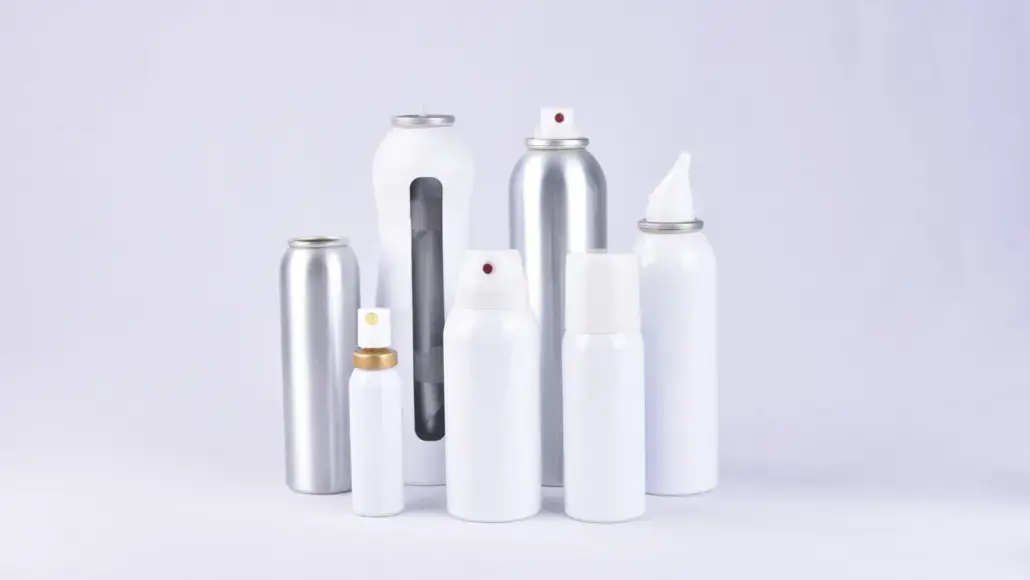

Two personal care products may call for the same metallic finish yet need fundamentally different packs. A body mist delivered through a finger pump and a dry shampoo dispensed as an aerosol might sit on the same shelf, but their containers have different sealing, filling and performance requirements. The useful comparison is not aluminium versus aluminium. It is which dispensing system the formulation—and the consumer experience—actually needs.
Start with the Way the Product Leaves the Pack
For non-pressurised products, an aluminium bottle fitted with a spray pump, lotion pump or screw cap offers a familiar packaging architecture. The closure meters or releases the product mechanically, and the bottle does not rely on an internal propellant. This can suit fine fragrance mists, hair treatments, lotions and other formulas when the selected dispensing component delivers the required spray pattern or dose. Pump output, viscosity and the neck finish have to be considered together.
An aluminium aerosol can is a different system. Its valve and actuator control discharge from a pressurised container, allowing dispensing characteristics that a conventional finger pump may not provide. Product categories such as deodorants, hairsprays, dry shampoos and shaving foams may use this architecture, although the formulation and desired output determine the actual configuration.
Bag-on-valve systems introduce another distinction: the product is held in a bag while compressed air or nitrogen provides pressure outside it. The choice between conventional aerosol and bag-on-valve changes the filling process and component specification, not simply the marketing description.
The Dimensions on a Quotation Are Not the Whole Specification
Shining Packaging’s aluminium screw-bottle range includes capacities from 30 to 1,000 mL and thread options from 18 to 43 mm, depending on the bottle selected. Common finishes include 20/410, 24/410 and 28/410.
These figures matter because a matching nominal thread is only the starting point: the actual pump, gasket, dip tube and closure torque must work with the selected neck geometry. A packaging team moving from PET or glass also needs to check conveyor guides, handling equipment and fill-height settings rather than assume a like-for-like line change.
For aluminium aerosol cans, Shining Packaging lists diameters from 22 to 80 mm and full capacities from 17 to 1,000 mL. Here the difference between container capacity and marketable fill volume is especially important.
One 45 × 150 mm can is listed at 210 mL full capacity, with indicative fills of 150 mL for the supplier’s liquid-gas configuration and 125 mL for its compressed-gas/bag-on-valve configuration. Those numbers describe particular configurations, not universal filling limits. Selecting a can by the number on the retail label alone can produce a costly mismatch.
Internal Coatings Are Part of Formulation Development
Aluminium blocks light, but the metal substrate is not automatically compatible with every cosmetic formulation. Internal coatings help separate the product from the container wall. Shining’s aerosol-can specifications identify standard EP and PAM options, alongside other coating systems; its screw-bottle portfolio includes EP and polyester-based options.
The decision should reflect what is being packed—particularly where alcohol, fragrance ingredients, water-based chemistry or aggressive ingredients are involved.
This is where a packaging sample must become a filled-product sample. Relevant checks can include appearance changes, odour, corrosion, coating adhesion and any effect on dispensing after storage under the intended conditions. The closure liner, valve seals and other contact materials belong in the same review. A supplier’s general statement about coating availability does not establish compatibility with a specific formula, nor does it by itself establish suitability for every market.
Pressure Performance Changes the Aerosol Purchasing Brief
The supplier describes its monobloc aerosol cans as cold-extruded from 99.7% aluminium and offers 25.4 mm and 20 mm openings. The opening affects valve selection and crimping equipment, while shoulder profiles affect overall geometry and decoration.
Its published deformation-pressure thresholds are 1.2 MPa for standard cans and 1.8 MPa for high-pressure versions; corresponding burst-pressure thresholds are 1.4 and 2.1 MPa. These are stated test thresholds, not permission to use those figures as operating or filling pressures.
For buyers, the practical question is whether the specified empty can, valve, propellant or compressed-gas system and intended filling conditions form a qualified package. The can supplier and filler need to agree on the relevant pressure class, opening, crimp dimensions and inspection requirements before a production order is released.
Design Freedom Still Has to Survive Manufacturing
Both formats offer scope for printed decoration. Shining lists eight- to nine-colour printing and glossy or matte finishes for its aluminium bottles and aerosol cans, with variations in base coats and profiles.
Direct-to-container graphics can make a consistent visual identity possible across a pump bottle and an aerosol line, but artwork must be checked against shoulder curvature, the usable print area and abrasion during packing and transport.
A productive sourcing discussion therefore starts with a product brief rather than a photograph of a desirable bottle. State the formula, target fill, expected dispensing behaviour, planned closure or valve, sales markets and existing filling equipment. Ask for the precise drawing and coating specification for the proposed SKU, not just a category-wide catalogue.
Aluminium bottles and aerosol cans can share a visual language; whether they can deliver the same product experience depends on the engineering beneath it.