



















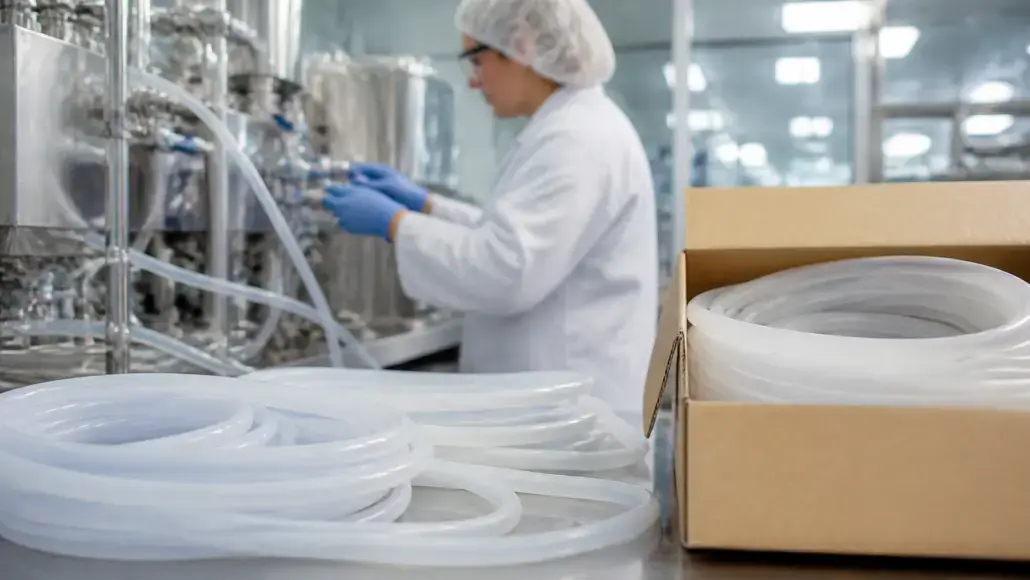

Treating single-use tubing procurement as a last-minute purchasing decision can create requalification work and production delays if orders arrive late or specifications change. While single-use tubing plays a critical role in pharmaceutical manufacturing processes, the real risk lies in how you source it.
Supplier reliability, spec consistency and ordering predictability determine whether your validated processes stay on schedule or face costly disruptions.
What Pharmaceutical Packaging Teams Need From a Single-Use Tubing Supplier
Pharma manufacturing processes get validated against a specific tubing spec. The exact material, inner diameter, wall thickness and sterilization method used during process validation are the only versions of that tubing allowed in production without triggering a review.
Pharmaceutical packaging and procurement teams can’t treat tubing as a commodity purchase the way a facility might treat gloves or wipes.
A supplier switch or even a minor spec substitution forces the quality team to determine whether the change is significant enough to require requalification, additional testing or a filing update. That review process can take a long time, depending on the product and regulatory pathway.
Because of this, the supplier relationship potentially matters more than the per-unit price. A cheaper tubing source that can’t guarantee the same spec, lot after lot, often costs more in requalification time and production delay than it saves on the purchase order.
Why Repeat-Order Availability Shouldn’t Be a Gamble
Single-use tubing is often made to custom or semi-custom specs rather than pulled from generic stock. A supplier without a stocking program manufactures each purchase order rather than shipping from inventory. That turns routine reorders into new production runs with their own lead times.
Running out midprocess is a production stoppage. A batch that’s already underway can’t simply wait for restock without affecting hold times, environmental monitoring windows and, in some cases, the validity of the batch itself. Pharmaceutical equipment distributors like Sentinel Process Systems address this through dedicated stocking programs that align inventory levels with customer production schedules and forecasted demand.
This maintains safety stock to buffer against allocation shortages and unexpected volume increases.
How Delivery Delays Throw Off Your Production Schedule
Clean room time, equipment availability and trained staff are all scheduled in advance in most pharma manufacturing environments, because resources are shared across products and shifts. Tubing arriving late pushes the batch entirely out of its allocated production window.
Rescheduling a batch means rebooking a clean room suite that’s already committed to another product, reassigning qualified operators or re-executing environmental qualification if enough time has passed since the last clean room certification. The pharmaceutical industry faces significantly longer lead times than other industries, jeopardizing timely delivery.
The financial impact compounds past the missed date itself. A delayed batch can push back the next one in the same suite. For companies with clinical trial timelines or committed delivery dates, that ripple effect is often the costliest part of the delay, not the tubing itself.
The Importance of Consistent Tubing Specifications
A spec change covers more than swapping brands. Other factors include using alternative silicone or thermoplastic elastomer formulations, modifying the inner diameter or wall thickness, or adopting a new sterilization method, such as gamma, ethylene oxide or autoclave. Even moving production to a new manufacturing site for the same nominal product would be considered a change that needs to be assessed.
Under the FDA’s framework for disposable manufacturing material changes, buyers are expected to assess whether a change is significant enough to require reporting. In some cases, prior approval is required before it’s implemented in a validated process.
Changes involving disposable manufacturing materials may require different FDA reporting pathways depending on their potential effect on product quality. This ranges from annual reporting to prior approval before implementation.
A supplier that changes raw material sources or manufacturing sites without proactively notifying customers puts that evaluation burden on the buyer afterward, often after the product has already shipped or been used. This is a much worse position than knowing about a change in advance.
Sentinel Process Systems emphasizes consistency and documentation to support regulated manufacturing environments, helping procurement and quality teams maintain more predictable sourcing for recurring orders.
Solving the Inventory Forecasting Challenge
Tubing demand is driven by batch schedules that shift constantly. It’s tied to clinical trial enrollment pace, manufacturing yield and regulatory approval timing, which suppliers can’t see. Buyers forecasting against future production plans are often working with assumptions that will shift before orders arrive.
On the supplier’s side, buyers typically don’t have visibility into actual lead times, safety stock levels or how close a given stock-keeping unit (SKU) is to a reorder point. That means a buyer’s forecast is built on assumptions about supplier capacity rather than real data.
Both sides plan around incomplete information, a structural feature of pharma supply chains. Limited transparency in supply chains makes it difficult to calculate lead times and maintain correct inventory levels. Suppliers who share more of their own inventory and lead time data directly reduce that gap.
What to Look for in a Supplier That Scales With You
Breadth of inventory means how many SKUs, sizes and material types a supplier actually holds ready to ship versus how many require a custom manufacturing run. A supplier can appear comprehensive on a catalog page while stocking only a fraction of the items, so confirm this directly.
Distributors with direct relationships with multiple raw material and component manufacturers have more rerouting options than those reliant on a single upstream source.
Documentation support means whether lot traceability, certificates of analysis and change notifications are provided as standard practice or only on request after something has already gone wrong. The difference between those two models often determines how quickly a buyer’s quality team can respond to a supply disruption.
Sentinel Process Systems offers access to over 100,000 products from more than 30 manufacturing partners and has served as a strategic partner since 1950. It provides the breadth and longevity worth evaluating for recurring single-use tubing suppliers.
Frequently Asked Questions
Here are some common concerns for procurement and quality teams.
What makes a single-use tubing supplier reliable for repeat orders?
A reliable supplier maintains consistent stock levels, provides predictable lead times, and communicates proactively about any changes to product availability or specifications. Stocking programs aligned with your production schedule reduce the risk of allocation shortages during periods of high industry demand.
Why do tubing specifications need to stay consistent across orders?
Validated processes are locked to specific tubing specs, including material formulation, dimensions, required packaging, and sterilization method. Any deviation from that spec can trigger a quality review, requalification testing or regulatory filing updates, all of which delay production and increase costs.
Building a Tubing Supply Strategy That Grows With You
Scalability means more than finding suppliers who ship larger quantities. It’s partnering with a distributor who understands the regulatory constraints you operate under, maintains the inventory depth to support repeat orders and provides the documentation your quality team needs to respond quickly when conditions change.
Choosing a supplier with the infrastructure to scale alongside your production needs protects your validated processes and packaging and manufacturing timelines.