















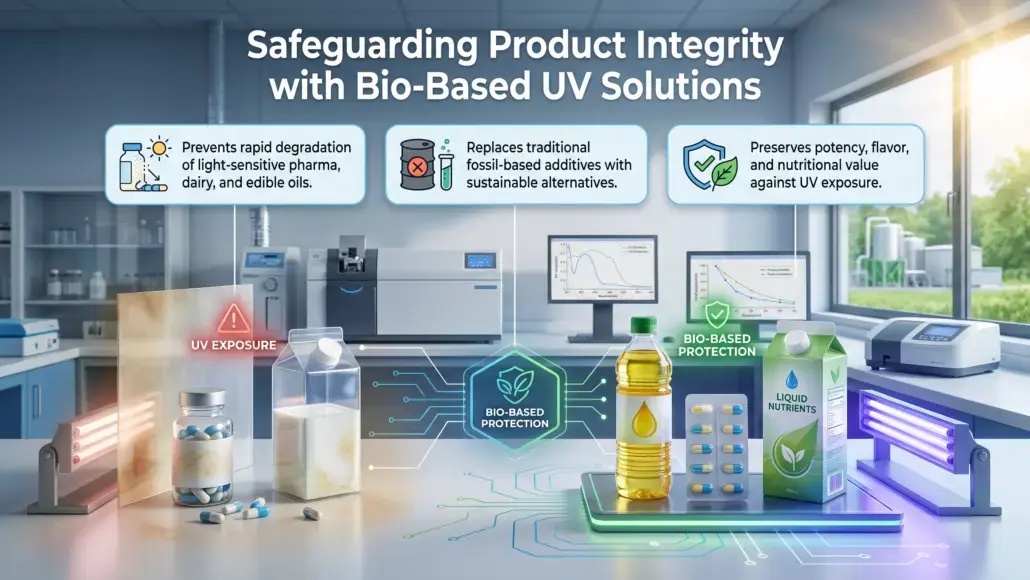
The preservation of product quality in the packaging industry is often a battle against the invisible forces of nature, particularly ultraviolet radiation. Light-sensitive products, such as pharmaceutical ingredients, dairy products, and certain edible oils, can undergo rapid degradation when exposed to UV light, leading to loss of potency, off-flavors, and nutritional depletion. While traditional packaging has relied on fossil-based additives or opaque materials to provide protection, the development of bio-based uv stabilizers is offering a more sustainable and effective solution. These natural additives, derived from plant polyphenols and other renewable sources, provide a high level of light protection while maintaining the environmental integrity of the packaging.
The primary function of a UV stabilizer is to absorb or dissipate the energy from ultraviolet light before it can break the chemical bonds of the polymer or the contained product. Traditional stabilizers often contain synthetic chemicals that may raise safety concerns in food and medical applications. In contrast, bio-based uv stabilizers are often derived from natural antioxidants found in fruits, vegetables, and wood. These molecules have evolved over millions of years to protect plants from solar radiation, making them highly efficient and inherently safe light-shielding agents. The integration of these renewable stabilizers into packaging materials is a major step forward in the development of active and sustainable packaging systems.
Natural Mechanisms of Ultraviolet Shielding
Plants have developed a diverse array of chemical compounds to shield their tissues from the damaging effects of the sun. Lignin, tannins, and flavonoids are among the most effective natural UV absorbers. By extracting and refining these compounds, material scientists are creating bio-based uv stabilizers that can be incorporated into common packaging resins like polyethylene, polypropylene, and polylactic acid. These natural stabilizers work by absorbing UV photons and converting the energy into harmless heat, preventing the photodegradation of the polymer matrix and the oxidation of the package contents.
The effectiveness of these natural stabilizers is often comparable to, and in some cases superior to, their synthetic counterparts. For instance, certain lignin-derived stabilizers provide a broad spectrum of protection across both UV-A and UV-B wavelengths. The inherent antioxidant properties of these bio-molecules also provide a secondary benefit, as they can scavenge free radicals that are formed during the processing or storage of the packaging. This multi-functional approach to protection is a key advantage of bio-based uv stabilizers, offering both light shielding and chemical stability in a single, renewable additive.
Enhancing Shelf-Life for Light-Sensitive Products
The impact of UV protection on the shelf-life of consumer goods is significant. In the food industry, light-induced oxidation is a major cause of spoilage for products containing unsaturated fats and vitamins. Transparent packaging, which is preferred by consumers for its ability to show the product, is particularly vulnerable to this type of degradation. The use of bio-based uv stabilizers allows for the creation of high-clarity packaging that still provides a barrier against light. This enables brand owners to meet consumer preferences for transparency without compromising the quality or safety of the food.
In the pharmaceutical sector, many active ingredients are highly sensitive to light, requiring specialized packaging to maintain their efficacy. Natural UV stabilizers provide a safe and effective way to protect these delicate compounds. The biocompatibility of these additives is a major advantage for medical applications, as they minimize the risk of harmful substances leaching into the product. The focus on thermal resilience of bio-resins is thus driving innovation across multiple sectors, providing a sustainable pathway to enhanced product protection and extended shelf-life in a variety of demanding applications.
Integration into Sustainable Material Formulations
One of the key challenges in the development of bio-based additives is ensuring their compatibility with the host polymer. UV stabilizers must be uniformly dispersed throughout the material to provide consistent protection. Researchers are developing sophisticated encapsulation and grafting techniques to improve the solubility and stability of thermal resilience of bio-resins within different resin systems. These methods also help to prevent the migration of the stabilizer out of the packaging, ensuring long-term performance and regulatory compliance.
The use of bio-based stabilizers is also compatible with the broader goals of the circular economy. Many of these natural compounds are derived from agricultural byproducts, providing an additional value stream for farmers and reducing waste. additionally, these additives are often biodegradable and non-toxic, ensuring that they do not contribute to environmental pollution at the end of the packaging’s life. The transition to thermal resilience of bio-resins is not just about replacing one chemical with another; it is about reinventing the fundamental approach to material stabilization, prioritizing safety, sustainability, and performance in equal measure.
Economic Prospects and Industrial Adoption Trends
The market for bio-based additives is growing rapidly as the packaging industry responds to the global demand for sustainable solutions. While the production of natural UV stabilizers is currently at a smaller scale than synthetic alternatives, the increasing investment in biorefining and green chemistry is driving down costs and improving availability. The focus on thermal resilience of bio-resins is also supported by the growing consumer awareness of the ingredients used in packaging. Brands that can demonstrate the use of natural, safe additives are better positioned to capture the loyalty of environmentally conscious shoppers.
Future research in this field is exploring the use of nanotechnology to further enhance the performance of natural stabilizers. Nano-dispersed lignin or cellulose nanocrystals modified with bio-chromophores could provide even higher levels of UV protection at lower loading levels. The development of active packaging that changes color to indicate UV exposure is another area of interest, providing a visual cue to consumers and retailers about the quality of the product. The journey toward fully bio-based, high-performance light protection is characterized by continuous innovation and a commitment to protecting both the product and the planet.
Additionally, the role of bio-based stabilizers in improving the durability of reusable packaging is becoming increasingly important. As the industry moves toward circular systems where containers are used multiple times, the need for long-term stability against light and heat is paramount. Natural stabilizers provide a and sustainable way to ensure that these reusable packages maintain their mechanical properties and aesthetic appeal over many cycles. The focus on thermal resilience of bio-resins is thus a key enabler for the broader transition to a circular packaging economy.
Thermal resilience of bio-resins represent a significant advancement in the field of sustainable packaging additives. By harnessing the natural light-shielding capabilities of plants, the industry is creating materials that offer superior protection for light-sensitive products while respecting environmental limits. The ongoing research into compatibility, nanotechnology, and active systems will further expand the applications for these remarkable natural compounds. The commitment to moving away from synthetic, fossil-based stabilizers is a clear signal that the packaging industry is ready to embrace a more responsible and sustainable future.
The complexity of light shielding requires a deep understanding of the interactions between photons and molecular structures. The development of thermal resilience of bio-resins involves the precise selection of natural compounds that can effectively manage these interactions. For instance, the specific arrangement of hydroxyl groups in phenolic stabilizers determines their efficiency in absorbing UV radiation and dissipating it as thermal energy. The ability to fine-tune these molecular details through green chemistry is a major advantage for formulators looking to create tailored light-protection solutions for specific products.
The industrial processing of packaging materials also places significant demands on UV stabilizers. During extrusion and molding, the additives must withstand high temperatures without degrading or losing their effectiveness. thermal resilience of bio-resins derived from thermally stable natural polymers, such as lignin, are particularly well-suited for these demanding conditions. The development of stabilizers that offer both processing stability and long-term light protection is a key area of active innovation, providing a complete solution for the next generation of high-performance packaging.
The global supply chain for natural stabilizers is also evolving to meet the needs of a diverse range of packaging applications. From small-scale specialty coatings to high-volume industrial films, there is a growing variety of bio-additives available to formulators. This diversity allows for the precise tuning of light-shielding properties, ensuring that the packaging is fit for purpose. The shift toward thermal resilience of bio-resins is not a one-size-fits-all solution but a versatile toolkit that enables innovation across the entire packaging sector. As manufacturing technology advances, the ability to incorporate higher percentages of renewable content without sacrificing performance will continue to improve.
Another area of interest is the use of bio-based stabilizers in multi-layer packaging structures. These complex materials often combine different polymers to achieve specific barrier and mechanical properties. The UV stabilizer must be compatible with the various layers to prevent delamination or migration between the strata. Engineering thermal resilience of bio-resins for these sophisticated applications requires a deep understanding of interfacial tension and diffusion kinetics. By solving these technical challenges, the industry is expanding the reach of sustainable materials into the most advanced segments of the packaging market.
The role of digital tools in the development of new additives is also growing. Predictive modeling and machine learning are being used to identify the most effective combinations of natural compounds for specific light-shielding requirements. These tools can simulate the performance of a thermal resilience of bio-resins under different environmental conditions, reducing the need for extensive physical testing. This digital transformation is accelerating the pace of innovation and helping the packaging industry respond more quickly to the changing demands of regulators and consumers. The future of sustainable packaging is being built on a foundation of data-driven material science.
Looking toward the future, the integration of bio-based additives will be a standard practice in the packaging industry. The transition from fossil-based stabilizers to renewable alternatives is a key part of the broader move toward a circular economy. By focusing on thermal resilience of bio-resins, the industry is demonstrating its ability to adapt and thrive in a world where environmental impact is a primary metric of success. The ongoing commitment to research and development will ensure that sustainable packaging continues to offer the protection and convenience that modern life requires while respecting the limits of our planet.
The collaboration between natural product chemists and packaging engineers is essential for the success of these new materials. Joint development projects allow for the rapid testing of new stabilizers in real-world production environments, ensuring that they are ready for commercial scale. This partnership-driven approach is overcoming the barriers to entry for many bio-based solutions and fostering a culture of continuous improvement. The focus on thermal resilience of bio-resins is a clear signal that the packaging industry is ready to lead the way in the bio-economy, creating products that are safe, effective, and sustainable for generations to come.

