






















The global beauty and personal care industry is undergoing a structural realignment in primary packaging design. For decades, cosmetic containers functioned primarily as single-use promotional vessels: intricate, multi-material assemblies engineered to capture consumer interest at the retail shelf, only to enter municipal solid waste streams within weeks of purchase.
As extended producer responsibility legislation expands and corporate sustainability frameworks mature, disposable primary container models present mounting compliance and commercial liabilities. In response, as Packaging World Insights observes, refillable packaging has advanced from a novelty concept into a rigorous engineering discipline focused on extending the working lifecycle of packaging hardware.
Transitioning from linear distribution to circular refill architectures fundamentally alters packaging development. Packaging engineers, industrial designers, and material processors must develop durable outer housings that retain aesthetic appeal over extended lifespans while formulating ultra-lightweight replenishment vessels that safeguard sensitive active ingredients. The engineering challenge is multifaceted: the durable chassis must withstand mechanical wear, household moisture, drop impacts, and repeated consumer handling, while inner refill cartridges must drastically minimize material mass without compromising gas barrier performance, shelf stability, or evacuation efficiency.
Mechanical Architecture and Delivery System Typologies
Modern refillable packaging systems fall into two primary formats: rigid cartridge assemblies and flexible decanting envelopes. Developing robust delivery systems across these formats requires careful management of dimensional tolerances, fluid mechanics, and seal reliability.
Rigid Drop-In Cartridges and Airless Delivery
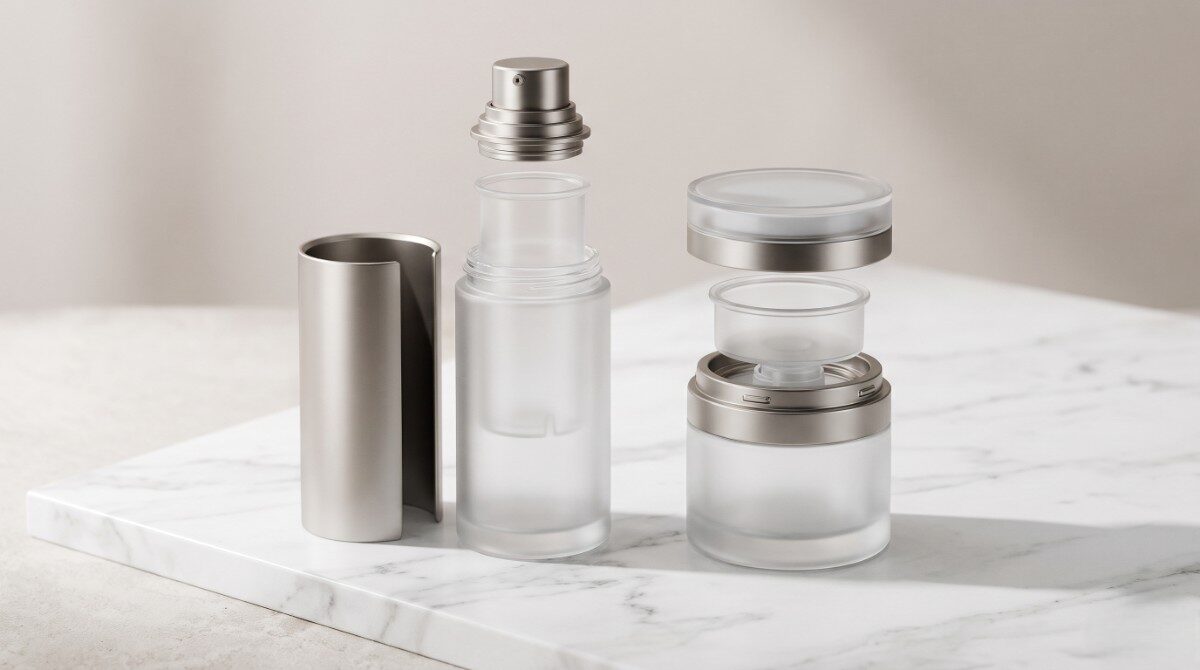
The rigid drop-in pod is the benchmark standard for high-end facial treatments, serums, and precision cosmetics. In airless drop-in systems, the outer shell functions as an aesthetic, ergonomic frame, while the inner cartridge incorporates the hermetic chamber, sealing piston, and dosing mechanism. The interface between these components requires precise mechanical engineering.
When marriage occurs between an outer aluminum casing and an internal polypropylene cartridge, engineers must account for divergent thermal expansion coefficients. Tooling variances across production runs can cause cartridges to bind excessively within the casing or disengage prematurely when subjected to handling shock. Retaining consistent engagement over repetitive replacement cycles requires precision detent geometries, internal bayonet lugs, or low-profile magnetic catches engineered to maintain uniform insertion and extraction resistance.
Flexible Monomaterial Pouches and Evacuation Dynamics
Alongside rigid pods, recyclable monomaterial flexible packaging has emerged as a cornerstone of circular replenishment, replacing multi-layer composite foils with high-barrier single-polymer structures that streamline post-consumer recovery. For high-viscosity rinse-off personal care items such as hair cleansers and conditioning creams, flexible monomaterial pouches offer exceptional packaging-to-product efficiency.
Modern pouches increasingly utilize oriented polyethylene films co-extruded with ethylene vinyl alcohol barriers to ensure product preservation without introducing unrecyclable composite foils. The primary design objective centers on product evacuation. Product residue left along gussets, thermal seals, or beneath fitments represents lost usable product and interferes with downstream wash-line recycling. Directional bottom channels, angled spout positions, and targeted pouch geometries facilitate near-complete product extraction prior to container recycling.
Formulation Integrity, Barrier Chemistry and Microbiological Safety
Replacing traditional single-use packaging with refill architectures introduces critical variables in formulation stability and preservation. In conventional packaging, cosmetics remain isolated from atmospheric contaminants until opened, with the product passing through a clean dispensing route. Open refill systems, where users manually decant bulk liquids from an auxiliary container into an unwashed primary jar, expose sensitive emulsions to ambient moisture, airborne fungal spores, and household bacteria. Over time, residual product along jar threads can foster bacterial growth that challenges topical preservative systems.
To eliminate microbiological vulnerabilities, packaging engineers increasingly design closed-loop, sealed-cartridge configurations. In these architectures, the consumer never contacts the product fluid path directly. The replenishment pod arrives hermetically sealed by an induction liner, foil membrane, or integral snap-valve that is pierced only upon insertion into the outer housing. The dispensing pump engine is either permanently attached to the replaceable cartridge or integrates clean self-venting mechanisms that prevent air ingestion into the formulation reservoir. This closed architecture maintains product stability, limits microbial exposure, and allows formulators to use balanced, gentle preservation systems without risk of premature destabilization.
Human Factors, Ergonomic Feedback and Replenishment Compliance
A refillable packaging program can fail if human factors are overlooked during development. If a replenishment mechanism is confusing, requires excessive torque, or risks spilling active formulations on bathroom surfaces, consumer compliance drops precipitously. When consumers abandon a refill system in favor of conventional single-use alternatives, the initial manufacturing investment in the durable package is squandered.
To establish seamless user habits, packaging developers apply deliberate tactile and audible cues. Refill locking systems increasingly incorporate audible clicks, spring-assisted push-to-release buttons, and directional track guides that clearly signal correct alignment and secure engagement. Ergonomic finger notches, push-ejection wells, and intuitive rotational detents remove the friction associated with cartridge replacement. Concurrently, the permanent outer housing must communicate structural permanence through premium finishes, cold-touch metallic textures, durable ceramics, and weighted bases that signal physical longevity and justify the initial price premium.
Standardization, Sorter Detectability and Industrial End-of-Life
While proprietary refill systems allow individual brands to lock consumers into closed product ecosystems, they introduce downstream challenges for sorting and recycling infrastructures. Automated material recovery facilities rely heavily on near-infrared optical sorting equipment to detect, classify, and separate polymer streams. Compact refill capsules, dark-pigmented plastics, and heavy adhesive labels can prevent sorting machines from reading polymer signatures, causing recyclable cartridges to be sent to residual waste streams.
To ensure circularity at scale, packaging converters and brand owners are pursuing standardization across several technical domains:
- First, modular inner-pod diameters and connection neck finishes are being designed to fit shared outer housings, establishing predictable form factors across product portfolios.
- Second, converters are adopting detectable, non-carbon colorants and water-releasable label adhesives that wash away cleanly without polymer contamination.
- Finally, pump manufacturers are successfully replacing traditional multi-material dispensing engines, which rely on internal metal springs and elastomeric valves, with all-plastic, monomaterial polyolefin pumps.
Packaging World Insights notes that by combining metal-free dispensing engines with clean-evacuating mono-material pods, the next generation of refillable packaging ensures that technical circularity is matched by real-world recyclability.

