
























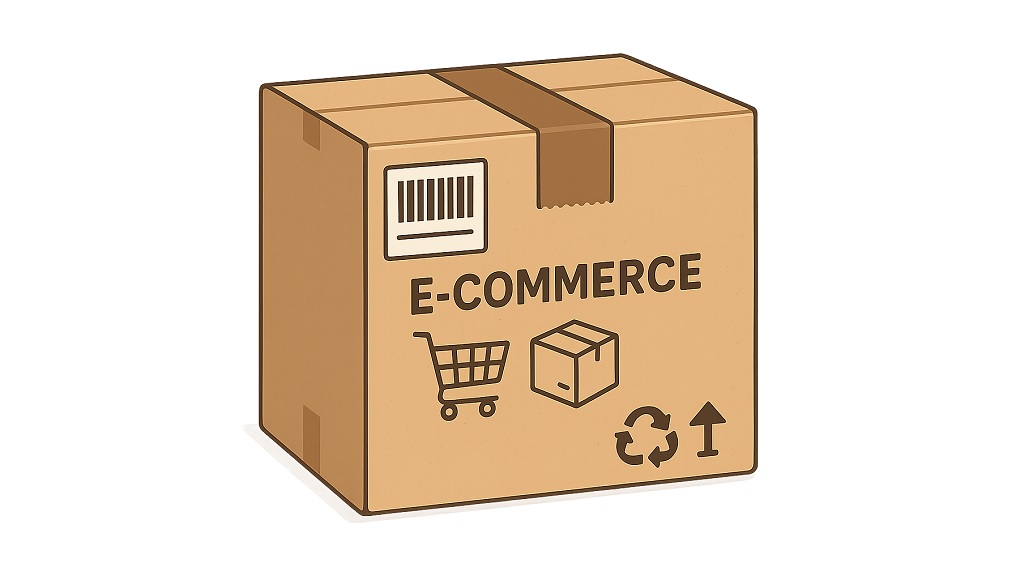

The exponential growth of e-commerce has fundamentally reshaped global retail landscapes, creating unprecedented demand for packaging solutions that can protect products through complex supply chains while meeting evolving consumer expectations for sustainability and functionality. Paper packaging for e-commerce has emerged as the preferred solution, offering the unique combination of protection, cost-effectiveness, and environmental responsibility that modern commerce demands.
The E-commerce Revolution and Packaging Transformation
Global e-commerce sales continue expanding at remarkable rates, with projections indicating the sector will reach over $8 trillion by 2027. This growth trajectory creates enormous opportunities for paper packaging solutions specifically designed for digital commerce requirements. Unlike traditional retail packaging that primarily serves marketing and protection functions at the point of sale, e-commerce packaging must excel across multiple performance dimensions including shipment protection, storage efficiency, and customer experience optimization.
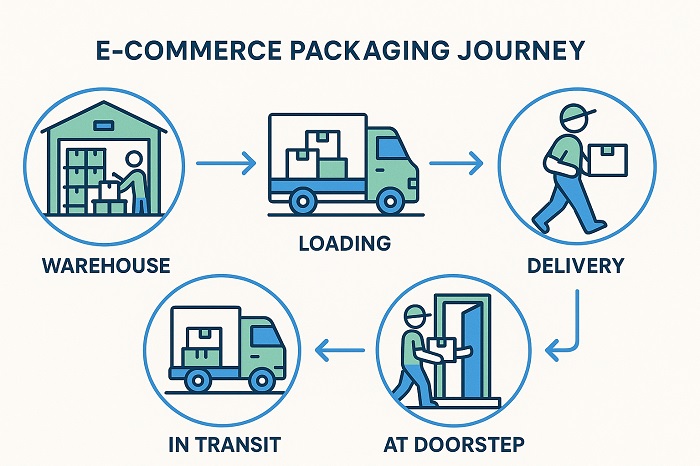
The Indian e-commerce paper packaging market exemplifies this transformation, projected to reach 150,000 million units by 2029 with a compound annual growth rate of approximately 12 percent. This growth reflects broader global trends where paper packaging for e-commerce becomes essential infrastructure supporting digital commerce expansion.
Modern e-commerce operations require packaging solutions that perform reliably across diverse transportation networks, varying climate conditions, and automated handling systems. Paper packaging technologies have evolved to meet these challenges through advanced structural designs, protective capabilities, and cost optimization strategies that make them ideal for high-volume e-commerce applications.
Corrugated Solutions Driving Market Leadership
Corrugated packaging represents the backbone of e-commerce logistics, accounting for approximately 65 percent of total e-commerce packaging volume. The global corrugated packaging market, valued at $325.37 billion in 2025, demonstrates steady growth at 4.36 percent CAGR, driven primarily by e-commerce expansion and sustainability requirements.
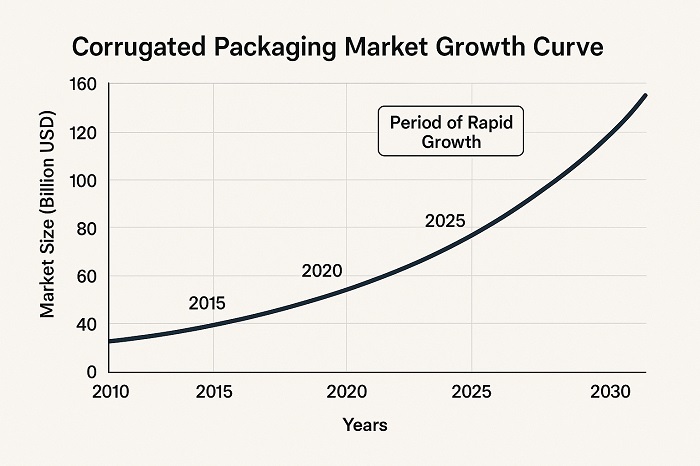
The versatility of corrugated solutions enables customization for virtually any product category, from fragile electronics requiring specialized protection to bulk consumer goods needing cost-effective containment. Advanced corrugated designs incorporate features like self-locking mechanisms, tear-resistant construction, and optimized dimensional efficiency that reduce shipping costs while enhancing protection levels.
Manufacturing innovations in corrugated production focus on lightweight optimization without compromising strength characteristics. Modern corrugated facilities achieve significant material savings through precision engineering that maximizes structural integrity while minimizing weight and material usage. These improvements translate directly into reduced shipping costs and environmental impact for e-commerce operations.
Edge-to-edge printing capabilities and sophisticated graphics applications enable corrugated packaging to serve dual functions as protective containers and brand communication vehicles. This dual functionality proves particularly valuable for e-commerce brands seeking to create memorable unboxing experiences that drive customer loyalty and social media engagement.
Kraft Paper Innovation in Digital Commerce
Kraft packaging innovations have transformed this traditional material into a sophisticated solution for modern e-commerce requirements. Contemporary kraft paper packaging combines the natural aesthetic appeal that consumers associate with sustainability with advanced performance characteristics that meet rigorous e-commerce demands.
The kraft paper market, valued at $17.09 billion in 2022 and projected to reach $21.6 billion by 2029, reflects growing adoption across diverse e-commerce applications. Kraft solutions excel particularly in food delivery, personal care products, and fashion retail where the natural appearance reinforces brand positioning around authenticity and environmental responsibility.
Advanced kraft formulations incorporate barrier coatings that provide moisture protection without compromising recyclability or biodegradability. These innovations enable kraft packaging to compete effectively with plastic alternatives in applications requiring enhanced protection while maintaining superior environmental credentials.
Printing and finishing technologies specifically developed for kraft substrates enable sophisticated brand communication while preserving the material’s natural character. Water-based inks, embossed textures, and sustainable coating applications create premium appearances that command higher perceived value while supporting environmental messaging strategies.
Addressing E-commerce-Specific Challenges
E-commerce packaging faces unique challenges that traditional retail packaging never encounters. Products must withstand multiple handling events, varying storage conditions, and potential shipping delays while maintaining protection integrity. Paper packaging for e-commerce addresses these challenges through engineering approaches that optimize performance across the entire logistics chain.
Dimensional optimization represents a critical success factor for e-commerce packaging, as shipping costs directly correlate with package size and weight. Paper packaging solutions achieve remarkable efficiency through precise sizing algorithms, minimal waste designs, and structural configurations that maximize protection while minimizing dimensional footprint.
Automated handling compatibility ensures paper packaging performs reliably in high-speed sorting systems, robotic handling equipment, and conveyor-based logistics operations. Design specifications must accommodate machine tolerances while maintaining structural integrity throughout automated processing sequences.
Return logistics considerations influence e-commerce packaging design significantly, as products may need to be repackaged for return shipment. Paper packaging solutions incorporate features like resealable closures, easy-open mechanisms, and reusable configurations that facilitate reverse logistics while maintaining cost effectiveness.
Consumer Experience and Brand Differentiation
The unboxing experience has become a crucial brand touchpoint for e-commerce operations, creating opportunities for paper packaging to deliver memorable customer experiences that drive loyalty and word-of-mouth marketing. Sophisticated paper packaging designs transform functional protection into brand storytelling opportunities that enhance customer relationships.
Personalization capabilities enabled by digital printing technologies allow e-commerce brands to create customized packaging experiences that reflect individual customer preferences, purchase history, or demographic characteristics. These personalized approaches demonstrate attention to customer detail while reinforcing brand values around sustainability and quality.
Sustainability messaging integrated into paper packaging design communicates brand commitment to environmental responsibility while educating consumers about proper disposal and recycling procedures. Clear labeling, recycling instructions, and sustainability certifications help consumers make informed decisions while supporting circular economy objectives.
Interactive features incorporated into paper packaging designs enhance customer engagement through QR codes, augmented reality applications, and social media integration that extends the brand experience beyond the physical unboxing moment. These digital integrations create measurable marketing value while maintaining sustainable packaging principles.
Supply Chain Integration and Logistics Optimization
Successful paper packaging for e-commerce requires seamless integration with complex supply chain networks that span multiple geographic regions, transportation modes, and handling systems. Packaging design must optimize performance across these diverse environments while maintaining cost effectiveness and reliability.
Warehouse efficiency considerations influence packaging design through stackability requirements, storage density optimization, and handling equipment compatibility. Paper packaging solutions maximize warehouse utilization through precise dimensional specifications and structural designs that maintain integrity under stacking loads.
Transportation optimization encompasses multiple factors including weight minimization, damage prevention, and space utilization that directly impact shipping costs and delivery reliability. Advanced paper packaging designs achieve optimal balance across these competing requirements through engineering approaches that maximize value delivery.
Inventory management benefits from standardized paper packaging systems that reduce complexity, minimize storage requirements, and simplify procurement processes. Standardization strategies enable economies of scale while maintaining flexibility for product-specific requirements through modular design approaches.
Technology Integration and Smart Packaging
Digital technology integration creates opportunities for paper packaging for e-commerce to deliver enhanced functionality beyond traditional protection and containment roles. Smart packaging applications incorporate sensors, tracking devices, and communication technologies that provide real-time visibility throughout the logistics chain.
Internet-of-Things applications enable paper packaging to communicate handling conditions, location data, and environmental exposure information that optimizes logistics operations while providing customers with delivery visibility. These capabilities enhance service quality while maintaining sustainable packaging principles.
Blockchain integration provides authentication and traceability capabilities that combat counterfeit products while providing customers with detailed product provenance information. This technology integration proves particularly valuable for premium products where authenticity verification adds significant customer value.
Artificial intelligence applications optimize packaging design through predictive analytics that anticipate product protection requirements based on shipping routes, seasonal conditions, and handling patterns. These data-driven approaches minimize over-packaging while ensuring adequate protection levels.
Market Dynamics and Competitive Landscape
The paper packaging for e-commerce market demonstrates robust growth dynamics driven by multiple converging trends including digital commerce expansion, sustainability requirements, and technological advancement. Market leaders recognize that early investment in specialized e-commerce packaging capabilities creates competitive advantages that strengthen over time.
Regional market variations reflect different e-commerce maturity levels, regulatory environments, and consumer preferences that influence packaging requirements and adoption patterns. Understanding these regional differences enables packaging providers to optimize solutions for specific market conditions while maintaining global scalability.
Competitive differentiation increasingly depends on specialized capabilities including custom design services, rapid prototyping, supply chain integration, and sustainability certifications that demonstrate measurable environmental benefits. These value-added services create customer relationships that extend beyond basic packaging supply arrangements.
Innovation investment priorities focus on materials science advancement, manufacturing efficiency improvement, and digital integration capabilities that enhance packaging performance while reducing costs and environmental impact. Sustained innovation investment provides the foundation for long-term market leadership in rapidly evolving e-commerce environments.
Future Trends and Strategic Implications
The evolution of paper packaging for e-commerce continues accelerating as digital commerce grows and consumer expectations advance. Emerging trends include increased automation integration, enhanced sustainability requirements, and expanded functionality that transforms packaging from cost centers into value-generating assets.
Automation compatibility becomes increasingly important as e-commerce operations achieve higher efficiency through robotic handling, automated sorting, and intelligent logistics systems. Paper packaging designs must accommodate these technological advances while maintaining flexibility for manual handling when required.
Sustainability requirements continue intensifying through regulatory mandates, consumer preferences, and corporate responsibility commitments that favor recyclable, biodegradable, and renewable packaging solutions. Paper packaging’s inherent environmental advantages position it favorably for sustained growth in increasingly sustainability-conscious markets.
Functionality expansion creates opportunities for paper packaging to deliver additional value through features like temperature indication, freshness monitoring, and interactive customer engagement capabilities. These advanced features differentiate premium offerings while maintaining cost effectiveness for standard applications.
The future of paper packaging for e-commerce represents extraordinary opportunity for organizations that understand the unique requirements of digital commerce while maintaining commitment to sustainability, functionality, and cost effectiveness. Success requires continuous innovation, supply chain excellence, and deep understanding of evolving e-commerce customer expectations.