






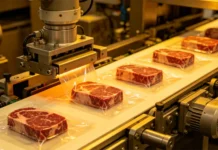











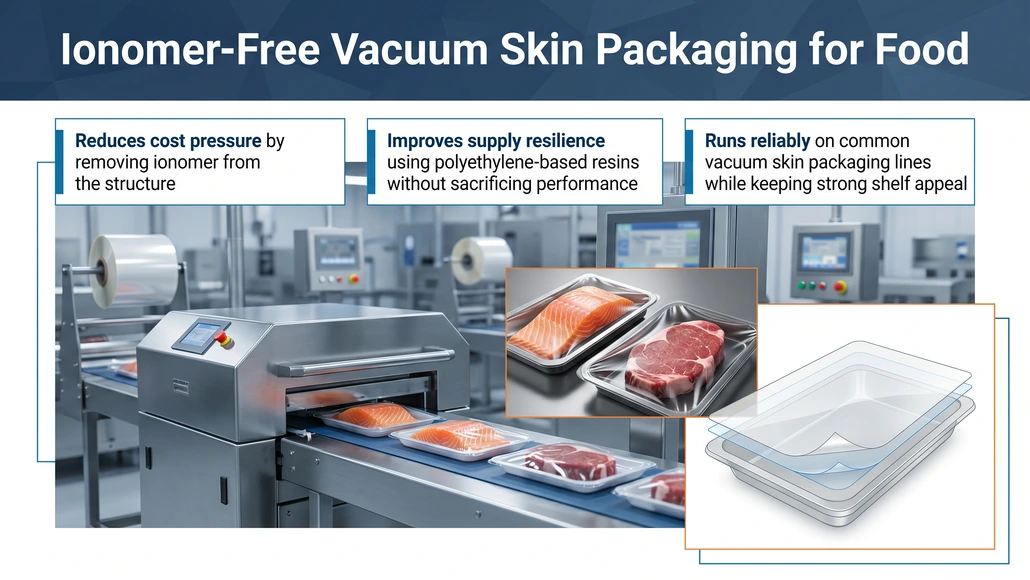

ExxonMobil has introduced a new vacuum skin packaging material for food applications that eliminates the use of ionomer — a move aimed at helping manufacturers manage rising production costs and reduce their exposure to ongoing supply shortages in the packaging sector.
The ionomer-free vacuum packaging solution was developed in collaboration with Kuraray, blown film extrusion company GAP, and packaging machinery specialist G Mondini. The initiative directly addresses material price pressures and supply chain constraints that have long affected conventional ionomer-based vacuum skin packaging.
In a published case study, ExxonMobil noted that traditional ionomer packaging has been “easily impacted by ionomer material shortage, hence be expensive to produce.” By removing ionomer from the packaging structure entirely, ExxonMobil stated that production costs can be lowered and reliance on a constrained material reduced — a critical consideration for food manufacturers operating in a volatile raw materials environment.
This development also coincides with ExxonMobil’s broader rollout of its Signature Polymers portfolio brand, which consolidates its polyolefin products under a single unified offering.
The ionomer-free vacuum packaging structure is built around three primary resins supplied by ExxonMobil. Exceed Flow+ m 0516 metallocene polyethylene contributes what the company describes as “excellent optical and mechanical properties with good sealing performance.” Exceed Tough+ m 0512 metallocene polyethylene is incorporated for forming performance, while ExxonMobil EVA 06519FL polymer supports forming and ensures a tight fit around the packaged product.
Kuraray supplied the EVAL EVOH barrier material used within the structure, providing the necessary gas barrier properties expected in food-grade vacuum skin packaging applications.
Italy-based GAP produced the blown film using these materials, which was subsequently tested across G Mondini’s vacuum skin packaging lines. According to ExxonMobil, the material performed reliably on both semi-automatic and automatic systems, including equipment from Multivac.
The ionomer-free vacuum packaging achieved a gloss level of 81 and a transparency haze rating of 7.5%, according to ExxonMobil’s findings. The company noted these results support both product protection during distribution and shelf presentation standards. The material also retains key functional attributes including seal integrity, tear and puncture resistance, optical clarity, and barrier performance — properties considered essential in vacuum skin packaging for food.
The introduction of an ionomer-free vacuum packaging alternative carries direct relevance for packaging decision-makers and food manufacturers who have experienced disruption from ionomer supply constraints. The ability to replace ionomer with more readily available polyethylene-based resins — specifically ExxonMobil’s Exceed performance polyethylene grades — offers a potential path to greater supply chain resilience without compromising on packaging performance.
The use of Exceed performance polyethylene resins in this structure reflects ExxonMobil’s broader effort to position its metallocene polyethylene portfolio as a functional alternative in applications where specialty materials like ionomer have traditionally been the default.