












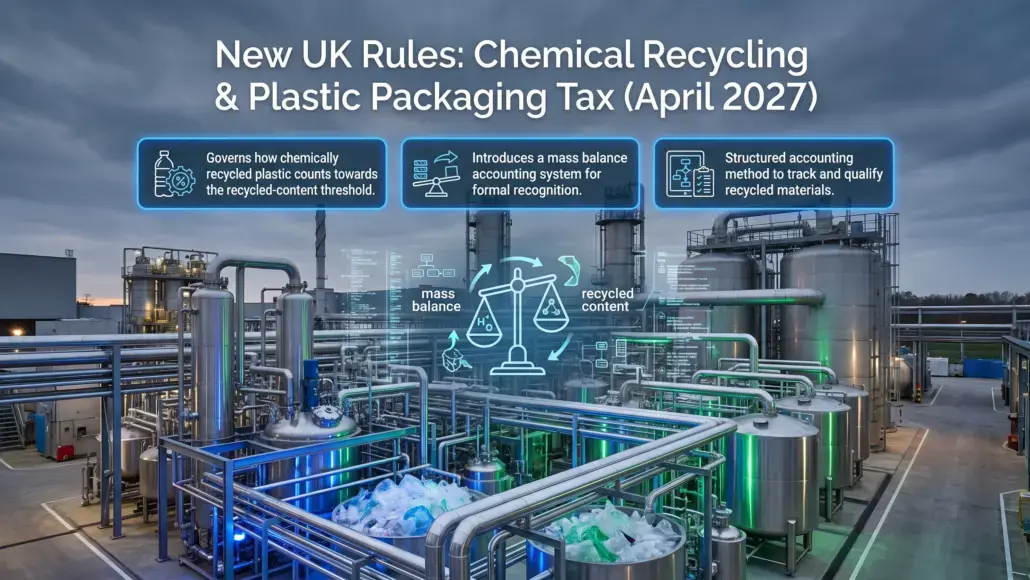
HM Revenue & Customs (HMRC) has outlined new rules governing how chemically recycled plastic can count towards the recycled-content threshold under the UK’s Plastic Packaging Tax (PPT), with the changes taking effect from 1 April 2027. The rules introduce a mass balance accounting system for businesses seeking formal recognition of chemically recycled plastic as qualifying recycled content under the tax framework.
The mass balance system is essentially a structured accounting method. It tracks the amount of qualifying recycled material entering a production process, even when that material is blended with virgin, or newly made, plastic during manufacturing. Because chemical recycling fundamentally alters the chemical structure of plastic waste — unlike mechanical recycling, which physically processes waste plastic without changing its chemical makeup — the recycled and virgin materials can become physically indistinguishable once mixed. Mass balance addresses this by recording inputs and allowing an equivalent amount of recycled content to be attributed to products leaving the system, under defined rules.
From 1 April 2027, this attributed content will be eligible to count towards the 30% recycled-content threshold under the Plastic Packaging Tax. Businesses choosing to use chemically recycled plastic will only be able to claim its recycled status for PPT purposes if they operate within this mass balance framework. Without it, HMRC will treat the material as non-recycled for tax purposes.
The rules apply to packaging components manufactured in the UK using chemically recycled plastic, as well as finished packaging components imported into the UK that were produced using such material. Businesses using only mechanically recycled plastic will continue under the existing accounting system.
HMRC published its preparation guidance and minimum certification requirements on 28 August 2026, with more detailed guidance expected in early 2027.
Certification Requirements for the Supply Chain
A central requirement of the mass balance system is independent, third-party certification. Businesses across the relevant supply chain — from the chemical recycling stage through to the completion of the plastic packaging component — must be certified under a scheme that meets HMRC’s minimum requirements. Depending on the supply chain structure, this could include chemical recyclers, petrochemical operations, polymer producers, and packaging manufacturers or converters.
Businesses in the same supply chain are not required to use the same certification scheme, provided each scheme meets HMRC’s minimum standards. One notable exception applies to importers: a business that only imports finished plastic packaging produced using mass balance does not itself need to hold certification. However, it must ensure the relevant supply chain is certified and must retain supporting evidence from its supplier.
HMRC will not directly regulate certification schemes or the organisations that carry them out. Instead, certification schemes must meet HMRC’s published minimum requirements for their certificates to be accepted as PPT evidence. From 1 April 2027, certification schemes will also be required to operate electronic registers, enabling businesses to verify certification details and validity dates.
Supply-Chain Records and Attribution Declarations
Certification alone is not sufficient. Businesses must also maintain documentary evidence showing how attributed chemically recycled material moves through the supply chain. When material changes hands between businesses, the supplier must provide both a valid certificate and an attribution declaration — a formal document recording how much chemically recycled content has been assigned to a specific delivery or batch.
Each new delivery or batch containing attributed chemically recycled content requires a new attribution declaration. The declaration must include the quantity of recycled material covered, a unique batch number, the dispatch date, and the identities of both the supplier and the recipient.
Receiving businesses are responsible for verifying that their suppliers are properly certified and that all declarations are complete and valid. If a declaration is incomplete, the receiving business will not be able to use the attributed content to claim a PPT exemption. For packaging manufacturers and converters, this places significant weight on the quality of supplier records throughout the supply chain, not just on internal calculations made at the point of final production.
All certificates, attribution declarations, and relevant mass balance records must be retained for six years. HMRC has stated that businesses unable to produce the required evidence during a compliance check may be liable to pay PPT on packaging previously reported as exempt. Penalties may also apply where chemically recycled material has been accounted for without satisfying the minimum requirements.
Site-Level Accounting and Operational Demands
The mass balance system requires detailed, site-specific record-keeping. Businesses must operate on three-month accounting periods and cannot assign more recycled content to products than their records confirm is available. The recycled-material account cannot fall below zero at any point — meaning a business cannot attribute 100 tonnes of recycled content if only 80 tonnes are recorded as available.
These accounting periods run continuously from the date of certification and do not need to align with a business’s quarterly PPT accounting periods. Production losses must also be factored in. If 100 tonnes of qualifying material enters a process but 10 tonnes are lost during manufacturing, only 90 tonnes can be treated as available for attribution to products. Businesses must therefore apply site-specific conversion factors based on their own operational data.
More complex rules govern refineries and petrochemical plants that produce multiple outputs from the same process, particularly where some outputs are directed to fuel use rather than plastic production. For packaging businesses, meeting these requirements will mean internal systems must reconcile recycled and virgin materials entering a site, outgoing products, stock levels, production data, and the volume of recycled content assigned to different outputs.
Current PPT Framework and the April 2027 Changes
The Plastic Packaging Tax applies to finished plastic packaging components that contain less than 30% recycled plastic. The tax rate stands at £228.82 per tonne from 1 April 2026. Businesses are generally required to register for PPT if they manufacture or import 10 tonnes or more of finished plastic packaging components within the relevant 12-month period.
The April 2027 change creates a defined route for qualifying chemically recycled material to count towards the 30% recycled-content threshold. For packaging producers and importers, this means commercial decisions will extend beyond sourcing chemically recycled plastic. They will also need to confirm that the material has passed through a properly certified supply chain and that the necessary documentation is in place to support its recycled status for PPT.
Pre-Consumer Plastic Waste: A Parallel Change
A further change to PPT takes effect on the same date. From 1 April 2027, pre-consumer plastic waste will no longer qualify as recycled plastic for PPT purposes. Pre-consumer waste is plastic generated during manufacturing before a product reaches consumers, whereas post-consumer waste originates from plastic products after consumer use. Reprocessed post-consumer plastic waste will continue to qualify as recycled content for PPT.
The government announced this change alongside the mass balance reform as part of a broader package of PPT adjustments. For packaging businesses, the combination of these two changes means that existing recycled-content calculations and supplier evidence should be reviewed ahead of April 2027.
The mass balance framework gives chemically recycled plastic a structured and auditable route to contribute towards PPT recycled-content calculations, even in cases where recycled and virgin materials become physically indistinguishable during production. Chemical recycling can work alongside mechanical recycling by processing plastic waste that may be technically difficult or economically unviable to recycle mechanically.
The government’s approach does not replace mechanical recycling but instead establishes a separate accounting route for qualifying chemically recycled material, supported by certification requirements and supply-chain documentation. For the packaging sector, the rules define the conditions under which chemically recycled material can count towards the PPT threshold, which may influence decisions about material sourcing and supplier selection as businesses assess their routes to meeting the 30% requirement.
The 1 April 2027 implementation date provides packaging businesses with time to put the necessary systems in place. Companies considering using mass balance should begin by mapping their chemically recycled material supply chains and identifying which businesses within those chains will need to hold certification.
Businesses should establish whether their suppliers intend to use certification schemes that meet HMRC’s requirements and put in place processes for receiving, checking, and storing certificates and attribution declarations. Internal systems may also need to be updated to record material movements, supplier certification status, attribution declarations, production data, and the running balance of recycled material available for assignment to products. These records must be maintained in a retrievable format for the required six-year period.
Importers of finished packaging should establish procedures for verifying supplier certification and reviewing attribution declarations, even where they are not themselves required to hold certification. HMRC has confirmed that more detailed operational guidance will be published in early 2027. The August 2026 documents provide a preparatory framework, with further specifics on system operation still to follow.
For packaging manufacturers, converters, and importers, the changes connect recognition of chemically recycled plastic under the Plastic Packaging Tax to a documented chain of evidence running from raw recycled material through processing, manufacturing, and on to the finished packaging component. From April 2027, participation in this system remains a choice — but businesses that choose it will need to demonstrate, through certification, accounting records, and supply-chain documentation, how much chemically recycled material they are entitled to count.

