


















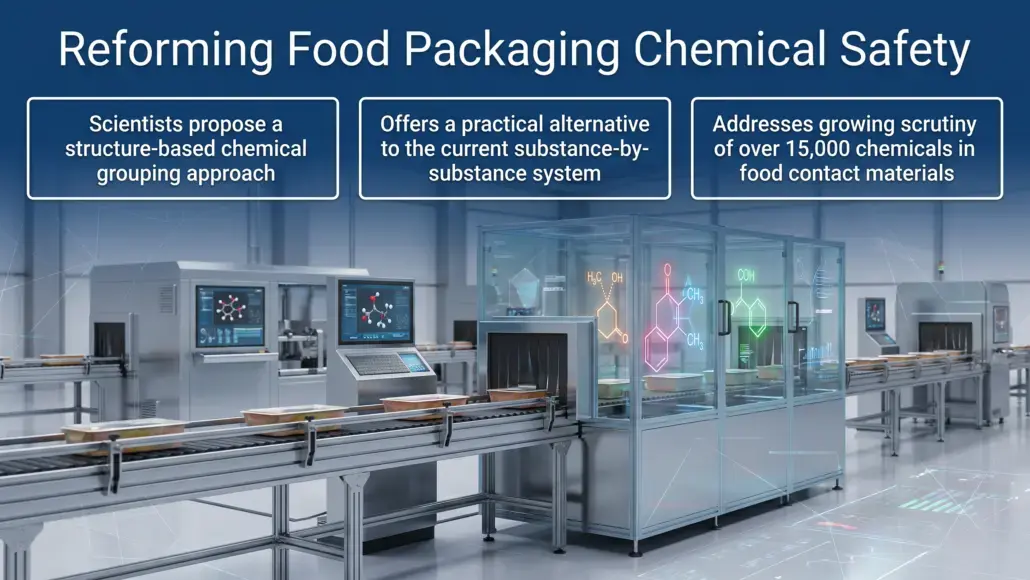

A peer-reviewed study published on September 1 in Environmental Science & Technology is calling for a fundamental rethink of how regulators assess chemicals used in food packaging, proposing a structure-based chemical grouping fix as a practical and immediately deployable alternative to the current substance-by-substance evaluation system.
The study, led by scientists at the Food Packaging Forum, arrives at a time of growing scrutiny of more than 15,000 chemicals present in food contact articles — ranging from packaging materials to kitchenware — of which 87% lack sufficient safety data to meaningfully evaluate their potential health impacts.
A Regulatory System Under Strain
The researchers make a compelling case that today’s one-chemical-at-a-time approach, practiced across both Europe and North America, was never built to manage a chemical universe of this scale. Of the more than 15,000 substances currently in circulation within food contact materials, 1,222 have already been identified as priority chemicals that are hazardous to human health. The remaining 13,000-plus have little to no publicly available data, leaving regulators and industry effectively working in the dark when it comes to food packaging safety.
To address this data gap, the research team developed a method that groups chemicals by their structural similarities, operating on the well-established scientific principle that structurally similar compounds tend to share similar hazard properties. Through this approach, the study identifies 38 priority chemical groups that contain a disproportionately high concentration of known hazardous substances. Among the groups flagged are ortho-phthalates, PFASs, organophosphates, isocyanates, and primary aromatic amines — all significant categories within the broader food contact chemicals landscape.
The Scope of the Problem
In total, 4,222 food contact chemicals fall within these 38 flagged groups, meaning a substantial portion of substances currently on the market are structurally proximate to known hazards. This finding carries direct implications for manufacturers making substitution decisions, as it highlights the very real risk of introducing what researchers describe as “regrettable substitutes” — chemicals swapped in to replace a restricted substance, only to carry the same or similar hazard profile.
Lead author Helene Wiesinger addressed the substitution risk directly, stating, “Replacing known hazardous chemicals with very similar but insufficiently tested alternatives is not solving the problem.” She noted that the chemical grouping fix allows for rapid identification of chemicals of concern, giving both policymakers and industry a faster route to informed action on food packaging safety.
Co-author Jane Muncke was equally direct in her assessment of the current regulatory framework. “Today’s regulatory approaches in Europe and North America look at each chemical individually, but this is inefficient and does not sufficiently protect consumers,” she said. “We are proposing an evidence-based grouping approach decision makers can already use now until the proper testing methods and testing data become available.”
The combined weight of both statements points to a structural deficiency in how regulatory frameworks currently handle the complexity of food contact chemicals — and positions the proposed method as a bridge solution rather than a distant reform goal.
Free Tools Released Alongside the Study
Rather than leaving the chemical grouping fix as a theoretical framework, the research team released two practical tools in tandem with the study’s publication.
The first is an updated FCCprio List, which ranks known hazardous food contact chemicals and serves as a reference baseline for hazard prioritization. The second is FCCgroup, an interactive application that enables users to screen their own chemical inventories against the 38 identified priority groups.
Co-author Albert Anguera Sempere outlined the practical commercial value of these tools, emphasizing that FCCgroup is designed to be accessible and efficient. He noted it is built to make it easy and quick for anyone to screen a set of chemicals and identify which might be hazardous — a capability he said could help companies get ahead of future legal restrictions, avoid litigation, and better protect their customers.
Industry and Regulatory Relevance
With regulators in both the European Union and the United States signalling growing interest in reforming food contact material rules, the availability of a free, structure-based screening tool meaningfully shifts the risk calculus around substitution decisions. Companies replacing a restricted chemical with a structurally similar alternative — without first checking where it falls among the 38 priority groups — may be exchanging one liability for another. The tools now provide a direct mechanism to make that check before any commitment is made.
The study represents a concrete and research-backed step toward addressing one of the most persistent challenges in food packaging safety: the vast gap between the number of chemicals in commercial use and the depth of safety data available to evaluate them. By combining structural chemistry logic with freely accessible screening tools, the Food Packaging Forum research team has provided both regulators and industry with an actionable framework at a moment when reform conversations are actively under way.