










Two major players in the specialty materials and chemical industries have joined forces to speed up the shift toward recyclable fiber packaging. UPM Specialty Materials and BASF have announced a collaboration aimed at helping brand owners, converters, and formulators move away from conventional mixed packaging structures toward high-performance, paper-based alternatives.
The partnership brings together UPM’s barrier and barrier base papers with BASF’s Joncryl HPB high performance barrier technology resins to enable the development of packaging materials that meet demanding regulatory requirements across a wide range of food and non-food applications.
A Response to Growing Regulatory Pressure
The packaging industry is navigating an increasingly strict regulatory environment. The European Union’s Regulation (EU) 2025/40 on packaging and packaging waste has placed ambitious recyclability targets at the forefront of industry agendas, driving a broad move toward design-for-recycling principles. This collaboration between UPM and BASF is a direct response to these market shifts, offering a materials-based pathway for the industry to meet those targets.
UPM’s barrier papers including grades such as UPM Solide Lucent and UPM Asendo are specifically engineered for demanding packaging converting and printing applications. When paired with coatings based on BASF’s Joncryl HPB polymers, these papers enable packaging materials that deliver strong protection performance while maintaining recyclability credentials. The combination is being positioned as a credible reference approach for replacing plastic-based or PE-laminated structures with paper-based packaging designed for recycling.
What the Collaboration Delivers
The core value of this collaboration lies in pairing complementary technologies across the packaging value chain. UPM brings premium paper grades developed for flexible packaging applications, while BASF contributes waterborne Joncryl HPB resins that have been tested and shown not to negatively impact paper recyclability according to the CEPI v. 2.0 standard in Europe.
UPM packaging papers carry recyclability certifications under CEPI v. 2.0 (Europe), PTS-RH 021/97 category II, and WMU SBS-E (U.S.), providing documented backing for their recyclable fiber packaging credentials. Third-party testing of the complete combined structure is currently ongoing.
Mika Uusikartano, Senior Manager of Product Portfolio Management at UPM Specialty Materials, noted that the transition to recyclable fiber-based packaging calls for both advanced barrier performance and close collaboration across the value chain. He described the barrier papers developed by UPM as designed to support co-creation with partners, enabling new, high-performance packaging applications. He added that the collaboration with BASF demonstrates how combining innovative barrier technologies with barrier papers can deliver functional, recyclable solutions that accelerate the packaging transformation.
Rolf Alles, Director of Sales Resins EMEA at BASF, pointed to rapidly growing demand for sustainable packaging solutions across the value chain from brand owners to converters and formulators. He described the combination of UPM’s premium paper grades with barrier coatings based on waterborne Joncryl HPB resins as forming a strong and credible reference approach for the development of paper-based alternatives designed to replace plastic-based or PE-laminated structures.
Targeting a Broader Industry Transition
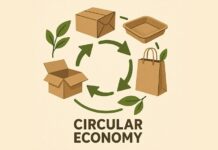
The collaboration reflects a wider industry movement away from multi-material packaging structures that are difficult or impossible to recycle. By combining UPM’s fiber-based expertise with BASF’s advanced resin technology, the partnership is designed to give the industry a workable and scalable route toward sustainable packaging that does not compromise on protection performance.
For brand owners and converters seeking to align with evolving recycling regulations and meet their own sustainability commitments, this type of cross-industry collaboration in recyclable fiber packaging offers a practical, tested solution that is grounded in real materials science rather than aspirational targets alone.

