















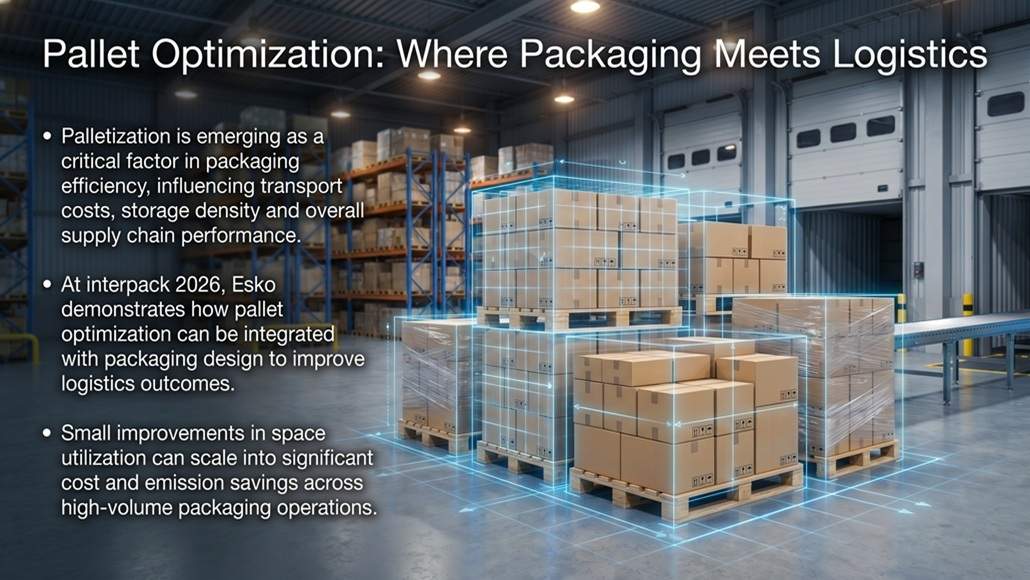

As packaging operations evolve, attention is increasingly shifting beyond design and production to the final stages of the value chain. Palletization, once considered a purely logistical step, is now emerging as a critical factor in improving efficiency, reducing costs, and supporting sustainability goals.
At interpack 2026, this shift is reflected in how Esko is demonstrating packaging workflows that extend beyond production to include pallet optimization and logistics planning. By linking packaging decisions with downstream outcomes, the industry is beginning to treat palletization as a strategic function rather than an operational afterthought.
Click here to register for guided experience
Why Palletization is Gaining Strategic Importance
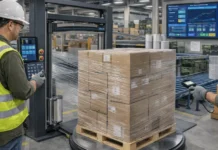
The way products are arranged on pallets has a direct impact on transportation efficiency, storage density, and overall supply chain costs. In traditional setups, palletization has often relied on standard patterns or rule-of-thumb configurations. While sufficient for stable, high-volume product lines, this approach becomes less effective in today’s environment of increasing SKU diversity and frequent packaging changes.
Even marginal inefficiencies in pallet utilization can scale significantly. A few centimetres of unused vertical or horizontal space, when multiplied across thousands of shipments, can result in additional transport loads, higher fuel consumption, and increased warehousing requirements. For companies operating across global supply chains, these inefficiencies translate into measurable cost pressures.
As a result, palletization is no longer viewed in isolation. It is increasingly being evaluated as part of a broader effort to optimise end-to-end packaging performance, from production through to distribution.
From Static Planning to Data-Driven Optimization
Historically, pallet planning has been a largely manual process, often based on fixed templates or prior experience. While this approach provides a baseline, it lacks the flexibility to adapt to changing packaging formats, product dimensions, and distribution requirements.
Digital tools are now enabling a more data-driven approach to palletization. By simulating different configurations, companies can evaluate how variations in packaging dimensions, stacking patterns, and load distribution affect overall efficiency. This allows for scenario-based planning, where multiple options can be tested before a final configuration is selected.
Such simulations also help identify constraints that may not be immediately visible in manual planning—such as load stability, weight distribution, or compatibility with transport and storage systems. By addressing these factors early, companies can reduce the risk of damage, inefficiencies, and operational disruptions further down the line.
Linking Packaging Design with Logistics Outcomes
One of the most significant shifts in packaging strategy is the growing recognition that design decisions have direct implications for logistics performance. Dimensions, structural integrity, and pack configuration all influence how efficiently products can be palletized and transported.
In many cases, packaging is optimised for shelf presence or production efficiency without fully considering its impact on palletization. This disconnect can lead to suboptimal outcomes, where well-designed packaging performs poorly in distribution.
By linking design and logistics more closely, companies can ensure that packaging performs effectively across all stages of the value chain. Structural adjustments—such as resizing, reconfiguring pack formats, or optimising secondary packaging—can significantly improve pallet efficiency without compromising product integrity or branding.
Solutions such as Cape Pack from Esko reflect this integration by enabling pallet optimization alongside packaging design and workflow planning. This allows companies to evaluate packaging decisions not only in terms of production and marketing, but also in terms of their downstream logistics impact.
Click here to register for guided experience
Sustainability Gains through Better Space Utilization
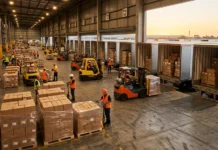
Improving pallet efficiency has a direct and measurable impact on sustainability. Better space utilisation reduces the number of shipments required to move the same volume of goods, leading to lower fuel consumption and reduced greenhouse gas emissions.
In addition, optimised pallet configurations can contribute to more efficient use of warehouse space, reducing energy consumption associated with storage and handling. These gains are particularly relevant as companies face increasing pressure to meet environmental targets and demonstrate reductions in their carbon footprint.
The ability to simulate and compare different packaging and pallet configurations also enables more informed decision-making. By understanding the environmental implications of different scenarios, companies can align operational efficiency with sustainability objectives.
From Packaging to Supply Chain Efficiency
What is becoming increasingly clear is that packaging decisions extend far beyond the production line. They influence transportation costs, warehouse utilisation, and overall supply chain performance.
In this context, palletization serves as a bridge between packaging and logistics. By integrating it into packaging workflows, companies can align design, production, and distribution into a more cohesive system. This not only improves efficiency but also enhances visibility and control across the value chain.
As supply chains become more complex and interconnected, this level of integration is becoming essential. Companies that are able to align packaging and logistics effectively are better positioned to respond to cost pressures, regulatory requirements, and evolving market demands.
Where to See it in Practice
At interpack 2026, Esko is demonstrating how pallet optimization fits within a broader packaging workflow, connecting design, production, and logistics into a more integrated process.
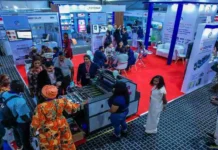
Visitors can explore how palletization, data integration, and packaging design come together in practice at Messe Düsseldorf from 7 to 13 May 2026 in Hall 8b, Booth 8BC14.