





























Colour is one of the most recognisable elements of packaging, but reproducing it consistently is more complicated than selecting a colour value in the design file. The same brand colour can appear differently when printed on different substrates, with different inks or through different printing processes. As packaging portfolios expand across formats and production sites, colour management is becoming an important part of controlling how a brand is represented in physical packaging. The challenge begins with the interaction between ink and substrate. Paper and board can differ in whiteness, surface characteristics and the presence of Optical Brightening Agents (OBAs), all of which can influence the final appearance of a printed colour. A recent study examining alkali-based inks on packaging substrates found measurable differences in colour accuracy between paper containing OBAs and paper without them. The findings reinforce why a colour specification cannot always be treated as independent from the material on which it is reproduced. For packaging teams, effective colour management depends on controlling the variables that sit between the intended design and the printed result.
- Establishing measurable colour targets rather than relying only on visual judgement
- Accounting for substrate and printing-process differences during reproduction
- Using standardised measurement conditions to compare printed results
- Maintaining defined tolerances across suppliers and production locations
Substrate Variation Affects Colour Accuracy
The research provides a direct example of how substrate characteristics can influence colour reproduction. In testing reflex blue, the study reported a ΔE00 value below 3 for the second print pass on non-OBA paper after 72 hours, while the corresponding OBA substrate produced a value of around 7. The results came from a controlled experimental setup, so they should not be treated as an industry-wide benchmark. They do, however, demonstrate that the same ink can produce materially different colour results depending on the substrate. 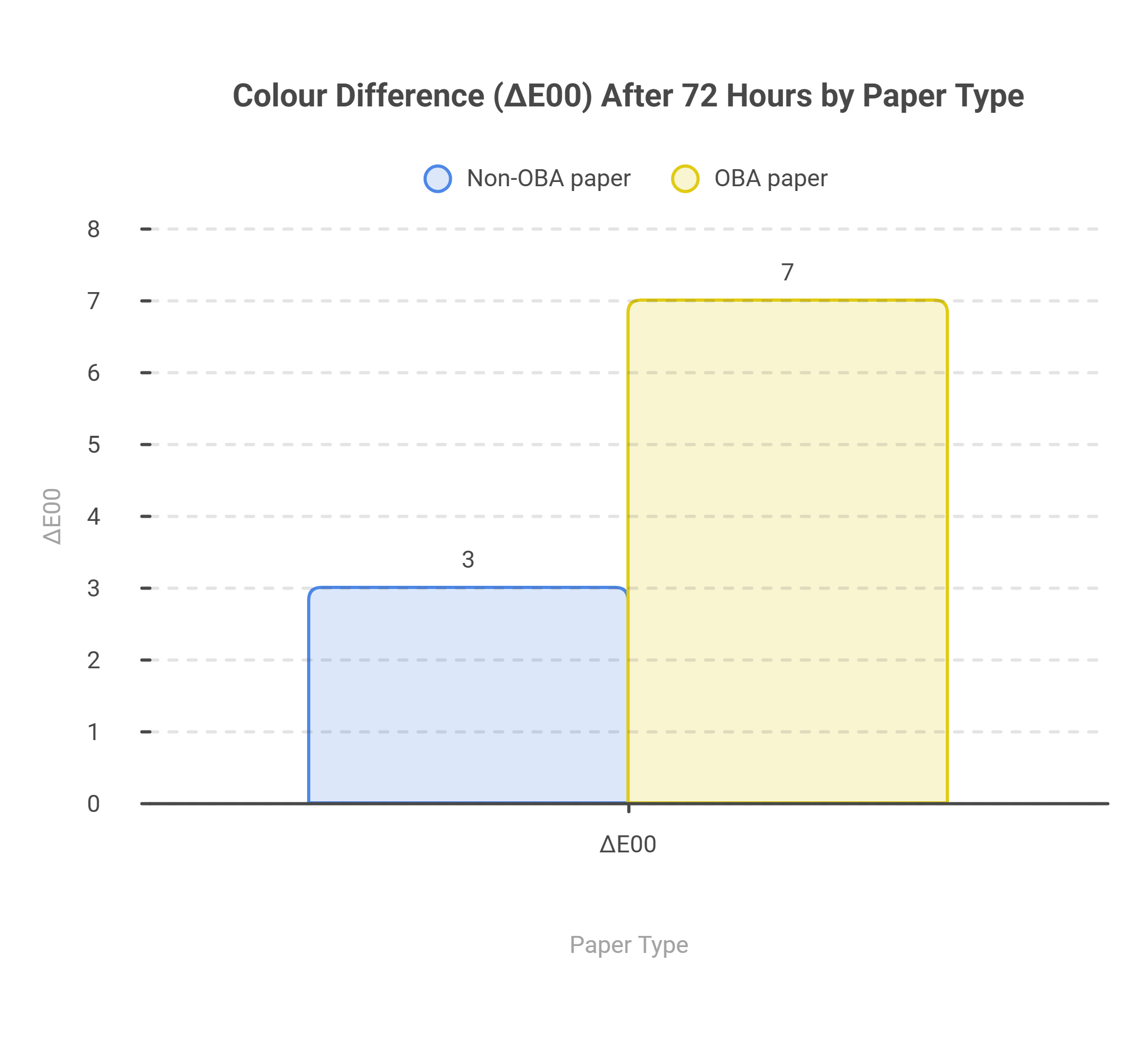
Standardisation Brings More Control
This is why colour management increasingly involves measurement, defined tolerances and repeatable production conditions rather than visual matching alone. Standards such as ISO 12647-6:2020 provide colourimetric printing aims and process parameters for flexographic packaging production, while ISO 13655:2017 establishes methods for spectral measurement and colorimetric computation in graphic arts. As colour becomes increasingly controlled through measurable specifications, packaging teams also have to consider how those requirements interact with different production technologies. This creates a direct connection to digital printing flexibility, where shorter runs and greater versioning can introduce another set of colour-management considerations.
Measurement and Process Control Strengthen Colour Consistency
The challenge for colour management becomes greater when the same packaging artwork moves between different printing technologies, substrates and production locations. A colour specification may provide a precise target, but achieving that target depends on how the printing system reproduces it. This makes process control and measurement important parts of packaging production rather than issues addressed only after a print run is completed. Extended Colour Gamut (ECG) printing illustrates this shift. By adding Orange, Green and Violet (OGV) to the conventional Cyan, Magenta, Yellow and Black (CMYK) process, printers can reproduce a wider range of colours while reducing reliance on individually specified spot colours. Research reported by the Flexographic Technical Association tested PANTONE+ Solid Coated colours on two different multicolour printing systems and found clear differences in the proportion of colours reproduced below a ΔE threshold of 2. The results demonstrate that colour management has to account for the characteristics of the complete printing system.
- Different presses and ink sets can produce different colour gamuts
- Substrate characteristics can affect how colours are perceived and measured
- Standardised targets allow printers and brands to assess deviations consistently
- Spectral measurement provides objective data for production and quality control
Measurement Supports Consistent Production
Standards provide the framework for making those measurements meaningful across the supply chain. International Organization for Standardization (ISO) 13655:2017 defines methods for spectral measurement and colorimetric computation in graphic arts, while ISO 12647-6:2020 establishes colourimetric aims, process parameters and recommended tolerances for flexographic packaging production. This standardisation becomes increasingly important when packaging is produced by multiple converters. Without a common measurement framework, colour approval can become dependent on individual visual assessments, making it harder to determine whether a difference is caused by the substrate, ink, press condition or another production variable. The move toward measured colour also creates opportunities for more automated quality control. Modern systems can capture spectral information during production and compare results against defined targets and tolerances. ISO 20616-2:2020 addresses the exchange of print-quality data and metadata between quality-control applications, supporting greater consistency in how production information is communicated.
Operational Controls Across the Packaging Supply Chain
For brands using multiple suppliers, colour consistency depends on controls that remain stable as artwork moves from design into production. These controls can include:
- Defining colour targets and acceptable tolerances before production
- Standardising measurement conditions across different print environments
- Monitoring colour during production rather than relying only on final inspection
- Sharing quality data between brand owners, prepress teams, converters and suppliers
This gives colour management a broader role than simply achieving a visually acceptable print. A defined colour system provides designers, prepress specialists, printers and quality-control teams with a common reference for approving and correcting production output. As brands use more packaging formats, suppliers and printing technologies, this shared framework becomes increasingly important for maintaining a recognisable visual identity across the finished portfolio.
Colour Management Becomes a Supply-Chain Discipline
The growing importance of colour management reflects a wider change in how packaging quality is controlled. Colour consistency now depends on a shared framework that connects design specifications with substrates, printing processes, measurement conditions and production tolerances. This becomes especially important when the same packaging is manufactured across different suppliers or locations. The most effective approach is therefore built around:
- Clearly defined colour targets and tolerances
- Standardised measurement and evaluation methods
- Consistent communication of colour data across production partners
Digital measurement and quality-control systems can support this process, but they do not remove the need to understand the physical factors that influence colour reproduction. Substrate, ink and printing conditions continue to shape the final result. As packaging production becomes more varied, these controls also create a foundation for greater digital printing flexibility, where colour consistency must be maintained across shorter runs, multiple versions and changing production requirements.
References
- International Organization for Standardization – ISO 12647-6:2020 Graphic technology – Process control for the production of half-tone colour separations, proof and production prints – Part 6: Flexographic printing – 2020
- International Organization for Standardization – ISO 13655:2017 Graphic technology – Spectral measurement and colorimetric computation for graphic arts images – 2017
- International Organization for Standardization – ISO 20616-2:2020 Graphic technology – Print quality assessment using metadata – Part 2: Print quality data exchange – 2020
- Color Research & Application – Impact of optical brightening agents on alkali-based inks in packaging: A comparative study on color accuracy – 2024
- Flexographic Technical Association – Expanded Gamut Study Evaluates Spot Color Reproduction in Multicolor Printing – 2024