






















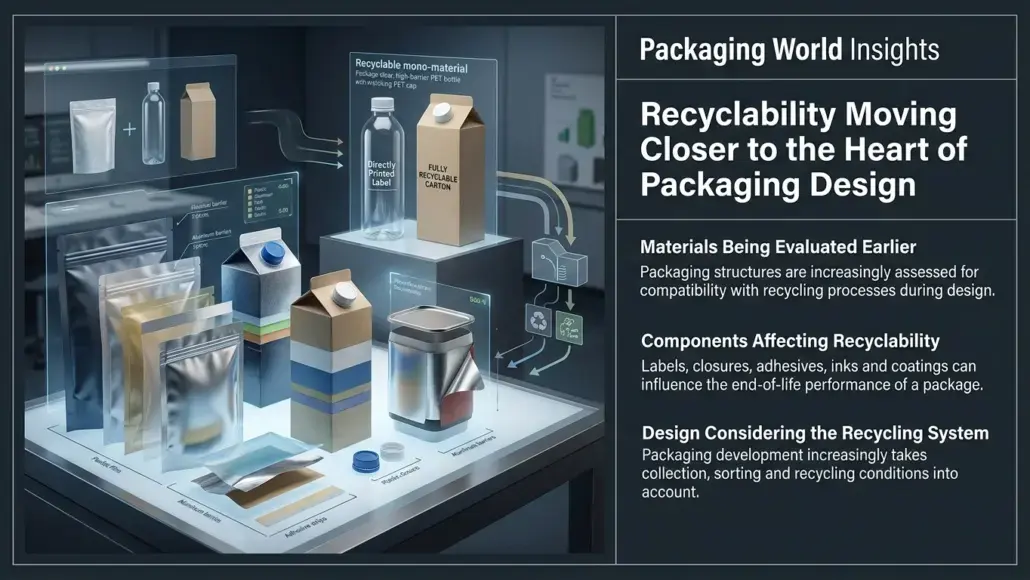

Packaging has traditionally been assessed for its ability to protect products, withstand distribution and meet production requirements. Recyclability is increasingly becoming part of those early decisions rather than something considered only after a package has been used. Packaging recyclability now depends not only on the material selected for the main pack, but also on components, labels, adhesives, coatings and how the finished structure behaves in collection and sorting systems. This shift is becoming more formal in the European Union. The Packaging and Packaging Waste Regulation (PPWR) establishes recyclability performance grades for packaging and progressively connects market access with those requirements. From 2030, packaging will be assessed against defined recyclability criteria, with further requirements linked to recycling at scale introduced later in the decade. For packaging teams, this means packaging recyclability increasingly has to be considered alongside functionality during design.
- Material structures need to be compatible with relevant recycling processes.
- Labels, closures, adhesives and other components can influence the overall packaging assessment.
- Design decisions need to consider collection and sorting as well as the material itself.
- Regional recycling infrastructure can affect whether a theoretically recyclable package is practically recoverable.
Recyclability Performance Becoming Measurable
The PPWR introduces specific recyclability-performance thresholds rather than relying only on broad descriptions such as “recyclable”. Grade A requires a score of at least 95%, Grade B at least 80% and Grade C at least 70% under the regulation’s assessment framework. Packaging below the applicable threshold is treated as technically non-recyclable within that framework. 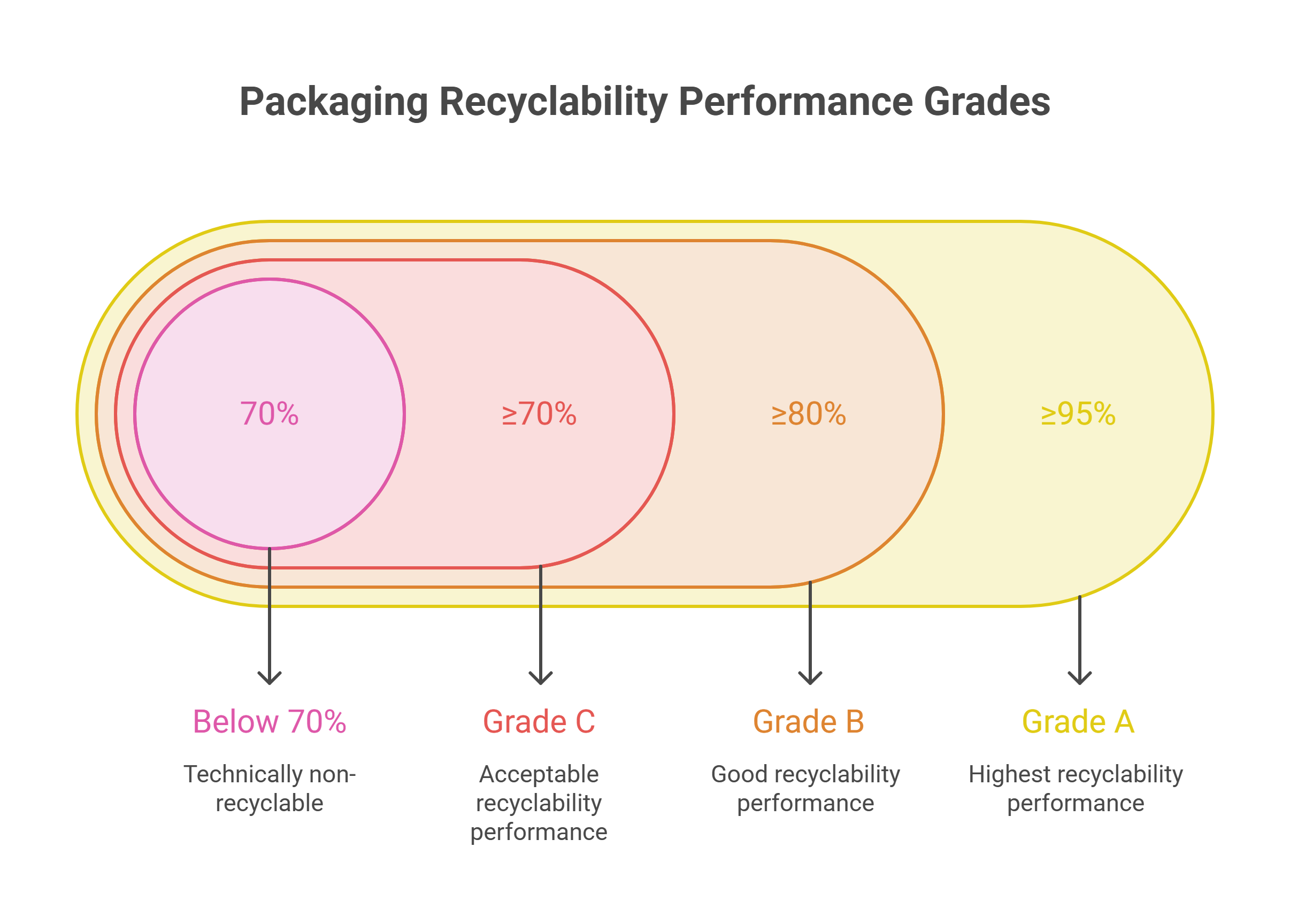
Design Choices Influencing End-of-Life Outcomes
The implications extend beyond regulatory scoring. Packaging that combines several materials may deliver important barrier, strength or shelf-life benefits while creating additional challenges for sorting and recycling. Research has found that packaging design can influence the effectiveness of sensor-based sorting, showing why end-of-life performance needs to be considered while structures are still being developed. This makes sustainability data a natural next step, as packaging teams increasingly need evidence to compare material choices against both functional and environmental requirements.
Recyclability Moving from Material Choice to Packaging Design
The practical challenge of packaging recyclability becomes clearer when the entire pack is considered rather than just its primary material. A plastic container may use a resin that is widely accepted for recycling, for example, but its label, closure, adhesive, pigment or coating can still affect how the finished item is sorted or processed. This is why newer design guidance increasingly evaluates packaging as a complete structure rather than assuming that the dominant material determines recyclability on its own. Research published in Resources, Conservation and Recycling found that packaging design can influence sensor-based sorting performance in lightweight packaging waste. The study estimated that better alignment between packaging design and sorting technology could enable up to 48,300 tonnes of additional correctly sorted rigid plastics per year in Germany. The finding provides a direct link between design decisions and what happens after packaging enters the waste stream.
Packaging Components Affect Recycling Performance
Design teams therefore need to assess the interaction between different parts of the pack before production. Important considerations include:
- Whether the combination of materials is compatible with the intended recycling process
- Whether labels, adhesives or closures interfere with sorting or reprocessing
- Whether colours or pigments affect detection by sorting equipment
- Whether coatings or barrier layers create material incompatibilities
This is particularly relevant for flexible packaging, where multiple layers can provide barrier and protection benefits but can also make separation and recycling more difficult. Research examining multilayer packaging has identified material incompatibility and polymer contamination as challenges for producing high-quality recycled material. The result is a more complex design decision. A structure cannot be evaluated only on whether it protects the product effectively. Its end-of-life characteristics also need to be considered alongside shelf life, mechanical performance and manufacturing requirements.
Design Guidance Becoming More Specific
Industry frameworks are increasingly translating these considerations into practical rules. RecyClass has continued updating its Design for Recycling guidance, including recommendations covering flexible packaging barriers, printing inks, closures and opaque Polyethylene Terephthalate (PET) containers. The Consumer Goods Forum’s Golden Design Rules similarly address packaging elements that can influence recycling outcomes. This means packaging recyclability is increasingly being considered through specific design attributes rather than a simple material label. For packaging teams, this can influence decisions such as:
- Selecting mono-material structures where they can meet required performance
- Limiting components that interfere with sorting or recycling
- Reviewing inks, adhesives and labels as part of the overall pack
- Testing proposed structures against recognised Design for Recycling guidelines
The shift also has commercial implications. Under the European Union’s Packaging and Packaging Waste Regulation (PPWR), recyclability performance is increasingly connected with market access and Extended Producer Responsibility (EPR) considerations. That gives packaging recyclability a more direct place in packaging development, where decisions made at the design stage can influence regulatory readiness and future packaging costs.
Recyclability Becoming a Core Design Requirement
The shift toward packaging recyclability means end-of-life performance is increasingly being considered alongside product protection, manufacturing and cost during package development. Regulatory frameworks and industry guidelines are making this evaluation more specific, while research continues to show that material structures and individual components can influence sorting and recycling outcomes. For packaging teams, the priorities increasingly include:
- Designing structures that align with established recycling processes
- Assessing labels, closures, adhesives, inks and coatings as part of the complete pack
- Considering the recycling infrastructure available in target markets
The direction is therefore moving beyond choosing a nominally recyclable material. Packaging needs to be designed with its complete lifecycle in mind, while still meeting functional requirements such as product protection and shelf life.
References
- European Union – Regulation (EU) 2025/40 on Packaging and Packaging Waste – 2025
- Resources, Conservation and Recycling – Influence of plastic packaging design on sensor-based sortability in lightweight packaging waste sorting plants – 2024
- RecyClass – RecyClass Methodology – 2025
- The Consumer Goods Forum – Golden Design Rules for Plastic Packaging – 2025