











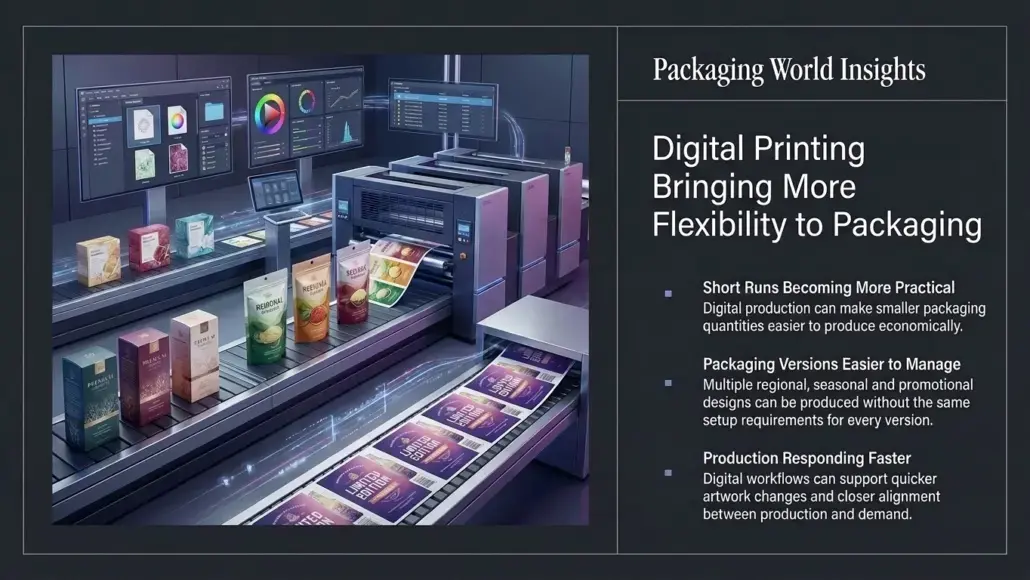

- Smaller production runs can be handled without the same setup requirements as traditional processes
- Artwork changes can be introduced without creating a new printing plate for every version
- Regional, seasonal and promotional packaging can be produced in more manageable quantities
- Production can move closer to actual demand, reducing the need to commit to large volumes in advance
Shorter Runs Support Greater Packaging Variation
The economics become particularly relevant when packaging requirements change frequently. Digital workflows can make it more practical to produce multiple versions of the same package, test a new design in a limited market or respond to changes in demand. Industry analysis from drupa has identified shorter runs, lower order quantities, faster turnaround and regional packaging as important areas where digital production can offer an advantage. Newer systems have also expanded the range of run lengths that can be considered economically viable, although conventional processes continue to hold advantages for many high-volume jobs. The shift does not mean that digital printing is automatically cheaper. Its value depends on the combination of run length, version count, turnaround requirements and production complexity. The main factors influencing the production decision include:
- Volume required for each packaging version
- Number and frequency of artwork changes
- Time available between order and delivery
- Cost of setup, plates, inventory and potential obsolescence
This gives digital production a distinct role within the broader packaging print mix, particularly where flexibility, versioning and responsiveness are more important than achieving the lowest unit cost at very high volumes.
Digital Printing Expanding the Range of Viable Packaging Runs
The flexibility of digital printing becomes more significant when packaging requirements involve multiple versions rather than one standardised production run. A converter may need to produce different graphics for regions, seasonal campaigns, product launches or smaller customer segments, with each version requiring a relatively modest quantity. Digital workflows can handle these changes without the same plate-making and setup requirements associated with conventional processes, allowing production to respond more closely to actual demand. Market data indicates that this capability is becoming more relevant. Smithers forecasts the global digital packaging and label market to increase from $22.0 billion in 2025 to $36.9 billion by 2030, representing a compound annual growth rate of 10.9%. Digital still represents a small proportion of the overall packaging print market, however, which underlines its role as an expanding production option rather than a universal replacement for analogue printing. The commercial advantages become clearer when packaging requirements include:
- Multiple versions of the same base package
- Limited-edition or seasonal designs
- Regional artwork and language variations
- Smaller batches for market testing or new product launches
Market Growth Reflects Increasing Production Flexibility
The projected increase in digital packaging print reflects growing demand for production models that can accommodate more variation. Digital printing can reduce the need to commit to large quantities of a single design, particularly when packaging demand is uncertain or changes frequently. 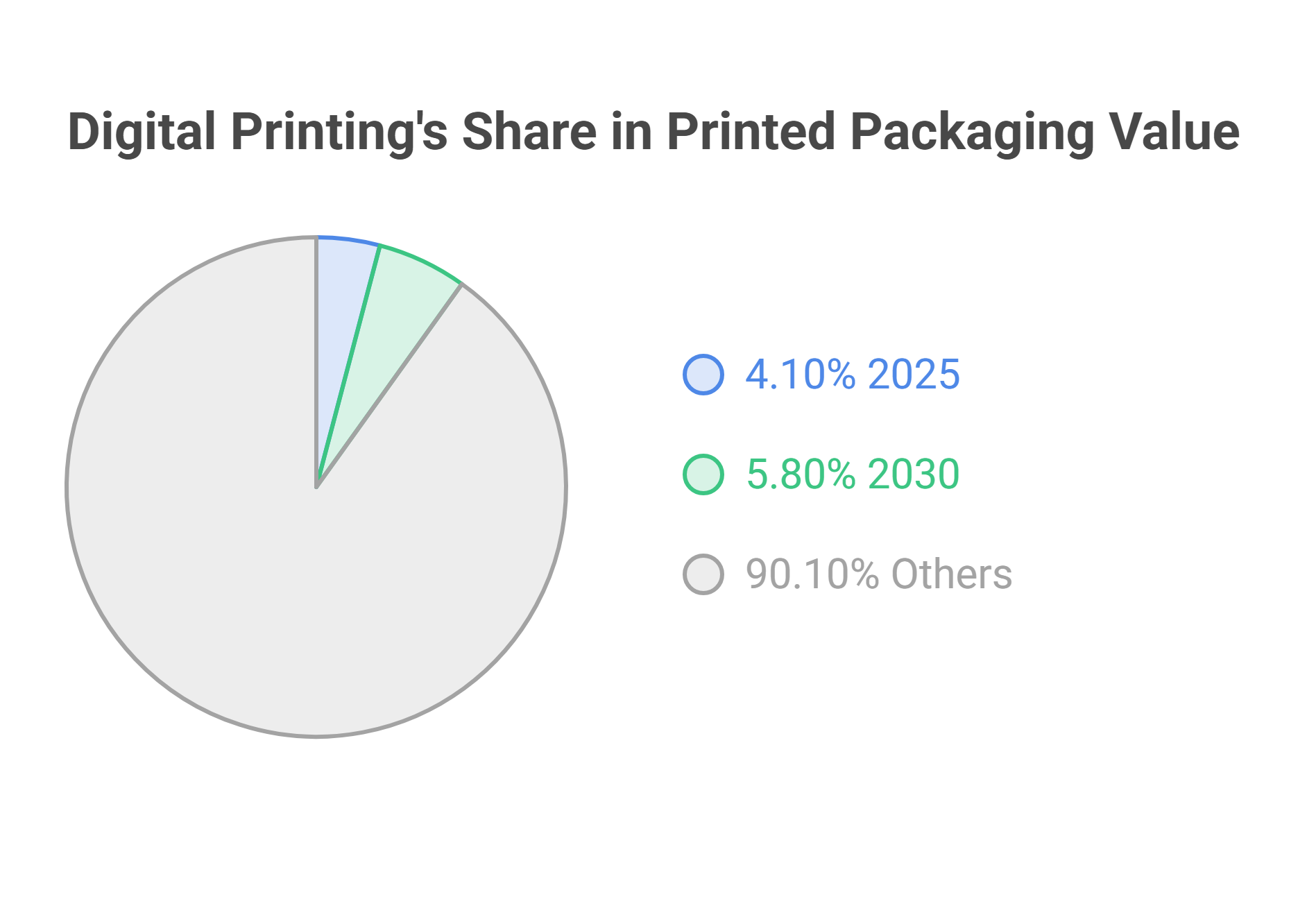
Run Length and Version Count Shape the Economics
The business case for digital printing depends heavily on the relationship between run length and the number of versions required. Conventional printing can remain more economical for large, repetitive orders because its setup costs are distributed across a much greater volume. Digital becomes more attractive when a job involves shorter runs, frequent artwork changes or several variations that would otherwise require separate setups. The decision can therefore depend on several factors:
- Total volume across all packaging versions
- Average run length for each version
- Frequency of artwork changes
- Inventory and obsolescence risks
- Required turnaround time
This flexibility can also support packaging that carries more information or functionality across versions. As brands move toward connected packaging, digitally produced variations can provide another way to accommodate different market, campaign or consumer requirements without rebuilding the entire production model.
Digital Printing Increasing Packaging Responsiveness
The growing role of digital printing reflects a broader shift toward packaging production that can respond to changing volumes, designs and market requirements. Its strongest advantage is not that it replaces conventional printing, but that it can make shorter runs and frequent version changes more practical. For packaging teams, the approach can support:
- Smaller quantities when demand is uncertain
- Faster introduction of new or regionalised designs
- Lower exposure to obsolete packaging inventory
- Greater flexibility across seasonal and promotional campaigns
The economics still depend on run length and production requirements. Conventional printing remains well suited to high-volume, repeat jobs where setup costs can be spread across large quantities. Digital therefore expands the range of production choices rather than eliminating the need for established print processes.
References
- Smithers – The Future of Digital Print for Packaging to 2030 – 2025
- drupa – Digital Packaging Printing: What Has Happened Since drupa 2024 – 2025
- International Organization for Standardization – ISO 2836:2021 Graphic technology – Prints and printing inks – Assessment of resistance of prints to various agents – 2021
- International Organization for Standardization – ISO 12647-8:2021 Graphic technology – Process control for the production of half-tone colour separations, proof and production prints – Part 8: Validation print processes working directly from digital data – 2021