





















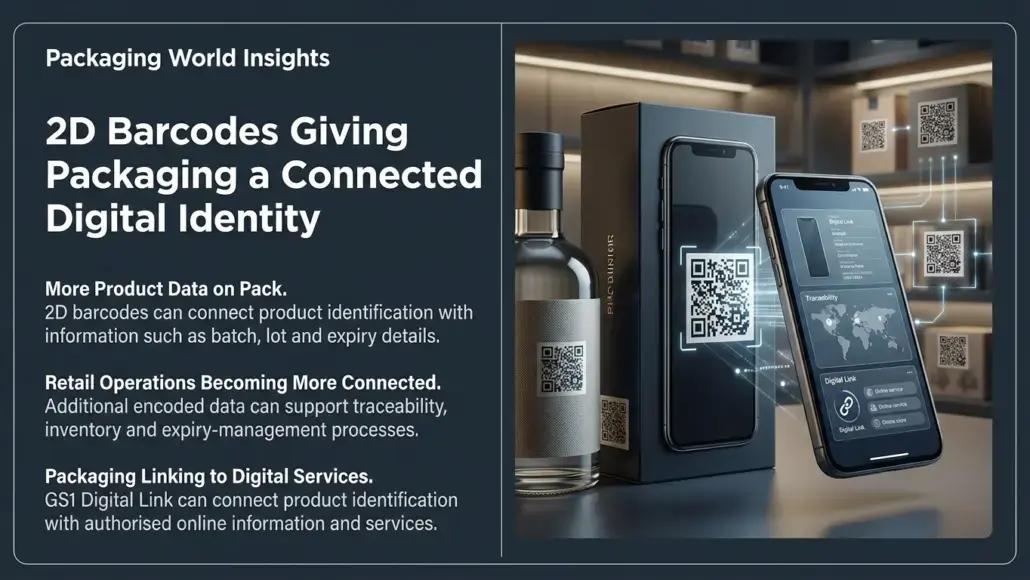

Packaging has traditionally used barcodes to identify products at checkout and support basic retail transactions. That role is expanding as brands and retailers look for ways to place more structured information on packs and connect physical products with digital services. 2D barcodes can encode product identification alongside information such as batch or lot numbers, serial numbers and expiry dates, giving packaging a more capable information layer. The development is closely linked to GS1’s Ambition 2027 programme, which aims for retail Point-of-Sale (POS) systems to be capable of processing GS1-compliant 2D barcodes by the end of 2027. The transition is designed to take place alongside existing linear barcodes, allowing retailers and suppliers to upgrade scanners, software and packaging workflows progressively. GS1 reports that next-generation barcode testing is taking place in more than 45 countries, representing about 85% of global Gross Domestic Product (GDP). These figures describe testing coverage rather than adoption rates. For packaging teams, 2D barcodes are therefore becoming more than an alternative barcode format. They can connect product identification with operational information and, when the appropriate standards are used, digital services.
Product Information Expanding on Pack
The additional data capacity creates several potential applications across retail and supply-chain operations:
- Product identification can be combined with batch, lot, serial or expiry information.
- Retailers can use additional product data to support inventory and expiry management.
- Brand owners can provide consumers with access to authorised product information.
- One packaging identity can support multiple operational and information requirements.
The growing interest is reflected in GS1’s global retail transition programme, but implementation depends on more than changing the symbol printed on packaging. Retail scanners, point-of-sale software and product databases must also be able to interpret and use the information encoded within the symbol. 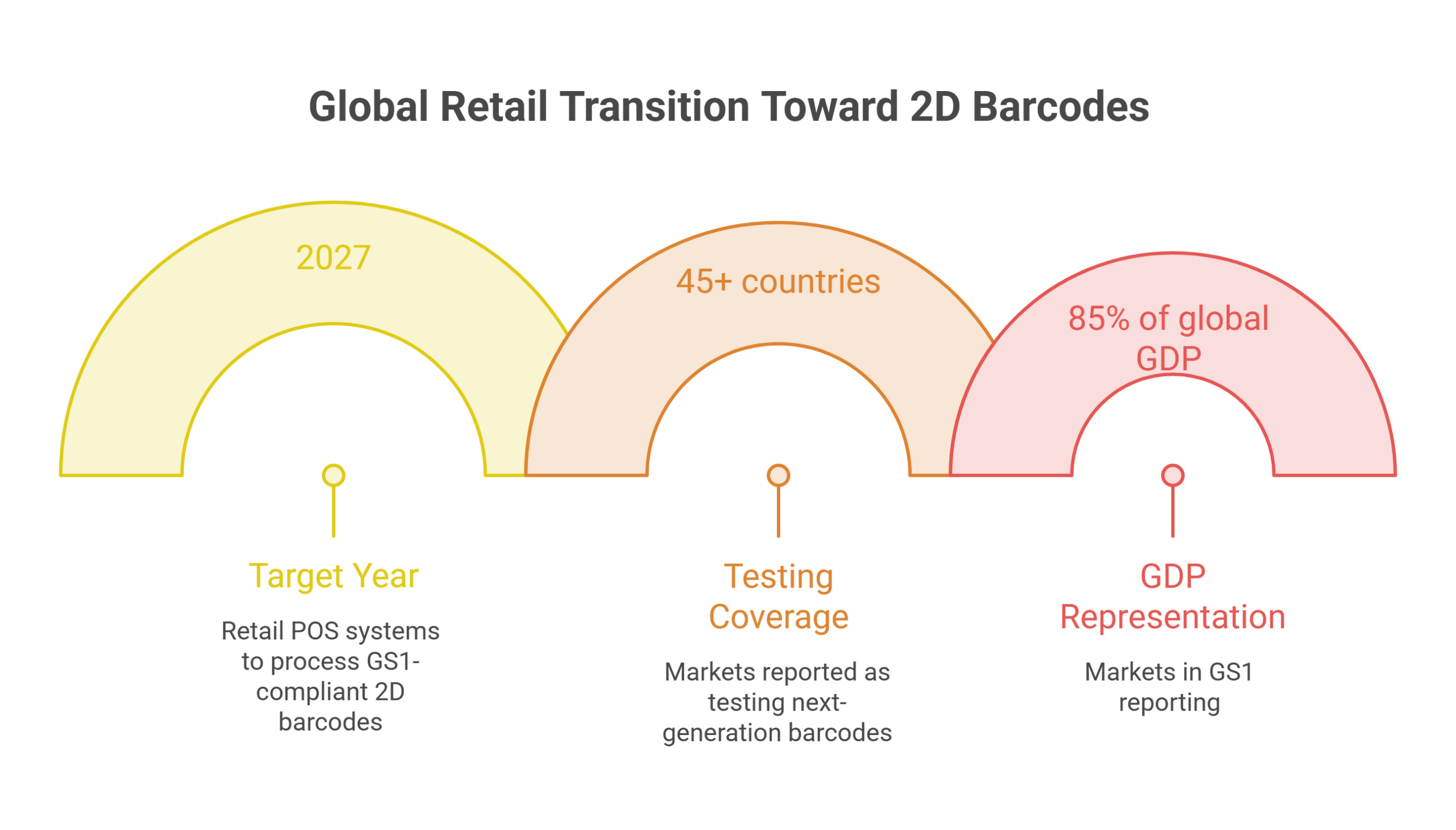
Packaging Connecting Physical and Digital Information
The technology also creates a distinction between storing more information and establishing a digital connection. A Quick Response (QR) Code using GS1 Digital Link can connect a product identifier to web-based information and services. This can give consumers access to authorised product information while allowing businesses to use the same identification framework for operational applications. The transition requires coordination across the packaging ecosystem:
- Barcode artwork and symbol quality must support reliable scanning.
- Retail scanners and POS software need to recognise and process the relevant data.
- Product information systems need to remain aligned with the physical identifier.
- Existing linear barcode infrastructure may need to operate alongside 2D systems during the migration.
Standards such as ISO/IEC 18004:2024 establish technical requirements for QR Codes, while ISO/IEC 16022:2024 covers Data Matrix symbols. Together with GS1 identification standards, these frameworks provide a technical foundation for reliable machine-readable packaging. As these systems become more integrated across retail and supply chains, 2D barcodes are giving the physical package a more connected role in how products are identified, managed and accessed digitally.
2D Barcodes Extending Packaging into Retail Operations
The value of 2D barcodes becomes more apparent when the information encoded on packaging is connected to the systems that manage products after they leave the production line. A conventional barcode can identify a product, but additional data can allow retailers to work with attributes such as batch numbers, serial numbers and expiry dates. GS1 identifies applications including inventory management, dynamic pricing, traceability and recall management as part of the transition toward next-generation barcodes.
This creates a practical shift in retail operations. Instead of treating every unit as an identical product identified only by its Global Trade Item Number (GTIN), retailers can potentially use information associated with a specific batch, lot or expiry date. That can make the barcode more useful at different points in the product lifecycle.
The operational applications include:
- More precise expiry and inventory management
- Better identification of products during recalls
- Support for dynamic pricing based on product dates
- Greater traceability across distribution and retail systems
Operational Benefits Emerging from Early Adoption
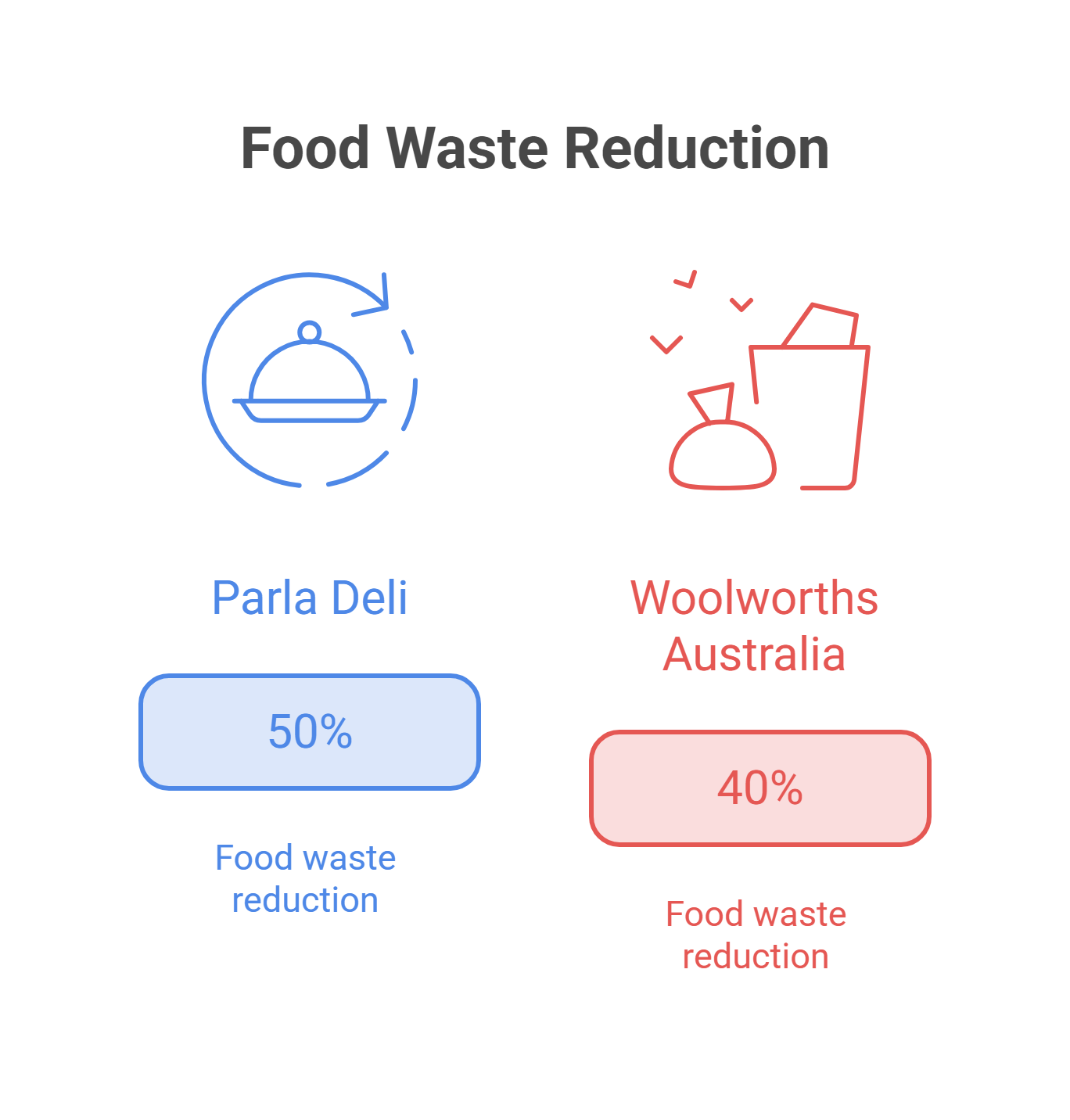
Early implementations provide evidence that the technology can produce measurable operational outcomes. GS1 reports that Woolworths Australia achieved up to a 21% productivity improvement and up to a 40% reduction in food waste on products fully transitioned to 2D barcodes. The retailer uses GS1 DataMatrix to encode information including product identification, batch details, best-before dates, net weight and price. These figures are specific to the Woolworths implementation and should not be treated as industry-wide benchmarks.
A separate GS1 case study from Parla Deli in Brazil reported a 50% reduction in food waste after implementing QR Codes with GS1 Digital Link alongside its enterprise and retail systems. The example demonstrates how 2D-enabled identification can connect packaging with operational processes rather than functioning only as a replacement for a conventional barcode.
Digital Services Expanding the Role of the Pack
The significance of 2D barcodes also extends to information accessed outside retail systems. A QR Code using GS1 Digital Link can connect a product identifier with web-based information and services. This gives brands the ability to associate the physical package with authorised digital content while retaining the underlying product identity. That connection can support several types of consumer-facing information:
- Product details and usage information
- Ingredient or sourcing information
- Recycling and disposal guidance
- Sustainability-related content
- Brand services and other digital experiences
The model also creates greater flexibility because the digital information associated with the product can change without necessarily changing the physical barcode. GS1 describes Digital Link as a way of connecting product identification to multiple online information sources and services, making the package a potential gateway to information that can evolve over time. The result is a packaging system in which one physical identifier can serve retail, supply-chain and consumer functions, giving 2D barcodes a role that extends well beyond the checkout counter.
2D Barcodes Strengthening Packaging’s Digital Role
The expansion of 2D barcodes is turning packaging into a more active information layer across retail, supply chains and consumer interactions. Their value comes from combining standardised product identification with additional data and digital connections, allowing the same physical package to support more functions throughout its lifecycle. The transition will depend on coordinated investment across packaging, retail and technology systems. Key requirements include:
- Reliable barcode printing and verification
- Compatible scanning and Point-of-Sale (POS) infrastructure
- Accurate product and batch data
- Digital content connected to the correct product identity
The shift also creates a pathway for packaging to provide consumers with information beyond the product itself, including recyclability information. This connection could become increasingly relevant as brands look for practical ways to communicate disposal and circularity information through the pack. Ultimately, the significance of 2D barcodes lies less in the symbol itself and more in the systems connected to it. As standards and retail infrastructure mature, packaging can become a more reliable bridge between physical products, operational data and digital services.
References
- GS1 – 2D Barcodes at Retail Point-of-Sale Implementation Guideline – 2025
- GS1 – GS1 Digital Link Standard – 2026
- International Organization for Standardization / International Electrotechnical Commission – ISO/IEC 18004:2024 Information technology – Automatic identification and data capture techniques – QR Code bar code symbology specification – 2024
- International Organization for Standardization / International Electrotechnical Commission – ISO/IEC 16022:2024 Information technology – Automatic identification and data capture techniques – Data Matrix bar code symbology specification – 2024
- GS1 – Woolworths Australia Seeing Multiple Benefits From 2D Barcodes – 2024
- GS1 – Parla Deli Case Study – 2024